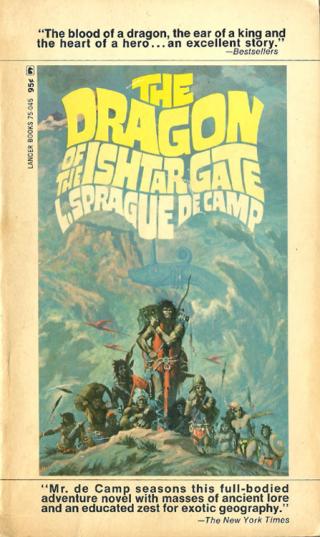
The Dragon of the Ishtar Gate
- Автор: Де Камп Лайон Спрэг
- Год: 1968
- Язык: английский
- Год: Lancer Books
- Жанр: Научная фантастика

Электронная книга - «The Dragon of the Ishtar Gate». Краткое содержание книги:
Dragon is probably closest in mood to de Camp's fantasy novels, while Bronze God and Arrows are closer to his science fiction, with their description of engineering problems, and personality clashes among researchers and engineers. Dragon also reflects de Camp's then-recent acquaintance with the Conan stories and other works of Robert E. Howard. Bessas, the huge Persian nobleman, is not only a close match for Conan in physique, but his mood swings, fixation on his mother, and tendency to toss of verses, seems a reflection of Howard himself. (Fortunately, his poems reflect de Camp's verbal dexterity and wit, not Howard's melancholy.)
"Beshrew me if this be not iron-bearing country!" said Shimri.
The first afternoon along the river, Shimri's horse acted sick, hanging its head and moaning through its nose. One of the Arabs told Myron:
"I tried to warn that man not to let his horse eat of the ushar, but he heeded me not. So I thought he must have some charm against the poison of this shrub."
Myron asked Shimri about this. The Judaean gave a nervous laugh and said:
"Oh, he came up shouting some gibberish, whilst I was looking at the iron ore, but I never heed what these barbarians say. All they want is a chance to rob one."
By nightfall the horse was dead and Bessas in a fury. Shimri hid in a gully until the Bactrian's wrath was softened. By the most tender care, Bessas had so far avoided losing a single horse or mule. He was, however, far less solicitous with his human companions. It was as if, being himself impervious to heat, cold, thirst, hunger, and fatigue, he took it for granted that all other men were equally hardy.
The Arabs skinned and ate the horse. Bessas warned his followers thereafter to keep their beasts away from the thick, fleshy, bright-green leaves of the poisonous shrub.
On the seventh of Duuzu they arrived at the mud-hut village of Epis, opposite Meroê, capital of independent Kush. Here a ferry ran. Bessas and Zayd crossed on the ramshackle flatboat while Myron and Salimat, as the two leaders' lieutenants, remained to the last to make sure that all the other men and beasts got across in good order.
"Master Myron!" said Salimat, looking gravely with dark eyes over the top of the veil. In the desert and at the oasis, she had laid aside the veil, but now that they were traveling through settled parts of Kush she resumed it. "Pray tell your man Skhâ that, if he make another advance towards me, I shall slay him." Quick as a serpent's stroke, she whisked a curved dagger from under her robe. "I certainly will," said Myron.
He did not doubt that Salimat would indeed kill Skhâ or anyone else who molested her. Perhaps old Zayd thought he had to come along to protect his daughter, but any protecting was likely to be the other way round. The shaykh presided benignly over his little caravan and exchanged elaborate courtesies with Bessas and his people. But it was Salimat who routed the Arabs out before dawn, bullied them into motion, inspected the lading of the camels, settled disputes, and decided when and where the company should stop for the night.
XII – The Courts of Kush
Under a blinding sun, blazing high overhead in a brassy sky, the city of Meroê shimmered in merciless heat. Within its wall of sun-dried mud stretched a jumble of mud-brick houses. Little motion was visible, for in the heat of the day most Kushites disappeared within their walls. Here and there one might be seen, curled up asleep in a patch of shade. Somewhere a blacksmith's hammer clanged.
Outside the wall, the ground stretched away westward in a barren plain towards the Nile, invisible below its bluffs in the middle distance. To the east the country rose in a range of small, stony hills. On the south side, in the precarious shade of a giant sacred sycamore, huddled the tents of Bessas' company. They were camped outside the walls because Meroê had no inn.
Past these tents ran the road to Soba and the south. This road was merely a track in the sand, beaten by the feet of slave hunters and their victims, which ended at the Soba Gate, a large wooden door in the mud wall.
A pair of Kushite soldiers guarded this gate. The pair sat on the ground against the wall, with lean black arms encircling their legs and bushy black heads pillowed on their knees, sound asleep. Their iron-headed spears and cowhide shields, painted in gaudy patterns of red, white, and black, leaned against the wall. A bowshot away, down the road, a score of huge brown vultures tore at the carcass of an ass.
Bessas' remaining horses and mules stood under the trees in-pairs, head to tail, flicking flies. The camels, their long legs folded beneath them, chewed their cuds.
Within the encampment, hardly more motion was seen than in the sleeping city. Zayd's Arabs slept or stared blankly into the distance, not bothering to brush away the flies. Shimri, having just returned from a visit to the local smiths, hummed tunelessly while he mended a harness strap. Myron searched his garments for fleas and lice.
Bessas and Kothar emerged from the gate and strode towards the camp. "Myron!" called Bessas. Then, placing his face close to Zayd's tent, he cried: "Ya Shaykh!"
Zayd appeared blinking and yawning. "'Ahlan wa sahlan," he muttered. After the shaykh came his daughter. Bessas snarled:
"Know you what that little son of Ahriman, Barga, has been doing these ten days past?"
"What?" said Myron.
"He has been playing us like fish on a line, taking our bribes every day for promises to get us an audience on the morrow. But it turns out that Barga has no authority to arrange an audience with the king at all! This king does not give audiences. He is far too sacred for such defiling intercourse with mortals. By the Sleepless One, if Kothar had not restrained me, I had torn the rascal to pieces, as boys pull insects apart!"
"Isn't he the Royal Usher?" said Myron.
"He is, but the person with whom he should arrange audiences is the minister, General Puerma."
"Who is on campaign," said Myron.
"But who is due back today or tomorrow. He sent a runner ahead. Now Barga assures us that we shall have an audience with Puerma tomorrow."
"Let's hope it be not another chicane," said Myron.
"It had better not be," said Bessas, glowering, "or I'll lure the scoundrel outside—"
"He'll only protest that it is all a misunderstanding; that he did not fully comprehend Kothar's Egyptian," said Myron.
"I suppose so," said Bessas. "Where's Skhâ? It is time that he and Shimri took the beasts to graze."
Shimri looked up. "In this g-god-forsaken land, the grass is so sparse that the animals have to gallop from one tuft to the next."
"Skhâ went into the town," said Myron. "Here he comes now."
The short Karian trotted out the gate. "Ho, comrades! Guess what! I have found us a willing woman! Or rather," he amended, "one whose owner is willing."
Myron smiled. "At my age, my boy," said the Greek, "I find that black skins and flapping breasts fail to arouse what little lust I still have."
"Oh, but this one is young and well-formed."
"Then she will have that female circumcision that they practice here and in Egypt, which closes up their—"
"Nay; she comes of the Megabarri, who live up the Astabara and do not—"
Bessas cleared his throat, and the Karian fell silent. Bessas said: "Methinks this conversation is unfit for the ears of the young lady." He nodded toward Salimat.
"Oh, but she understands not—"
"I think she understands more Aramaic than she admits. Eh, my lady?"
A peal of laughter came from behind the blue veil. Salimat replied in broken Aramaic: "I go back in tent; leave men to talk as like."
Salimat returned to the tent, followed by Bessas' burning gaze. Bessas murmured in Greek:
"Do you know, O Myron, that next to a good horse, a good woman is the most precious possession one can have?"
Then the Bactrian shook himself, like a man coming out of a dream. His deep voice boomed out harshly in guttural Aramaic:
"The damnedest thing is that I cannot find anybody in Meroê to talk about the road to die south and the sources of the Nile. They call the Upper Nile the Astasobas, meaning 'River of Darkness,' and feign that they never heard of the course of this fell flume."
Shaykh Zayd, using Kothar as interpreter, said: "I know the reason, father of a sword. The established traders and slave hunters fear lest you invade their territories and compete with them. So they have spread the word that you are not to be helped. Count yourselves lucky if they stir not up the mob against you, saying you are foul foreign fiends and witches who would steal their children to devour. We have encountered much of that in Egypt."