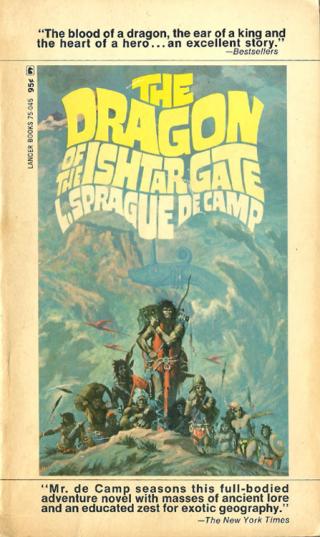
The Dragon of the Ishtar Gate
- Автор: Де Камп Лайон Спрэг
- Год: 1968
- Язык: английский
- Год: Lancer Books
- Жанр: Научная фантастика

Электронная книга - «The Dragon of the Ishtar Gate». Краткое содержание книги:
Dragon is probably closest in mood to de Camp's fantasy novels, while Bronze God and Arrows are closer to his science fiction, with their description of engineering problems, and personality clashes among researchers and engineers. Dragon also reflects de Camp's then-recent acquaintance with the Conan stories and other works of Robert E. Howard. Bessas, the huge Persian nobleman, is not only a close match for Conan in physique, but his mood swings, fixation on his mother, and tendency to toss of verses, seems a reflection of Howard himself. (Fortunately, his poems reflect de Camp's verbal dexterity and wit, not Howard's melancholy.)
For an instant Myron almost screamed and ran. Then, by a colossal effort of will, he blinked and shook his head. The vast ophidian form vanished—or did it whip out of sight?
"There's n-nothing there," he chattered. "It is all your im-imagination. And why does she not assail these other miscreants—"
"Blast you two, hasten!" hissed Bessas.
The moon was almost overhead when they came to a pile of tailings, which had been dug away to reveal the entrance to a tomb. This tomb opened into the side of a ravine.
Myron's scalp tingled as he looked into the black aperture. The thieves murmured. Two of them fastened their mantles over the entrance to make a curtain. The others slipped in, motioning Bessas and his companions to follow.
Inside, inky blackness engulfed them until it was shattered by the sparks of flint on steel. Presently the grave robbers had a couple of tiny pottery lampions burning and filling the tomb with the stench of castor oil.
The flickering yellow light revealed that they stood at the head of a shallow flight of steps—or rather, two parallel flights of steps with a sloping plane between. White stucco covered the side walls. At the foot of this double stairway was the main entrance to the tomb. A heavy stone door, already forced, now lay at an angle against one side of the tomb corridor.
Kothar whispered: "It seems that this tomb lies in the territory claimed by Imisib, a rival gangster. Imisib discovered the tomb and planned to loot it at leisure, but one of his henchmen blabbed. So Tjay hopes to clean out as much as he can by one quick raid. Naturally, he is queasy lest Imisib's gang trap us here and cut us all off."
"Now he tells us!" muttered Bessas. "I do not suppose these things have back doors?"
"Nay. Now must I perform my part, for you stand in danger of other than earthly origins. The gods have mercy upon us!"
From under his cloak, Kothar produced a small censer and a bronzen sistrum. He lit the censer from one of the lamps, and a horrid sulphurous stench commingled with the smells of castor oil and of musty antiquity. He swung the censer and shook the sistrum, which gave a shrill unmusical clank. Again and again he sounded the instrument, uttering exorcisms in' a low vibrant voice. At last he spoke in Egyptian to the grave robbers, who filed down the steps.
Over the main doorway was painted a scene showing two goddesses worshiping the divine sun. Inside the doorway were other painted scenes: a winged goddess and a god investing the king with divine powers. Masses of picture writing ran along the wall above and below these scenes. Bright-hued serpent-headed vultures flew along the ceiling. Kothar made one of the thieves hold a lamp still, near the writing, while he scanned the little processions of men, beasts, and plants.
"This man was truly a king, albeit a king of small importance," said the Syrian. "There is his name: Siptah."
Myron trailed the others along the silent corridor, which sloped down for a few reeds*( * 1 reed = 10-1/0 feet.), then ran level, then descended again. A plethron*(** 1 plethron = 100 feet.) and a half from the entrance, the corridor opened out into a broad square chamber, over sixteen cubits on a side. Four square pillars supported the ceiling. Except for the central aisle between the pillars, the chamber was packed and stacked with the dead king's personal effects. The lamplight shone upon an incredible treasure.
There were bedsteads of ivory and ebony; gilded couches; whole chariots of gilded wood; chariot wheels and poles trimmed with gold; cedar-wood chests; bronzen coffers inlaid with fayence; chairs of gold and ebony; alabaster lamps and vases; cups and dishes of gold and silver; swords and daggers with inlaid sheaths, golden hilts, and crystal pommels; gold-headed, jeweled walking sticks; lapis-lazuli cosmetic jars; an ebony shrine on which was coiled a jewel-eyed golden cobra; bows and staves bedight with golden filigree; statuettes of gold and copper and malachite; scepters, riding crops, footstools, headrests, crowns, gorgets, necklaces, amulets, pendants, bracelets, pectorals, fans, rings, chains, embroidered robes, gilded sandals, inlaid gaming boards ...
The gleam of gold and silver, the sparkle of jewels, crystal, and colored glass, and the glow of ivory, fine stone, and rare woods made Myron's head swim. He muttered:
"By Herakles, if this be the hoard of a minor king, I can hardly imagine the tomb of a Rameses or an Amen-hotep! A man could buy a kingdom with a tithe of this stuff."
"Not so easy," grunted Bessas. "Remember, these rogues must dispose of their plunder through fences, who'll mulct them of most of their gains. And the fences in turn must deal with other shady characters who won't give them full price. So, when all is done, the wealth thus liberated will be spread about quite widely."
"The spirits have smiled upon us," said Kothar, "for only rarely do the robbers come upon such a hoard as this. Most of the tombs were plundered long ago, during the ages when the land of Khem was sunken in anarchy. Now Tjay wants us in the burial chamber."
From the pillared hall, the corridor sloped down again and then ran level for nearly a plethron more before it reached the burial chamber, almost as large as the pillared hall and, like it, stacked with royal possessions. Here, the lid of the alabaster sarcophagus had already been pried off by earlier burglars, and Tjay's thieves were now lifting out the painted wooden mummy case. The lid came up with a creak of ancient, bone-dry wood, and there lay the mummy of King Siptah.
Next they pried out the mummy, which, over its wrappings of linen, was bound with bands of gold. These the thieves stripped off with practiced adroitness.
Kothar said: "Tjay says, if we want the king's ear, we must unwrap the mummy cloths. They will be otherwise occupied."
The tomb robbers were expertly going through the chambers. Two held a cloak by its corners while the others tossed into it the objects combining the most value with the least bulk.
"Hold the mummy crosswise on the mummy case," said Kothar, "whilst I unwrap the head."
Round and round went Kothar's hands, unwinding the crumbling yellowed cerements. The little oil lamp, flickering from the floor, cast weird shadows against the walls. These shadows reminded Myron unpleasantly of the beast-headed gods of ancient Khem. He had to clench his jaw to keep his teeth from chattering. When he should have been observing every detail of the surroundings for future reference, he found that his mind could focus on nothing save an intense desire to be gone.
"Behold King Siptah!" said Kothar, unwrapping the last layer of linen strips. Beneath them transpired the sunken brown face of Siptah, the lips drawn slightly back to expose the teeth in a faint, sardonic grin. On the king's shaven head rested a close-fitting golden headdress, with a cobra rearing its head in front and a vulture's wings coming down over the ears at the sides.
Kothar gingerly pulled off the headgear, whose thin gold gave out faint creaking and rattling sounds. He took out his knife, looked about uneasily, uttered a cantrip, and began to cut.
"This stuff cuts like wood," he muttered.
The robbers completed their work in the burial chamber and left. From the pillared chamber came faintly the clank of metallic objects tossed into the grave robbers' cloak. The three in the burial chamber were alone, save for the mummy.
"There you are," said Kothar at last. He handed the hard, shriveled, dark-brown ear to Bessas, who turned it over and dropped it into his scrip.
"What do you now?" rumbled the giant.
"I am cutting off his other ear," said Kothar. "If one ear will make a mighty magic for Ostanas, I see not why the other should not do the like for me."
"Well, hurry!" said Bessas. "I am fain to leave this accursed place."
The robbers had moved away from the treasure chambers and towards the entrance to the tomb. The sounds of their movements came more faintly to the travelers' ears.