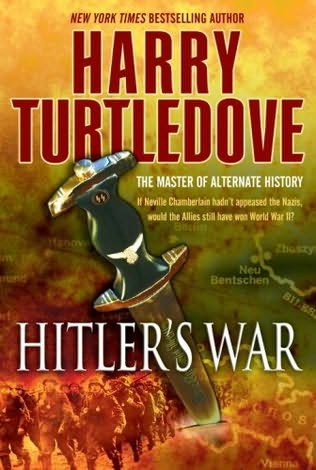
Hitler's war
- Автор: Тертлдав Гарри Норман
- Серия: The War that came early #1
- Язык: английский
- Жанр: Альтернативная история

Электронная книга - «Hitler's war». Краткое содержание книги:
Now, in this thrilling, provocative, and fascinating alternate history by Harry Turtledove, another scenario is played out: What if Chamberlain had not signed the accord? What if Hitler had acted rashly, before his army was ready-would such impatience have helped him or doomed him faster? Here is an action-packed, blow-by-blow chronicle of the war that might have been-and the repercussions that might have echoed through history-had Hitler reached too far, too soon, and too fast.
Turtledove uses dozens of points of view to tell this story: from American marines serving in Japanese-occupied China to members of a Jewish German family with a proud history of war service to their nation, from ragtag volunteers fighting in the Abraham Lincoln Battalion in Spain to an American woman desperately trying to escape Nazi-occupied territory-and witnessing the war from within the belly of the beast.
A novel that reveals the human face of war while simultaneously riding the twists and turns that make up the great acts of history, Hitler's War is the beginning of an exciting new alternate history saga. Here is a tale of powerful leaders and ordinary people, of spies, soldiers, and traitors, of the shifting alliances that draw some together while tearing others apart. At once authoritative, brilliantly imaginative, and hugely entertaining, Hitler's War captures the beginning of a very different World War II-with a very different fate for our world today.
“Ja! Ja!” Maybe the German understood a little English, even if he didn’t seem to speak any. Or maybe the sergeant’s gestures made sense to him. Walsh kept his finger on the trigger while the man disarmed himself. If he turned out to be a fanatic, he’d be a dead fanatic pretty damn quick. But he didn’t. He tossed the little automatic-smaller and neater than the Enfield. 38 revolver that was the British standard in this war, to say nothing of the last go-round’s man-killing brute of a Webley and Scott. 455-into the bushes.
“All right.” Walsh knelt beside him and pointed to the trench from which he’d come. “I’m going to take you back there.” He got the German’s arm around his shoulder. Grunting as he rose, he went on, “This may hurt a bit.”
The airman hopped awkwardly on one leg. He tried not to let his other foot touch the ground at all. Sure as the devil, that ankle was ruined. Well, he’d done worse to plenty of Dutchmen and Belgians and Englishmen.
“Give me a hand with this bugger,” Walsh called. Unenthusiastically, the other British soldier did.
Once in the hole, the flyer reached inside his coverall. He came closer to dying than he probably realized. But he came out with… “Zigaretten?” he said, proffering the packet.
“Thanks.” Walsh took one. So did the other soldier, who gave him a light. They both took a drag. “Bloody hell!” Walsh said. “Tastes like hay and barge scrapings.” If this was what the Germans were smoking, no wonder the bastards acted mean.
He gave the Luftwaffe man a Navy Cut. People said they were strong. God only knew they were cheap. But the new prisoner’s eyes went wide when he puffed on it. “Danke schon! Sehr gut!” he said. He reverently smoked it all the way down to the end. It probably had more real tobacco in it than he usually got in a week.
Stretcher-bearers took him off to the rear. If he got more proper cigarettes, odds were he was glad enough to go.
* * *
Christmas was right around the corner, but Peggy Druce found Berlin a singularly joyless place. She supposed she should count her blessings. If she weren’t from the neutral USA, she would have been interned, not just inconvenienced. All the same…
So many shops were empty. Hardly any cars rolled down the street. Even the trolleys operated on a wartime schedule, which meant you took a long time to get anywhere. The city was blacked out at night. As far as Peggy could tell, the whole damn country was blacked out at night.
Maybe all of Europe was blacked out. Peggy tried to imagine Paris dark at night. The picture didn’t want to form. The City of Light was bound to be as shrouded as any other European capital. After what the Germans did to Prague and Marianske Lazne and the rest of Czechoslovakia, they wouldn’t leave Paris alone. She supposed it was a genuine military target. But the idea of bombs falling on it made her almost physically ill.
She walked past a restaurant not far from the hotel where they’d put her up. She hadn’t the slightest desire to go inside. Like everyone else in Germany, she had a ration card. Even in a restaurant, she had to spend points on what she ate. Whatever she got, most of it would be cabbage and potatoes and black bread. Fats of any sort-butter, cheese, lard-were hard to come by. Milk and cod-liver oil were reserved almost exclusively for children and nursing and pregnant women.
A man with a white mustache walked past her. He tipped his hat as he went by. His wool suit had seen better years, but he couldn’t do much about that. The Germans had ration points for clothes, too. If you bought a topcoat, that was about it for the year. Peggy didn’t have all the clothes she wanted, either; most of what she’d brought to Czechoslovakia was still there. Or, maybe more likely, it was on some German woman’s back these days.
A team of horses drew an antiaircraft gun down the street. The horses might have come straight out of the Civil War. The field-gray uniforms on the soldiers were modern, though. As for the gun, it might have appeared from the future. She didn’t think she’d ever seen a piece of hardware that looked more lethal.
Newsboys held up papers full of headlines about German triumphs. People walked past without buying. If the Berliners were enthusiastic about the war, they hid it well.
“English and French air pirates bombard German towns!” a boy shouted. “Many innocent women and children murdered! Read about the latest enemy atrocities!”
Peggy almost stopped at the street corner to argue with him. Only the thought that her husband would have told her she was crazy made her keep her mouth shut. She admired Herb’s common sense, most of the time without wanting to imitate it. And she’d seen the fun the Nazis had knocking Czechoslovakia flat. If they were on the receiving end for a change, if this wasn’t all just propaganda and nonsense, boy, did they ever deserve it!
But the kid wasn’t to blame for that. He was only doing his job. The ones who were to blame were Hitler and Goebbels and Goring and Himmler, and she couldn’t very well tell them where to head in. If she took it out on the newsboy, what would happen to her? Neutral or not, American or not, she didn’t want a visit from the Gestapo.
Because she looked as shabby as everybody else, the Berliners assumed she was a German, too. They’d nod and say, “Guten Morgen.” She could manage that. She understood German tolerably well, but she spoke French much better. When people here expected much more than Good morning from her, she stumbled badly.
She hated that. She also hated being so dowdy. She’d made a life of standing out from the crowd. No one would ever have noticed her if she didn’t make a point of getting noticed. If she disliked anything, it was invisibility.
A few minutes later, ambling along on a day as gray and gloomy as her mood, she found a way to get noticed. She walked past a place whose window said ROTHSTEIN’S BUTCHER’S SHOP. It wasn’t bigger or fancier or more run down than the shops to either side: a secondhand bookstore to the left, a place that sold wickerwork purses and baskets to the right. The wickerwork place was busy-wicker, unlike leather, didn’t eat up ration points.
Rothstein’s, however, had a large sign taped in the window: GERMAN PEOPLE! DON’T BUY FROM DIRTY JEWS!
Next thing Peggy knew, she was walking through the door. Maybe a demon took hold of her. Only when the bell over the door jangled did she realize what she’d done. And she’d been so proud of herself for wanting to steer clear of the Gestapo! Well, so much for that.
Behind the counter, Rothstein looked astonished. “You aren’t one of my regulars!” he blurted. “You aren’t even-” He stopped, but Jewish hung in the air anyway.
“You’re right. I’m not. Give me a chicken leg, please.” Peggy had enough German for that. She could boil the leg on the hot plate in her room. It would make a better lunch-maybe lunch and supper-than she was likely to get in the hotel restaurant or a cafe. Not much good food left for civilians in Berlin.
Moving like a man in a dream, Rothstein weighed the leg. He was unmistakably a Jew, with a long nose and dark, curly hair. “It comes to 420 grams-almost a week’s ration for meat,” he said. “If you like, I will bone it, so it costs you fewer points.”
“Bitte,” Peggy said.
Deftly, he did. “Now it is only 290 grams. I need coupons for so much, and two Reichsmarks fifty.” As he spoke, he wrapped the chicken in-what else?-butcher paper.
Sixty cents American money, more or less. That was a hell of a lot for a leg. Peggy paid without blinking. She also handed over the swastika-marked ration coupons. Those were part of the game, too.
Rothstein gave her a meticulously written receipt. “Danke schon,” he told her. “You are very brave. You are also very foolish.”
“I hope not,” Peggy said. “Auf wiedersehen.” Till I see you again , it meant literally. She wondered if she was brave enough-or foolish enough-to come back.
She got out fast, but not fast enough. Somebody’d squealed on her. Two blackshirts were trotting up the street toward Rothstein’s. “What kind of Dummkopf do you think you are?” one of them roared. “How dare you go into that damned Jew’s place?”