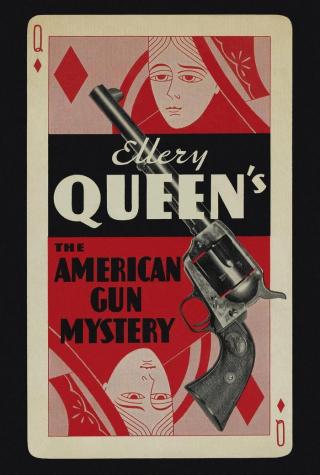
The American Gun Mystery (Death At the Rodeo)
- Автор: Куин (Квин) Эллери
- Серия: Ellery Queen #6
- Год: 1933
- Язык: английский
- Год: Frederick A. Stokes Company
- Жанр: Классические детективы

Электронная книга - «The American Gun Mystery (Death At the Rodeo)». Краткое содержание книги:
The Inspector reached for one of his telephones. “Something at last,” he snapped. “I’ll find out what all this hocus-pocus is, by God! There’s your sweet nice Western lassie for you!”
Ellery started out of a reverie and clamped his hand over the telephone. “Dad! No!”
The Inspector was startled. “What? What’s this?”
“Please don’t,” said Ellery quickly. “You’ll spoil everything. For heaven’s sake, hold off. Wait. We can’t afford—”
Inspector Queen leaned back, annoyed. “And what,” he demanded, “is the holy use of putting a man on a hot trail and then when he finds out something, not doin’ anything about it?”
“A little incoherent,” grinned Ellery — who knew the battle was won, “but nevertheless a reasonable question. The answer is: that a possible relationship between Hunter and Kit Horne was not in my mind when I asked you to have the girl shadowed.”
“Suppose it wasn’t,” said the Inspector sarcastically. “After all, you can’t foresee everything. All right, now we find out there’s somethin’ up between Hunter and the girl. Why should we sit back and lose a chance, maybe, to get some new lead?”
“I’ll tell you why, and I’m not underestimating the possible importance of this unexpected Kit-Hunter relationship,” said Ellery. “There are two reasons. One is that you probably won’t get a word out of either of them. The other is — and this is by far the more vital consideration — that it will give away our hole card.”
“What hole card?”
“The fact that Kit Horne is being shadowed. You see,” said Ellery patiently, “once that girl knows she is under incessant surveillance, we lose our—”
“What?”
Ellery shrugged. “What’s the use of going into that? I admit the chances are all against anything coming out of it. But everything must be sacrificed to keep the way clear for that bare eventuality’s coming to pass — and for us to be aware of it when it does come to pass.”
“For a feller that went to college,” grumbled the Inspector, “you sure do talk like a Kentucky mountaineer with the mumps!”
To add to the Inspector’s irritation, a telegram was delivered to Ellery one morning at breakfast; a telegram which, under the circumstances, might have contained brilliantly illuminating information for all the old man knew; a telegram, in effect, which Ellery read quickly and without changing expression, and then flung into the healthy fire in the living room. The Inspector, whose pride was hurt, asked no questions; and although Ellery could not have been unconscious of his father’s pique, he offered no explanations. Had the old man been aware that the wire bore a Hollywood, California, source-line, he might have decided to swallow his pride and demand enlightenment after all. As it was, it was not until the very end that he discovered the contents of the telegram.
Ted Lyons continued to write sprightly tidbits about the celebrities involved in the Horne case.
Another complication arose at this time to add gray hairs to Tony Mars’s head, swell Wild Bill Grant’s profane vocabulary, and etch new lines on the face of Inspector Queen. The contract between Grant and Mars called for the rental of the Colosseum to Grant for a period of four weeks. Under the terms of the agreement, therefore, Grant was still entitled to the use of the premises for four weeks less one day — the day of the fatal opening. Yet three weeks had already elapsed, and the Colosseum was still kept barred by the police.[4] There would have been no difficulty had not Tony Mars’s other plans interfered. The stumbling block was the championship heavyweight prize-fight in which Tommy Black was the challenger. The articles had been signed months before, and the date set. The date had been so arranged that the fight was scheduled to take place in the Colosseum on the Friday night following the last performance of Wild Bill Grant’s Rodeo. With the battle only a week off, Mars found himself in an uncomfortable position. Tickets had been printed long before; the champion’s manager and cohorts were adamant; Grant would listen to no arguments but insisted on resuming his rodeo exhibition the instant the police ban was lifted from the Colosseum... Powerful strings began to tug at Centre Street.
It was field day for the press; and Grand Marshal of the field was Ted Lyons. After squeezing every last drop of gossip from the Mars-Grant-Centre Street controversy, he turned his attention to Tommy Black.
The item that set the bomb appeared without warning in Lyons’s column one morning. “Shades of Gentleman Jim and the Manassa Mauler! How times do change... What prominent challenger for the Biff-Bang title in the mastodon class is training on a diet of jazz, orange-blossoms, and Orchids? And what’s the matter with the Orch’s better half — or laugh — who’s being made an old cuck by said stumble-bum, as every wise guy on the Main Stem knows? Come, come, Rollo; your house is afire.”
The first echo of the explosion reached Headquarters a half-hour after it rolled back from the cliffs of the downtown canyons. Julian Hunter, to the delight of an assembled and derisive staff, marched into the editorial offices of Lyons’s tabloid, carefully placed his derby and stick on an idle typewriter, kicked in the door of Lyons’s sanctum, took off his coat, and invited the columnist to put up the columnar hands. Lyons had made an impolite noise, in the creation of which he was a master, had pressed a button kept handy for just such emergencies, and Mr. Hunter soon after found himself outside the office, on the floor, propelled by a muscular gentleman who acted as the columnist’s bravo. Mr. Hunter, retrieving his outer garments, had departed with murder in his eyes. And the next morning Lyons’s column had continued the barrage of thinly camouflaged insinuations.
The second echo rolled back on the first night, the detonation being set off within the sacrosant precincts of the Club Mara itself.
The Inspector was aging. The case had drawn itself out to the most microscopic of vanishing points; Ellery was increasingly irritable and uncommunicative; the press was clamoring for action; there was an undercurrent of talk on Centre Street about a “shake-up, boys, a real shake-up!” Rather desperately the old man concentrated on Julian Hunter, now that Lyons was turning up delicious dirt and Hunter had lost his temper.
“I’ve told you all along,” he muttered to Ellery that evening, “that Hunter knows more than he admitted. About the Horne business, I mean. Ellery, we’ve simply got to do something.”
There was pity — and still reservation — in Ellery’s eyes. “We must wait. There’s nothing to be done. Time, dad. Only time will turn the trick.”
“I’m goin’ down to that bird’s club tonight,” snarled the Inspector, “and you’re goin’ with me.”
“But what for?”
“I’ve been finding out things about Hunter, that’s what for.”
An hour before midnight found the Queens at the door of the Club Mara. Sergeant Velie’s mountainous figure loomed dimly on the sidewalk across the street. The old man was cool enough, cooler than Ellery, who had a sick feeling in his stomach. They entered, and the Inspector asked for Hunter. There was some difficulty at first; the gentleman, it appeared, was not in evening dress. The gentleman, however (Ellery being properly attired) produced a gleaming little shield, and after that there was no trouble.
They found Hunter at a large table near the dance-floor, engaged in silent communion with a bottle of rye whisky. The man was pale as a goat, and taut; even the pouches beneath his eyes seemed to have shrunk and tightened. He kept looking at his glass, and a waiter kept mechanically refilling it.
4
Mr. Queen has often been criticized by readers for his seemingly heartless lack of co-operation with the Inspector in cases which claimed their joint attention. A psychiatrist could probably discover the truth in short order. It is necessary only to refer the interested reader to The Greek Coffin Mystery for the simple explanation. It will be remembered that in that investigation, which in point of time was one of the earliest Mr. Queen engaged in, he was repeatedly outwitted by a very clever criminal. His experience of giving on several occasions what seemed to him the proper solution, and then finding he was completely wrong, made him vow never to talk about his reasoning until he was utterly convinced, beyond any doubt, that the reasoning was correct.
— J. J. McC.