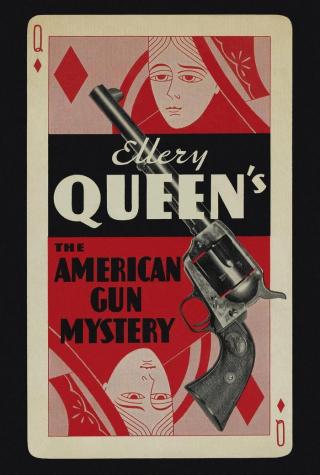
The American Gun Mystery (Death At the Rodeo)
- Автор: Куин (Квин) Эллери
- Серия: Ellery Queen #6
- Год: 1933
- Язык: английский
- Год: Frederick A. Stokes Company
- Жанр: Классические детективы

Электронная книга - «The American Gun Mystery (Death At the Rodeo)». Краткое содержание книги:
“William Grant — I presume that’s the way he signs his checks.”
“Grant! You mean the rodeo man? Wild Bill Grant?”
“That’s right.”
“Hmm,” said the Manager, and rubbed his chin abrasively. “What is it you want to find out about Mr. Grant?”
“Horne made out a check in the amount of twenty-five dollars,” explained Ellery patiently, “the afternoon of his murder. It was made out to Grant. I want to see that check.”
“Oh,” said the Manager again. “I— Did Grant deposit it?”
“Yes.”
“One moment, please.” The Manager rose and disappeared through the grilled door leading to the cashiers’ cages, and returned after five minutes with an oblong of paper. “Here it is. Horne and Grant both being customers of ours, the voucher was merely canceled by the teller, photographed — we photograph all checks, you know — and kept on file for Mr. Horne’s monthly statement.”
“Yes, yes, I know all that,” said Ellery briskly. “Let’s have it.”
He took the canceled check from the Manager and examined it. A moment’s scrutiny, and he placed the check on the desk.
“Very good. Now may I have a peep at Horne’s account-card?”
The Manager hesitated. “Well, matters like that are confidential, you know—”
“Police,” said Ellery sternly, and the Manager bowed meekly and went off again, to return with a large stiff record-card.
“Mr. Horne was a customer of this bank for only a few days, you know,” he said nervously. “There are only a few entries—”
Ellery looked over the card. There were five items noted. Four of them were small amounts — personal checks, apparently, for minor expenditures. But the fifth made Ellery whistle, and the Manager more nervous than before.
“Three thousand dollars!” exclaimed Ellery. “Why, he deposited only five thousand altogether in opening the account! Interesting, eh? I’d like to see that check and the teller who handled the transaction.”
Both were forthcoming after a little delay.
The check proved to be made out to cash, signed properly and authentically by Horne — who, having surrendered his original given name to the mists of antiquity, always wrote “Buck” before his surname — and was also properly endorsed by Horne.
“Did Horne himself cash this check?” Ellery asked the teller.
“Oh, yes, sir. I handled it myself.”
“Do you recall how he seemed while you were waiting on him? Was he preoccupied, jolly, nervous — what?”
The teller looked thoughtful. “Maybe it’s my imagination, but I got the notion he was worried about something. And he seemed sort of absent-minded — hardly heard what I said, but just watched me putting the bills together in a desperate sort of way.”
“Hmm. Did he ask for the amount in any specific fashion?”
“Yes, sir. He said for me to give him the three thousand in small bills. Nothing over a twenty.”
“This was two days ago — the day before the murder?”
“Yes, sir. In the morning.”
“I see. Thank you — both. Good day.”
Ellery strode out of the bank with knit brows. He recalled now that only thirty dollars had been found on Horne’s body, and no money at all in Horne’s room at the Barclay. He hesitated a moment, and then went into a cigar-store to a telephone booth.
He got Police Headquarters on the wire and asked for Inspector Queen. The Inspector was not in. Evidently he had not yet reached Headquarters from the offices of the newsreel company.
Ellery went out, looked about, and then crossed Broadway. He found a telegraph office, and went in. He spent ten minutes in the composition of a long message addressed to Hollywood, California. The wire paid for, he sought a telephone booth in the telegraph office and once more called Spring 3100. This time he was successful.
“Dad? Ellery. Did you get a complete report on the contents of Buck Horne’s dressing room at the Colosseum?... I’ll hold on... Yes? Well, was any cash found in Horne’s room?... None at all, eh? Hmm... No, nothing special. I’ve been meandering about... I’ll be downtown directly.”
He hung up and went out, heading for the subway.
Twenty minutes later he was seated in his father’s office, drawling a recital of his discoveries at the bank.
The Inspector was extraordinarily interested. “Withdrew three grand two days ago, hey? Well, well. That’s kind of hot, son.” He grinned. “Do you realize that that was the same day he had his mysterious visitor at the hotel?”
“Perfectly. The sequence — if it is a sequence — seems to be about as follows. Horne visits his bank only a few days after he has made a deposit of five thousand dollars, and withdraws three thousand of it in small bills. That very night he has a mysterious visitor. And the next day he is murdered...” He frowned. “Doesn’t seem to fit, eh?”
“Not the murder part of it. But you can’t tell,” said the Inspector thoughtfully. “If — mind you, I say if — if you put the withdrawal of the three grand and the visitor together, you get something that looks almighty like blackmail. But then, if that’s so, why the bump-off? Does a blackmailer kill his victim? Well, sometimes. Not most times, though — unless he’d sucked him dry...” He shook his head impatiently. “It’ll have to be looked into. I’m trying to trace his visitor, but it seems an impossible job. By the way, I got Sam Prouty’s autopsy-report this morning.”
Ellery started. “I’d forgotten completely about it! What did he say?”
“Nothing. Plain nothing,” grumbled the Inspector. “Couldn’t add a single item to what he told us on the scene.”
“Oh, that!” said Ellery with a flirt of his hand. “I didn’t mean that. The stomach, dad, the stomach — that’s what I’m interested in. Didn’t Prouty say?”
“He said,” said the Inspector glumly. “Sure he said. He said Horne hadn’t eaten for a good six hours before his death — maybe more.”
Ellery blinked; then quickly he began to examine a fingernail. “Is that so?” he murmured. “Well, well”
“Well, what?”
“Eh? Oh, nothing, anything new?”
“Look at this.” The Inspector rummaged through his desk and brought out a tabloid newspaper folded back, with something on the revealed page heavily ringed in red pencil. “Before I show you this. Doc also said there was no trace of poison in Horne’s innards.”
“Poison? Poison? Lord love that man!.. What’s that you’ve got?”
“Read what Santa Claus brought this morning.”
“Lyons?” asked Ellery absently, extending a long arm.
“Yump,” groaned the Inspector. “This Lyons bird is better than a whole Homicide Squad. Sees all, knows all, hears all. I’d like to wring his blasted neck!”
Lyons’s column of gossip and Broadway prattle was, as might have been expected, replete with tasty little items concerning the Horne murder. It spared no one, least of all the Inspector. The pertinent names loomed large in the column — Kit Horne, Wild Bill Grant, Tommy Black, Julian Hunter, Tony Mars, Mara Gay... One item was rather amusing. “Detec-stiff Inspector Queen thought ye ed — the kid himself — might have bumped the Great Bucko just because ye ed had a little gat in his didies. Go rest, old man, go rest! You need one.”
“Ah,” said Ellery with a chuckle, “the well-known Bronx gesture. What’s this?” His eyes narrowed. Near the foot of the column there was an innocent-seeming paragraph which took on the color of vitriol on closer examination.
“And what big-wig of the hardburly-girly clubs,” Ted Lyons asked derisively, “who was present in the flash when some unknown gladiator popped off the w.k. Buck Horne at the Colosseum last p.m. — not only was all set to fi-Nance said flicker fav-Writ’s return to the Silly Screen but is also ‘secretly’ the dark horse behind Cauliflower Row’s latest White Hope?”