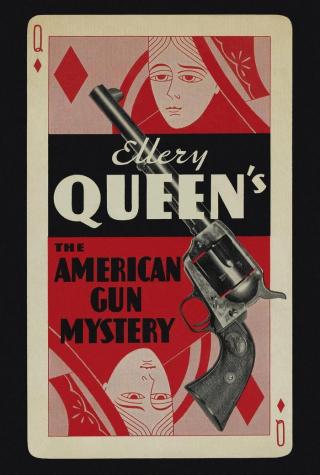
The American Gun Mystery (Death At the Rodeo)
- Автор: Куин (Квин) Эллери
- Серия: Ellery Queen #6
- Год: 1933
- Язык: английский
- Год: Frederick A. Stokes Company
- Жанр: Классические детективы

Электронная книга - «The American Gun Mystery (Death At the Rodeo)». Краткое содержание книги:
His nose was wrinkled as if a bad odor lingered in his nostrils. And his eyes were very thoughtful.
16: IOU
“...And scored his second kayo of the evening, this time his distinguished opponent being the Great Kazoo himself, Julian Hunter. What fun! There were magnums of champagne...”
Mr. Ellery Queen read Ted Lyons’s column through in silence at the breakfast table the next morning. Although Ellery could not remember having seen the tabloid columnist at the Club Mara the previous evening, Lyons’s latest eruption in The Lowdown was presumptive evidence that he had been present. He described in snatches the hilarity, the cast of characters, and the dramatic highlights of the evening. He gave the stars their due, and did not neglect to comment on the subtier phases of the piece. Ellery himself was mentioned as “one of the victims of the new champ’s muckety-amuck.” And then Ellery’s eyes narrowed. For at the end of the piece there was a startling insinuation — startling even when one considered the electrical source.
What hold, demanded Lyons in not so many words, had Hunter over his famous wife, Mara Gay — a hold not by any stretch of the imagination connubial? “The ’sipers will tell you (if you aren’t hep already) that this precious pair lead a cat-and-dog life, with hubby putting on the dog and wifey meowing like the queen of tabbies herself.” Was it just domestic infelicity which made Mara so nervous and highstrung, her eyes so alternately brilliant and dull? demanded Lyons. “There’s TNT in that little nest, folksies; and does hubby know it? And does wifey know what it would do to her career if it came out in the wash? Yes, he and she does or do!”
Ellery dropped the paper and helped himself to more coffee.
“Well, what do you think of it?” asked the Inspector.
“I’ve been stupid,” said Ellery. “Lyons, of course, like all rodents, has keen eyes. The woman is a drug addict.”
“Should ’a’ known,” grumbled the old man. “That dame’s always looked queer to me. Gives you the willies. Cokey, hey? So that’s what Hunter was threatening her with last night! — What are you’ grinning about?”
“Grinning? I’m grimacing. Over the possibilities.”
“What possibilities? Oh, you mean her being on the hop! Say, I’ve got some news for you.”
“News?”
“It’ll be news in the late morning editions. I got a tip from Tony this morning over the phone. Know what’s happening?”
“I haven’t the faintest notion. For heaven’s sake, what is it?”
The Inspector rather deliberately took his morning’s first ration of snuff. When he had sneezed the prescribed three times and vigorously wiped his little nose, he said: “Last-minute decision. Wild Bill Grant’s show has a new trouper.”
“You mean for the reopening tonight?”
“Yep... Guess who it is.”
“I’m the world’s poorest guesser.”
“Kit Horne.”
“No!” Ellery stared. “She’s really joining the rodeo troupe?”
“That’s what Tony Mars told me over the phone. He says it’s a new build-up — cash in on the murder publicity and all that. I don’t believe that.”
“Nor do I,” said Ellery with a frown.
“I think,” smiled the Inspector, “that the poor kid’s got a — what d’ye call it? — revenge complex. Why the devil else should she want to join a rodeo when she’s a movie star in her own right? I tell you, it’s plain as the nose on your face. I bet this gets her into trouble over her movie contract.”
“If I judge the young woman correctly,” said Ellery, “a mere contract won’t stand in her way. So...”
“And then again, maybe it’s because of this Grant boy,” said the old man. “I’d say there was more than a professional bond between those two. Because—”
The doorbell rang. Djuna ran into the foyer. When he reappeared it was to usher into the Queen’s living room Kit Horne herself.
Ellery sprang to his feet. “My dear Miss Horne!” he exclaimed. “This is a surprise. Come on in and join us in a cup of coffee.”
“No, thank you,” she said in a low voice. “Good morning, Inspector. I’ve dropped in for just a moment. I... there’s something I want to... well, tell you.”
“Now, isn’t that nice,” said the Inspector heartily, setting a chair for her. She dropped into it limply. Ellery offered her a cigaret and she declined it. He lighted one himself and stood by the window, smoking. One glance into the street below assured him that the detective set to follow the girl was oh duty; the man was leaning against an iron fence across the street. “What is it, my dear?”
“It’s a queer story.” She twisted her gloves in a knot. She was nervous; her eyes were shadowed by huge violet arcs and there was a drawn look about her. “It has to do with Buck.”
“With Mr. Horne, hey?” said the Inspector sympathetically. “Well, well, we can certainly use every scrap of information, Miss Horne. Just what is it?” and his small bright eyes examined her very keenly indeed. Ellery smoked quietly by the window. Djuna, who knew his place, had disappeared — notwithstanding his first worshipping glance — into the culinary regions.
“Frankly,” she began, fumbling with her gloves, “I... I don’t know how to begin. It’s so very difficult.” Then her hands stilled and she looked up at the Inspector fearlessly. “Perhaps I’m creating a tempest in a teapot. But to me it seems — well, important, if not significant.”
“Yes, Miss Horne?”
“It concerns — Julian Hunter.” She paused.
“Ah.”
“Not long ago I went to see him — to the Club Mara, alone.”
“Yes, my dear?” said the Inspector.
“It was at his own request. I—”
“He telephoned you, sent you a note?” said the Inspector sharply, envisioning carelessness on the part of his operative.
“No.” She seemed surprised at the purposelessness of the question. “He managed to get me aside one evening at the Club and asked me to call the next night, alone. He wouldn’t say what for. Of course, I went.”
“And?”
“I saw him in his private office. At first he was very polite. Then his mask came off. He told me a terrible thing. You know he runs a gambling house, Inspector?”
“Indeed?” said the Inspector. “What’s that to do with it?”
“Well, it seems that about a week before — before Buck died, just after we came East and Tony Mars introduced us to Hunter, Buck visited the gambling house Hunter runs — above the Club Mara. Buck played.”
“Poker? Craps?”
“Faro. And he lost a lot of money.”
“I see,” said the Inspector softly. “You know, we’ve been checking up on your foster-father’s finances, Miss Horne. Not here. I mean in Wyoming. And we found that he had withdrawn every cent he had — before he came to New York.”
“You didn’t tell me that,” said Ellery sharply, from the window.
“You didn’t ask me, my son. How much did Horne lose, Miss Horne?”
“Forty-two thousand dollars.”
Both men whistled. “That’s a heap of money,” murmured Inspector Queen. “Too much money, in fact.”
“What do you mean?” snapped Ellery.
“He had only eleven thousand and some-odd in his Cheyenne bank altogether, Ellery.”
“He withdrew it all?”
“Every cent. Except for his ranch property, that was all he had in the world. Not much, hey?... So, Miss Horne, he lost over forty thousand dollars! I think I see what’s coming.”
“Yes,” she said, and lowered her eyes. “He didn’t lose it all in one session. I think Hunter said he lost it over a period of four days. And he gave Hunter IOU’s.”