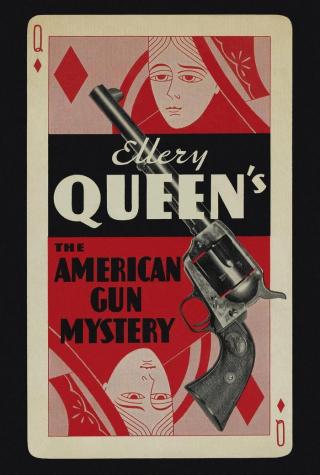
The American Gun Mystery (Death At the Rodeo)
- Автор: Куин (Квин) Эллери
- Серия: Ellery Queen #6
- Год: 1933
- Язык: английский
- Год: Frederick A. Stokes Company
- Жанр: Классические детективы

Электронная книга - «The American Gun Mystery (Death At the Rodeo)». Краткое содержание книги:
The identity of the visitor to Horne’s room at the Barclay on the night before Horne’s murder continued to remain a mystery.
And the Colosseum’s doors remained closed. Remained closed because of the weary insistence of Inspector Queen and the increasing irritation of Commissioner Welles. For the automatic which had fired the bullet which had in turn caused Buck Horne’s heart to stop beating was still undiscovered, despite an almost daily gleaning of the Colosseum. And Wild Bill Grant tore his hair and raved and shouted maledictions for the benefit of the reporters, vowing that never again would he bring his rodeo to New York. The Inspector piously echoed this sentiment, and the Commissioner almost dislocated his shoulders shrugging when he heard about it.
One line of inquiry — in the fruitless repetition of examination and cross-examination and re-examination of those harassed citizens involved in the Horne investigation — seemed fertile. That was the matter of Buck Horne’s finances. When questioned about this by the gentlemen of the press, the Inspector grew coy. He would not (or could not) say. Nevertheless, there was much mysterious activity on the part of Messrs. Ritter, Johnson, Hint, Hesse, and Piggott. The question was: What had happened to the three thousand dollars which the deceased had withdrawn from his account in small bills two days before his murder? No slightest trace of the money had been found.
It was a good question, but (it seemed) a very hard one to answer.
Ellery’s waiting took the form of a sociable relaxation. Perhaps for the first time since his undergraduate days he began to cultivate the gay life. His long tails emerged from the mothballs and flirted whimsically about polished dance floors. The laundry bills showed heavy additions for stiff bosoms and wing collars. He began to totter into the Queens’ West Eighty-seventh Street apartment in the small hours, slightly the worse for wear and vitriolic highballs. His sleep these nights was the profound coma of the physically exhausted, not unaided by the soporific effects of alcohol; and in the mornings he consumed pints of black coffee in a vain effort to scald the fuzz off his tongue. Djuna, a highly moral creature, complained in vain.
“It’s all in the cause of science,” Ellery groaned. “God, what martyrs we are sometimes!”
The inspector, who was attacking an egg at the moment, sniffed grouchily; and then examined his son with paternal anxiety.
“What the deuce are you accomplishing by this stepping out of nights?” he demanded. “You turning playboy on me?”
“To the last, no and yes,” replied Ellery. “To the first — a good deal. I am coming to know my characters. What a drama this is, dad! Take the Hunters, for instance—”
“You take ’em,” growled the Inspector. “I don’t want ’em.”
Nevertheless, it was a fact that Ellery had begun to cultivate his acquaintances of the Mars box. He spent much time with Kit Horne, who went through all the social motions with a mechanical smile while something distant and thoughtful glimmered in her soft eyes. In company with Kit, he attacked the night-clubs; more often than not with the Grants as members of the party; and more often than not the Club Mara. And there he was accorded the privilege of observing the regally emaciated Mara Gay — that Orchid of Hollywood — and Julian Hunter. He even met Tony Mars several times, and on two occasions found a group of representatives from the rodeo troupe hilariously engaged in consuming as much liquor as Julian Hunter’s waiters could serve. There was a gloss about the days and nights during the, period, an artificial sheen that covered something hard and unreal. Ellery lived, breathed, laughed, talked, and moved like a man in a dream.
Nevertheless, he did not permit reality to desert his senses altogether. It was impossible for him to spend every moment in the company of his new friends. So each morning found him at Police Headquarters reading the reports of the detectives detailed to survey the movements of Kit Horne and Wild Bill Grant — a survey, it will be recalled, dictated by him. In the case of Grant, he was irritated to find that the old Westerner was conducting himself in a vastly innocent manner. Whatever he had hoped to discover from placing a spy on Grant’s movements, contacts, and telephone conversations, it was certain that the hope was thus far a vain one. Grant drank hard, kept his troupe in hand — not a simple task — hovered watchfully over his son and Kit, and for the rest pestered the Inspector and Commissioner Welles with demands for the reopening of his rodeo.
As for the reports on Kit, they showed more promise. The girl’s faraway look, it turned out, had cold purpose behind it. An interesting incident was recorded one morning in the report of the detective assigned to watch her.
One night, several days after the murder, the operative had followed the’ girl from the Hotel Barclay to the Club Mara. Slim and brown in a white evening-gown, Kit had said coldly to the head waiter: “Is Mr. Hunter in?”
“Yes, Miss Horne. In his office. Shall I—?”
“No, thank you. I’ll find it myself.”
She had made her way along a row of private booths to the rear, where Hunter maintained his magnificent suite. The operative had checked his hat and coat, insisted upon a table near the rear, and ordered a highball. It was early, but the club was already crowded; Hunter’s famous jazz orchestra was blaring away at a new Calloway tune with the approved African tempo and savagery; couples were closely entwined on the darkened dance-floor; there was sufficient noise and darkness to cover the detective’s investigation.
He had risen quietly from his table and followed Kit Horne.
He saw her knock on the door marked: Private. Mr. Hunter; and after a moment observed the door open and Hunter’s well-garbed figure silhouetted against the bright background of the office.
“Miss Horne!” he heard Hunter exclaim in cordial tones. “Come in, come in. Glad to see you. I—” and then the closing door shut off the rest.
The operative looked about. The nearest waiter was lost in darkness. He was not observed. He pressed his ear to the panel.
He could not hear words, just tones. Now this operative, a specialist, was a highly trained eavesdropper; it was his boast that he could interpret emotions even if the words he barely heard were blurred and indistinguishable. So’ that his report became a study in homespun psychology.
“It started sociably,” went his report. “Miss H. from her voice was quiet, ready for anything; and she had made up her mind about something. J. H.’s voice boomed; I could hear he was friendly; but there was something queer, phoney, about it — he was slapping it on thick. I got the feeling they were sparring around for an opening. Then Miss H. got mad; her voice came through higher, tighter; she was slapping the words down like bricks. Laying the law down to Hunter about something. Hunter forgot to be friends; voice colder than ice; sneer came into it; words shot out fast, then slow, then fast again, as if the sneer was a cover-up for worry. She didn’t get it, because she got madder. I thought for a minute there would be a real blow-up. I was just getting ready to break in when I heard them stop jawing. So I wiggled out of the way. A second later the door smashed open and Miss H. came running out. I saw her face clearly; she was white, her eyes were hot and angry, and her lips were pressed tight together. She was breathing fast. She passed right by me and did not see me. He stood in the doorway a minute or two, looking after her in the dark, when he could not see her. I could not see his face, but his hand on the door was tight, knuckles white. Then he went back into the office. Miss H. took a cab back to the Barclay and did not go out again last night.”