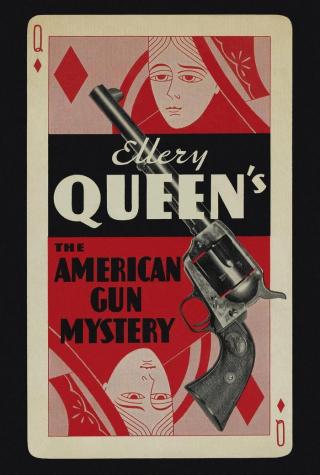
The American Gun Mystery (Death At the Rodeo)
- Автор: Куин (Квин) Эллери
- Серия: Ellery Queen #6
- Год: 1933
- Язык: английский
- Год: Frederick A. Stokes Company
- Жанр: Классические детективы

Электронная книга - «The American Gun Mystery (Death At the Rodeo)». Краткое содержание книги:
“Now I wonder,” snapped the Inspector, “how the devil Lyons found that out.”
“My amazement is rather more pointed,” murmured Ellery. “I wonder if Tony Mars knows it. Hunter backing Black, eh? On the q.t. I see the possibilities... Well, dad,” he jumped to his feet, “I can’t dawdle. Got to see Knowles,” and he made for the door.
“Hold your horses a minute. What did you mean this morning when you said you knew who—”
“Fo’give me, pater,” cried Ellery in haste, “I should never have opened my mouth. You’ll find out; you’d think me a lunatic if I said any more now. See you later,” and he hurried from the Inspector’s office.
He made his way to Room 114; and there found Lieutenant Knowles busy with a collection of colored cards.
“Damned nuisance, this filing system,” growled the ballistics expert without looking up, “but how it helps sometimes in court! Well, Mr. Queen, what’s the good word? Any more artillery?”
“There’s no relief from the war,” laughed Ellery, and produced from his overcoat pocket the ivory-handled .45 calibre revolver he had found in Buck Horne’s hotel room during the early hours.
“Say, haven’t I seen that rod before?” asked Lieutenant Knowles sharply, taking up the weapon. Ellery shook his head. “Then it must be its twin brother. I’ve got one just like it in the batch that came over from the Colosseum!”
“You certainly have. And it is a twin. The two belonged to Horne, except that this fellow was left behind in his wardrobe trunk.”
“She sure is one pip,” said Knowles with appreciation. “These old babies sometimes are. Little old-fashioned in type and design, but it’s like stamps. I’m an amateur stamp-collector, you know. The older they are the nicer they are. I’ve got—”
“I know, I know,” said Ellery, wincing. “I’ve met philatelists before. What I want to know is—”
“Whether this could have fired the bullet that killed Horne?” Knowles shook his head. “I told you it could only be a .25, and an automatic to boot.”
“Yes, yes, I know that.” Ellery sat down on the expert’s laboratory table. “Have you got the mate to this handy?”
“In the file, all tagged.” The Lieutenant went to a large cabinet, pulled out a drawer, and came back with the first Horne revolver. “Now what do you want to know?”
“Pick up both revolvers,” said Ellery queerly. “One in each hand, Lieutenant.”
Rather wonderingly, the expert obeyed. “Now what?”
“Was it my imagination, or am I right in believing that one of these weapons is a trifle heavier than the others?”
“Knowles, old boy, you’re always being asked the craziest questions!” said the Lieutenant with a burst of laughter. “Good God, Queen, is that all? Why so serious? Find out for you in a minute. As a matter of fact, one of ’em does feel a mite heftier than the other. But I’ll make sure.”
He dumped the revolvers one at a time on a scale. And he nodded. “Yes, sir. This baby with the tag is almost a full two ounces heavier than the other.”
“Ah,” said Ellery with satisfaction. “How very nice.”
The expert squinted at him. “No question, I suppose, about the authentic ownership of the two revolvers? I mean — they both really belonged to Horne, didn’t they?”
“Heavens, yes,” said Ellery. “No question about that at all. Lieutenant, you’d be amazed if I told you what your scale has confirmed for me.” Then he rubbed his palms together. “How beautifully it works out!” he sighed, and grinned. “You might tag that second one, Lieutenant, for filing and reference. We’ll probably have to give ’em all back soon. Meanwhile hold on to them. By the way!” He began to scowl. Do you think that tagged revolver was deliberately manufactured to be heavier than the other one? You know, they were both made at the same time — specially made for Horne.”
“Quite likely,” assented Lieutenant Knowles. “If Horne was a two-gun man — carrying ’em as he did in pairs — he probably wanted each one to fit the feel of his hand. Not necessarily so,” he added hastily. “Might have been an accident in manufacture. Some of the oldest short arms weren’t made any too carefully.”
“I should say these were made very carefully,” said Ellery. “Well, Lieutenant, thanks for a profitable ten minutes. See you some time.”
And he quickly left the office of the Bureau of Ballistics. Outside in the corridor he stopped smiling, and for a moment polished the lenses of his pince-nez reflectively.
14: Agenda
The loose and vasty association of crime investigators and criminal-hunters, when they foregather on some fantastic afternoon in the capital city of the Fifth Dimension, might do worse than adopt as their organization’s war-cry that immortal device on the national aegis of Vraibleusia: viz., Something will turn up. It would look particularly nice in Old English on a field or, with an embellishment of gules for symbolism. Statistics are uncertain, but it is not fanciful to say that half the sleuths in this world are waiting for something to turn up, while the other half are busily nosing along the trail of something that has already turned up. In either event the spirit of the motto holds.
The waiting period, however, is not necessarily a period of inaction. On the contrary, it is a period of frenzied activity which is termed “waiting” only because it accomplishes nothing and arrives nowhere. The activity, then, is of a negative sort; meanwhile, the something that is to turn up is biding its time — perhaps the psychological moment. It is the genius of most detectives that in the midst of a frantic and useless motion they preserve a calm philosophy. It is the philosophy of fatalism. The activity is merely animal energy expended to satisfy the conventional requirements of duty.
Ellery Queen recognized the signs from afar, and settled down — having no conventional requirements of duty to satisfy — to wait in a Stoical serenity. The worthy Inspector, however, who drew the sum of $5,900 per annum from the City treasury for his services as a guardian of the peace, was compelled to go through the motions. One of the motivating forces was that bugaboo of all old-line policemen, the Commissioner. The Commissioner, who was drawn back from a sandy Florida gambol by the magnetic echoes of the Horne murder, vented his irritation on the Inspector — obviously the cause of his curtailed vacation; whereupon the Inspector was silent and pale before the Commissioner, and voluble and red before his Department. It was a trying time for all concerned.
The conventional things had been done. Buck Horne’s movements for weeks before his murder had been checked and re-checked so many times that the Squad was growing just a bit weary writing out reports. “Might’s well do one with a dozen carbons,” groaned Ritter, who was a notorious malcontent; and not without justice, for the twelfth checking elicited no more than the first. The victim had passed his last few Weeks on earth in a Matilda-Queen-of-Denmarkish innocence. All his correspondence was examined; it was meagre, blameless, and as dry as a squeezed lemon. His friends and acquaintances in the East were questioned; they told nothing of importance. The wires between Wyoming and New York, and between Hollywood and New York, sizzled with questions and answers; the total result of which was zero raised to the nth power.
There was no one, it seemed certain, under heaven and on earth who had the faintest motive for seeking Buck Horne’s life — excepting One-Arm Woody, and he was eliminated because of his physical handicap.