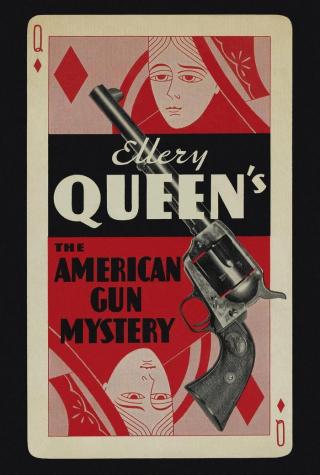
The American Gun Mystery (Death At the Rodeo)
- Автор: Куин (Квин) Эллери
- Серия: Ellery Queen #6
- Год: 1933
- Язык: английский
- Год: Frederick A. Stokes Company
- Жанр: Классические детективы

Электронная книга - «The American Gun Mystery (Death At the Rodeo)». Краткое содержание книги:
They continued to wait. Ellery was deep in the waters of cogitation. Detective Hesse closed his eyes, folded his hands, rested his head on the back of the seat, and instantly fell asleep. He snored frankly. Sergeant Velie cocked an eye at his superior, decided he might chance it, and proceeded to snatch a few winks himself.
Outside there was bedlam. In the room quiet.
When Major Kirby returned, he was triumphantly waving a set of damp photographs, eight inches by ten. Sergeant Velie started, and opened his eyes. Detective Hesse snored on.
The Queens bent over the wet prints; eagerly, very eagerly.
“Did our best,” said the Major apologetically. “I told you they would be out of focus. But we got the best magnification consistent with clarity.”
There were ten photographs in a series, the difference between the positions of the subjects in the successive photographs being infinitesimal. That they had been enlarged from motion picture celluloid was apparent from the film-frame visible around the pictures. The prints were consistently blurred, covered with a sort of grayish lambency which was the result of distorted focus. Nevertheless, details were discernible.
They showed Buck Horne on Rawhide at the approximate time of the man’s death, head-on to the camera, in a perfect frontal position — so that in the first picture the magnificent head of the animal stared directly into the lens, with the rider’s body looming behind it and facing similarly into the camera. All the pictures were in a sort of middle focus, so that the entire body of the horse was visible. It was plain from the photograph that Rawhide’s long-barreled body had been consistently parallel to the tanbark track during the entire time-period of the murder.
Five of the pictures revealed Horne an instant before his death. In this series the action was clear: in the first the victim had been sitting perfectly erect in the saddle, in the second he had begun to bend over in the saddle sideways to his left; in the third the leaning was more pronounced; and so on, until at the fifth his torso, still facing the camera, was leaning off the perpendicular to his left at an angle of thirty degrees. In comparison, Rawhide was in much the same position as in the first of the series; the horse’s leaning to the left was microscopic. Three photographs revealed Horne at the instant of death, and two as he began to crumple in the saddle and slip toward the floor. In all the pictures his hat was on his head, his left arm was elevated in clutching the reins, and his right arm flourishing the revolver high above his head.
“If you’ll recall the scene,” muttered Ellery, intent on the damp prints, “he began to topple from the saddle just after Rawhide rounded the northeastern turn of the track. That accounts for his pronounced leaning toward the right — his left — in these pictures. Isn’t that a sort of balance-compensation caused by centrifugal force, Major? Or am I being ridiculously unscientific again?”
They concentrated on the three photographs showing Horne at the very instant of death. Thanks to the victim’s predilection for white satin shirts, it was possible to study the effect of the shot very closely. The first of the three pictures revealed a small black spot beneath the rider’s crooked, elevated left arm, and a little toward the front at the level of the heart. The second revealed a slightly larger spot in the same place, and the third the largest of all — although the difference among the three was minute. These black spots were undoubtedly photographs of the bullet-hole.
On all the last five photographs the expression of the face was of shock, strain, distortion, lightning pain. Facing straight out toward the camera, as if its lens were the glaring eye of Death, he died again before their eyes.
Ellery looked up, and his eyes were veiled. “What a blind fool I’ve been,” he said thoughtfully. “And how simple this problem was after all.”
There was an astounded silence, and Major Kirby’s jaw dropped an inch.
“Was?” cried the Inspector.
Ellery shrugged. “There are two things I don’t know,” he said with a sad smile, “two things of vast importance, by and by, which must be explained before the case is complete. But there’s one thing I do know. Yes, there’s one thing I do know, and there’s no shadow of a question about its truth...”
The Inspector clamped his lips shut, and glowered.
But Major Kirby said eagerly: “What’s that? What’s that, Mr. Queen?”
Ellery tapped the falling figure on the last photograph with an impersonal fingernail. “I know who killed this poor old exhibitionist!”
13: Some Visits of Importance
“You know who killed Horne!” gasped the Inspector. “Well, for Christmas’s sake, let’s go get him!”
“But I don’t know,” said Ellery ruefully.
The Major and the old man stared at him. “Blast it!” cried the Inspector. “You getting smart again? What d’ye mean — you don’t know? You just said you do know!”
“I give you my word,” murmured Ellery, “I’m not pulling your leg, dad. It’s precisely as I say: I do know, and yet I don’t know. One of those things. You say: Let’s get him. But I tell you in all truthfulness that if I walked out of this building this instant I shouldn’t be able to lead you to the murderer. And yet I’m as positive I know who killed the poor fellow as — as old Jim Bludso was when he ‘seen his duty.’”
The Inspector threw up his hands. “There you are, Major. That’s what I’ve been putting up with all my life. A... a—”
“A sophist?” suggested Ellery sadly.
The old man glared. “When you get through speakin’ in riddles, you’ll find me downtown at h.q. ’Bye, Major. Thanks.” And he stalked out in a huff, followed obediently by Sergeant Velie and a yawning Hesse.
“Poor dad,” sighed Ellery. “He’s always peeved at my little circumlocutions. And yet, Major, for the life of me I couldn’t make it clearer. This time I’m in dead earnest.”
“But you said you know,” began Kirby in a puzzled way.
“My dear Major, the fact that I know the superficial truth is — believe me — the least important feature of this ghastly business. I wish I knew the two things I don’t know. There’s the rub; I don’t, and the Lord alone knows when I will, if ever.”
The Major chuckled. “Well, it’s too much for me. Now I’ve got to get back on the job. Remember — I’m at your service, Mr. Queen. Especially when you discover the answer to those two mysteries!”
“Always the newsgatherer, eh? May I have these prints?”
“Certainly.”
Ellery strolled up Broadway, the prints in an envelope under his arm. His brow was like an old-fashioned washboard. He sucked at a cigaret which he had forgotten to light.
He came to himself with a start, searched for a streetsign, got his bearings, paused to light the cigaret, and then turned down a side street and walked rapidly toward Eighth Avenue. A hundred feet from the corner he stopped before a small building characterized by marble facing, deeply incised letters, and iron bars. The letters said: Seaboard National Bank & Trust Company. He went through the revolving door and sought the Manager.
“I’m investigating the Horne murder,” he said pleasantly, flashing his special police card.
The Manager blinked nervously. “Oh! I see. I’ve been sort of expecting a call. Really, we know very little about Mr. Horne—”
“Enough for my purposes,” smiled Ellery. “But I’m also interested in one of your other customers who’s very much alive.”
“Yes?” said the Manager blankly.