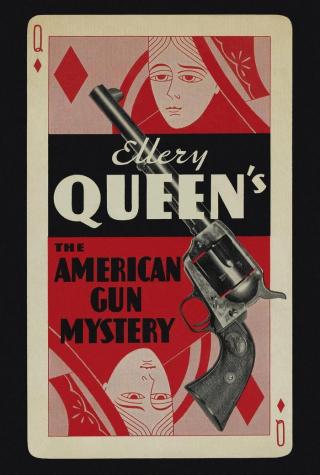
The American Gun Mystery (Death At the Rodeo)
- Автор: Куин (Квин) Эллери
- Серия: Ellery Queen #6
- Год: 1933
- Язык: английский
- Год: Frederick A. Stokes Company
- Жанр: Классические детективы

Электронная книга - «The American Gun Mystery (Death At the Rodeo)». Краткое содержание книги:
“Would you mind holding up a bit? The Inspector left for Headquarters before I awoke this morning, but he left word that he would stop in here if he could break away.”
“You’re the boss.” The Major sat down against the wall at a small table studded with buttons and lighted by a tiny powerful lamp. “Anything new?”
Ellery stretched his aching legs. “I’m afraid not,” he replied ruefully. “You know, Major, we’re face to face with an extremely metaphysical puzzle. Modern witchcraft! Problem: What happened to the automatic which fired the shot which killed Buck Horne? It can’t have been slipped out of the Colosseum, and yet it isn’t there. Apparently. Figure that one out.”
“Sounds like something out of the Arabian Nights,” smiled the Major. “I’ll admit it’s a poser. But I agree with Mars — heavens, man, it’s the only reasonable theory! — that somehow, in some way, the murderer managed to sneak the gun out of the building. Either personally or through an accomplice.”
Ellery shook his head. “We’re certain from indisputable testimony that not a living soul wriggled out of the place from the moment after the crime took place. And everybody thereafter — no exceptions, mind you — was thoroughly searched. No, Major, the answer is considerably more subtle than that. In fact,” he frowned, “I wish it were as simple as you say. Because I’ll have to confess I haven’t the least notion of what’s really happened to the hardware... Ah, dad! Top o’ the mornin’!”
Inspector Queen, looking smaller, thinner, and grayer than ever, appeared in the doorway of the projection room, flanked by Sergeant Velie and Detective Hesse. “Morning, Major. So you did get out of bed finally, did you?” He dropped wearily into one of the chairs, and waved his aides into others. “From the way you were tossing and groaning, you must’ve been havin’ nightmares... All right, Major. We’re ready if you are.”
Major Kirby twisted his head and yelled toward the largest orifice in the rear walclass="underline" “Joe!”
A bespectacled face popped into sight in the square window. “Yep, Major?”
“We’re ready, Joe. Shoot ’er along.”
Instantly the lights went out and they were left in a velvety, palpable darkness. There was a whirr and clacking roar of machinery from the operator’s booth behind. Suddenly a title materialized on the screen, accompanied by a stock blare of dirge-like introductory music. The title read:
The title flicked off, and another came on — a long passage:
EDITOR’S NOTE— These are the first pictures of the Horne shooting to reach the screen. These unique scenes of the events leading up to and following the shocking murder of Hollywood’s best-beloved Western star are made possible through the enterprise of News and the courtesy of the New York Police Department.
The title vanished, and the first view of the Colosseum the night before leaped onto the screen, accompanied by the newsreel announcer’s voice.
“Here you see the vast crowd who packed the Colosseum,” boomed the voice, as the scene slowly shifted from tier to tier of seats in the amphitheatre, “before the fatal shooting. The occasion was the grand opening at this world-famous sport arena in New York City of Wild Bill Grant’s Rodeo... Twenty thousand persons were enjoying the colorful spectacle of leaping horses, whooping cowboys—” The voice stopped and a burst of sound came from the amplifier as the cameras darted from one part of the arena to another, catching the sights and sounds of the preliminary events the Queens had witnessed the night before, including a brief glimpse of Curly. Grant laughing and showing his teeth as he popped the little glass balls out of existence with careless shots from his long-barreled revolver. Suddenly there was a hush; the arena emptied; the camera swung and fixed on the huge western gate. Out pranced Wild Bill Grant on his horse; the camera followed him to the center of the oval. It caught his gallop, his sliding stop in a group of flying dirt-clods, his wave of the Western hat, his smile, the applause and stamping of feet, Grant’s signal-shot toward the roof, and his bloodcurdling cowboy yell to gain silence. Then his opening bellow: “La-dees and Gentlemen, per-mit me to welcome you to the Grrrand Opening of Wild Bill Grrrant’s Rrrrodeo! The Larrrgest Ag—” The roaring continued. Then the dramatic appearance of Buck Horne on his magnificent mount, Rawhide, the yelling entrance of the forty-one riders, the signal-shots, the swirl of the start of the gallop around the tanbark track...
They leaned forward tensely as the events of the preceding evening recreated themselves with such startling faithfulness on the screen... Someone sighed tremulously as there was a hasty glimpse of Buck Horne twisting sideways from his saddle at the instant of the thunderous fusillade — this was a long, indistinct volley — his fall, the wild confusion of milling horses and the screams of the spectators... They sat silently as the camera leaped from long shots of personalities, of the Mars box, of the dismounted horsemen, of the rodeo doctor, and one of the blanketed body...
When the lights flashed on again, no one moved for some time. Then the Major called in a low voice: “All right, Joe, that’s all,” and the spell was broken.
“Fast work, eh?” went on the Major with a grim smile. “That reel’s in the State Theatre right now.”
“Very enterprising,” murmured Ellery absently. “By the way, how long does this run? It seemed to me longer than the usual newsreel episode.”
“I should say it is. Naturally we’ve made this a special. Takes the same importance,” chuckled Kirby, “as earthquakes and wars. Runs to just about a reel. About ten and a half minutes.”
The Inspector stirred. “Nothing there we didn’t get ourselves. I can’t see, Ellery—”
Ellery, sunk in deep reverie, did not reply.
“Well, is there?”
“Eh? Oh, no, no. Perfectly right,” sighed Ellery. He turned to Kirby. “You’ve been a trump, Major. I wonder if I could prevail upon you to spend some more of your company’s money? Is it possible for you to wangle your apparatus so that we can get a still-photograph — close-up — of Horne at the instant the bullet entered his body?”
Kirby frowned. “Well... It’s not impossible. It will be considerably blurred, you know; blow-ups of film always are. Besides, this was a long shot — not focused for close-up...”
“Nevertheless I want it most particularly. Be a good fellow.”
“Anything you say, old man.” Major Kirby rose and quietly left the projection room.
“These birds sure do work fast,” rumbled Sergeant Velie.
“Ellery,” said the Inspector, “what’s this hocus-pocus for, anyway? I’m busy, drat it—”
“It’s important.”
And so they waited. Several men poked their heads in. Once a large fat gentleman with an autocratic air marched in, introduced himself as the editor of the newsreel company, and asked if Inspector Queen would like to “say a few words” about the shooting into the microphone — there was a studio a few steps down the corridor... The Inspector shook his head.
“Sorry. I’d have to get the Commissioner’s permission, and he’s out of town. He doesn’t like his officers making stabs at publicity.”
“Oh, he doesn’t?” said the large fat gentleman dryly. “I take it the regulation doesn’t apply to himself? Say, I know that publicity hound! ’Scuse me, Inspector. Some other time, maybe, when His Nibs feels better. See you later.” And he hurried like the White Rabbit out of the room.