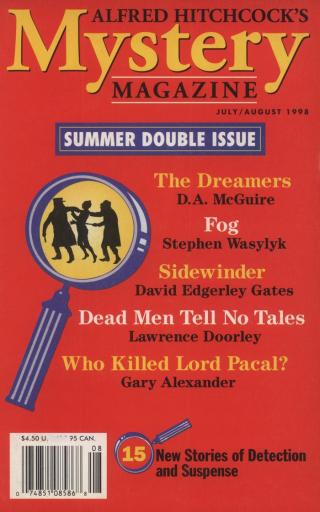
Alfred Hitchcock’s Mystery Magazine. Vol. 43, No. 7 & 8, July/August 1998
- Автор: Alexander Gary, Crawford Dan
- Год: 1998
- Язык: английский
- Год: Dell Magazines/Crosstown Publications
- ISBN: ISSN: 0002-5224
- Жанр: Другие детективы

Электронная книга - «Alfred Hitchcock’s Mystery Magazine. Vol. 43, No. 7 & 8, July/August 1998». Краткое содержание книги:
She was thanked, wished well.
Again the poor girl thanked the publisher. And since Ebb and Flow, Baxter’s fourth manuscript — which he had said would be the last of the Easterfields — had arrived, Martha put Appalachian Elegy aside, determined to race through it.
Of course she didn’t. She was a perfectionist, especially where Baxter’s manuscripts were concerned. She agonized over it, correcting the grammar, the spelling, the punctuation, eliminating the many, many inconsistencies in names, dates, episodes. She couldn’t help herself. But she could swear now, damn Baxter for being such a sloppy writer.
But she also wanted to please Mike Wilson, Baxter’s literary agent. He had paid the balance due on Harpoons and Whalebones. After the initial two hundred dollar check, Baxter hadn’t paid a cent. And Mike had given her two hundred fifty more for Harpoons and Whalebones and had not only paid her regular fees for the next two books but had given her a bonus of five hundred dollars for each.
And she couldn’t forget Scott Henry. He had edited Baxter’s three books at Sterling & Meeks before he and the other editors were downsized, replaced with eight dollar an hour college temps when the old line publisher was bought by Sharpe & Slashwright, a conglomerate with no experience in book publishing.
Scott had written Martha, praising her for her fine work on Baxter’s manuscripts, “his roughest of rough drafts.” In his last letter he had written, “When I compare Harry’s manuscripts with yours, Miss Ainsley, I say once again that you have made my job enormously easier. Thank you.”
And having observed the horrible editing of recent Sharpe & Slashwright books, Martha could well imagine what would happen with Ebb and Flow if she raced through it, heedless of the chaos.
For it was like the three other Easterfields. Again, it held the readers’ interest page by page and was guaranteed to be another bestseller. But who deserves more than a little credit for Baxter’s books’ being bestsellers? Me, pipsqueak Martha Ainsley, she snarled. Old mealy-mouthed Martha, too timid, too cowardly to demand that Harry Baxter, filthy rich author, pay me ten dollars a page, twenty dollars a page.
The poor girl, she was falling apart. No wonder. Enter Ginny Barnes, exuding sexuality, not intellectuality. Not that Ginny was simply a henna-haired scatterbrain. She was good at her job in the classified ads section of the local paper, but she was no bibliophile. She wouldn’t have known Emma Bovary and Becky Sharp from the Bobbsey Twins.
Her divorce finalized in September 1990, she getting the little house on Elm Street on the West End route, Ginny made a spectacular appearance on her front porch on the second Saturday of September, the opening performance avidly witnessed by Thelma, a dear old nibnose widow across the street for whom a daily dose of gossip was as essential to her well-being as her three different prescription pills.
(“Yes, that’s right,” sly Ginny had said to the postmaster, “At 218 Elm Street I’ll always have a stamped letter. I write to dear Mother in Florida every single Saturday.”)
Perfumed (she’d gone with Unbridled) and pulchritudinous, posturing and prancing provocatively, she was a sight to behold. And when the breathtaking performance was over, Thelma grabbed the phone, called Emily.
“You shoulda seen her. It was just like one o’ them hootchy-kootchy numbers Theda Bara used to do in the silent movies at the Lyric. Huh? Whaddaya mean you don’t remember Theda Bara? Who you kidding? You’re as old as I am. Now, do you want to listen or not?”
Emily listened. Then she telephoned Olive, who couldn’t wait to call Alice. As the titillating tale wove through town, it eventually reached Martha, a well-meaning quidnunc phoning her on Sunday evening.
Poor Martha, she felt like crying. But she didn’t cry, she swore. Damn that creature, damn her. Not satisfied with having had two husbands, she’s trying to steal my dear Walter. Damn her, damn her.
Seventh heaven at 146 Chestnut Street became a little less ethereal after Ginny wriggled front and center. Oh, Walter still told Martha that she looked nice — and she did, she redoubled her efforts to make the best appearance — and they still talked of the weather, books, her novel. They managed to accomplish a lot in sixty or seventy seconds. But an uncertainty in Walter seemed to be developing.
Martha knew why (the gossip grapevine kept humming). Walter reached Ginny’s house on Elm Street at eleven forty-five, a half hour before he arrived at 146 Chestnut. And he was having a tough time. Before Ginny appeared, he had been dreaming of how wonderful it would be married to Martha. He would be doubly blessed, the rapture of the nuptial chamber and the intellectual stimulation before, after, and maybe even during.
They would have hundreds of books. They would help one another with their writing, for after the wedding he would have the courage to tell her about Murder on the Route, the mystery he was writing, and about his dream of a mailman protagonist who saw more of the swirling undercurrent of small towns than anyone. She would tell him it was a wonderful idea. They would be so happy.
Then he would remember her mother. Oh boy, it wouldn’t work. But there was still time. She could still marry, she was an attractive woman for her age.
Then Ginny Barnes appeared. Poor Walter, he began having nightmares, Ginny flaunting her copious bodily charms, then Martha taking the floor, discussing Hardy and Jane Austen, Helen hovering nearby, seemingly rooting for Ginny. No wonder an air of uncertainty engulfed Walter.
And Ginny kept applying the pressure. Late in November a library volunteer phoned Martha to tell her Ginny had checked out three books that evening.
“One Hardy, Jude the Obscure,” the volunteer reported, “two Jane Austens, Pride and Prejudice and Sense and Sensibility. It’s the first time she’s been in the library since high school. I had to make out a new card.”
Poor Martha, she thanked the volunteer, put down the phone, snarled, “That insidious creature, resorting to something that fraudulent, trying to impress Walter. Is there no end to her despicable tactics?”
Much later that night, tossing and turning in bed, she attempted to rationalize. Why, it could backfire, allow Walter to see what a sly, sneaky person she is. He’s simply too intelligent to fall for something so transparent. He’ll be able to see through that flimsy subterfuge.
The poor distraught girl, she wasn’t thinking straight. It would have taken a blind man not to see through Ginny’s flimsy subterfuges. The weather didn’t matter, frost on the pumpkins, thermometer plunging, wind howling, out she pranced, coat open, attired in another breathtaking flimsy subterfuge.
Walter was in such an emotional state that he had to stop work on Murder on the Route, words like “decolletage” and “diaphanous” being exchanged between the victim and the protagonist.
With dear nibnose Thelma’s eagle eye focused on the escalating drama at 218 Elm Street, keeping the pipeline humming, the betting at Lil’s by early April 1991 had Ginny a three-to-one favorite to capture the brass ring.
Helen:
In April 1991, Helen, approaching her sixty-fifth birthday but looking years younger, had been out of work for eight years, downsized at the credit bureau by a secondhand computer. She no longer said anything derogatory about David — Martha had put a stop to that. But she had plenty to say about Harry Baxter at Lil’s. He was rich, and Martha had helped him get rich. If she hadn’t made improvements in his first awful manuscript, Harpoons and Whalebones, it wouldn’t have sold. And though his next two books might have done well because of the enormous success of Harpoons and Whalebones, Martha had also spent many, many extra hours improving those manuscripts.