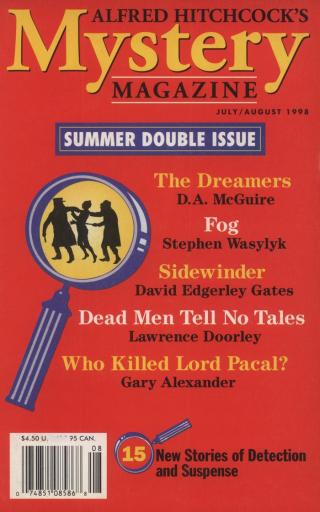
Alfred Hitchcock’s Mystery Magazine. Vol. 43, No. 7 & 8, July/August 1998
- Автор: Alexander Gary, Crawford Dan
- Год: 1998
- Язык: английский
- Год: Dell Magazines/Crosstown Publications
- ISBN: ISSN: 0002-5224
- Жанр: Другие детективы

Электронная книга - «Alfred Hitchcock’s Mystery Magazine. Vol. 43, No. 7 & 8, July/August 1998». Краткое содержание книги:
He took Appalachian Elegy from his desk, sat down, raced through forty pages, more than enough to almost convince himself that he was reading a Harry Baxter manuscript. A kinder, less rancorous, less explicit Baxter.
“Good Lord,” he exclaimed as he put the manuscript down. “This is unbelievable. Hell, it could easily be passed off as a Baxter manuscript. And think of it! It’s the only remaining Harry Baxter — famous author — manuscript on the face of the earth. It’s worth millions. Oh my God, think what this could mean. But am I such a rotten, unprincipled bastard as to beg that poor woman — who must have labored over it for months, maybe years — to sacrifice her manuscript so I can pretend it’s an early Harry Baxter, the last of the great writer’s work? And since that would constitute fraud — naturally I’d have to conceal the truth from the publisher — that means I would have lured that fine, decent woman deeper into crime.
Meantime, Martha had had a terrible day. She learned of Baxter’s death via the seven o’clock morning news. She phoned Mike twice; no word from him. Then around two thirty in the afternoon another blow: Ginny raised the ante.
“I heard it at Lil’s,” a well-meaning quidnunc phoned her at work. “I thought you ought to know. You know the Herald has a new publisher—” Martha knew “—a widower in his forties. Well, Ginny’s wheedled him into letting her take her lunch hour from eleven to twelve instead of twelve to one as she used to. As I said, I thought you ought to know.”
Fuming inside but ever polite, Martha thanked the caller, slammed down the phone. “What next?” she snarled. “Mr. Baxter dead, no word from Mr. Wilson, and now this... this... lewd, lecherous creature flaunting herself before poor, sweet, innocent Walter five days a week. If she were here now, I’d kill her, I would.”
She didn’t really mean that. Things were falling apart. How long could Walter resist that wriggling, slithering, half-naked creature now that she would be able to wriggle and slither five days a week in comparison to poor Martha’s one day?
“And... I don’t wriggle... or slither,” the poor girl whimpered. “Maybe I should have. Why doesn’t Mr. Wilson call me... why?”
Mike called around three thirty. Naturally, Martha was taking care of a customer.
“I’ll call you back,” she hissed. Wow, thought Mike, she has a temper. He waited. Martha rang back in fifteen minutes.
“Why didn’t you phone me long ago?” she demanded. “I’ve been in a terrible state. Poor Mr. Baxter, how awful. But what does this do to... to... you know?”
Mike knew; it changes things, he said.
“But we can’t discuss it over the phone,” he went on. “I must come to Hillsdale this evening. Now, now, I know about your mother. You’ll have to get her out of the house. How about having her go — take a friend, too — to a nice restaurant and maybe a movie afterwards. I’ll reimburse you. No, I can’t answer any questions. I’ll see you around seven thirty.” He quickly hung up.
Getting Helen out of the house wasn’t really too hard.
“Mr. Baxter’s literary agent is coming from New York,” Martha explained. “Just a minute, Mother,” she said sternly as Helen was about to speak. “We have a lot to discuss,” she continued very emphatically, “and we can’t have any interruptions. Why don’t you call Alice and you and she go to the White Swan and a movie afterwards. Mr. Wilson will be happy to pay for it.”
By now Helen had learned not to argue with Martha when she used her “I-don’t-want-to-discuss-it-further” tone.
“Hmm,” she hmmed. “I can take a hint.” Still, the opportunity to dine at the White Swan, the one remaining symbol of the glory days, and go to a movie was something that didn’t happen very often. She phoned Alice, who was thrilled.
It was a lovely, warm, fragrant spring evening. A huge moon beamed down on the creek, bathing it in a luminous glow. The water had gone down a lot, and the creek babbled melodiously as it wove its way among the rocks.
It was a scene to inspire a poet. It didn’t inspire Mike.
“Ah, go to hell,” he snarled as he walked across the humpbacked bridge. He was tense. Try as he might, he couldn’t convince himself — as desperate as his plight was, he would be broke in three months — to propose to Martha that she allow him to auction Appalachian Elegy as an early work of Baxter’s.
For shame, his outraged conscience berated him. Think what an effort she put into that manuscript. And you want her to give it up, pretend it’s Baxter’s. Have you no standards? Unfortunately, he did have standards.
I just can’t do it, he finally said. But he was still desperate, and on the plane to Pittsburgh he suddenly thought of something. No one but he knew that Ebb and Flow was no more. He could put out the word that Baxter’s typist was still working on it. And since her writing style was akin to that of Baxter and she’d already read, reread, agonized over, corrected, and improved Ebb and Flow, the memory would still be vivid, she could write it. Sure, it would take several months; so what?
“Then I’ll auction it off,” Mike told himself jubilantly. “I’ll get my commission, Baxter’s estate gets the rest, Martha gets her thirty-five thousand. It all ends happily. One thing I swear, if I ever get out of this mess, I’m going to start going to church again. I mean it.”
He had a hell of a time telling Martha what happened to Ebb and Flow. “That’s it,” he finished, scrunching down in the chair in a pitiful effort to hide. “Go ahead, Martha, call me a stupid blunderhead. I botched what should have been a simple little deal. Well, go on, for God’s sake, Martha, say something.”
She couldn’t. All she could do was make funny little whimpering noises. Then she suddenly covered her face with her hands, began to sob. Mike jumped up, rushed over to her, and began patting her on the shoulder, telling her that all was not lost, that if she could redo Ebb and Flow everything would turn out fine.
She finally stopped, put her hands down, raised her tear-stained face.
“I apologize, Mr. Wilson,” the poor girl said. “I’m ashamed of myself for acting like this. And I know how you must feel.”
“For God’s sake, Martha,” said Mike as he went back to his chair, “Quit the Mr. Wilson, call me Mike. We’re on close enough terms for first names.”
“All right, Mike,” she said with a woebegone smile, “and yes, I’m pretty sure I could redo Ebb and Flow. But it would take at least two months. And... well, you remember my telling you on the phone Friday that I am... am undergoing a crisis?”
Mike said he remembered.
“Oh, this is so humiliating. I never thought I could bare my soul so. I can’t go on, I can’t.”
“Sure you can, Martha,” urged Mike. “Baring one’s soul is no crime. Come on now, maybe something can be worked out.”
She took a deep breath, sat up straight, squared her shoulders, stuck out her chin, told him of the battle between her and one Ginny Barnes for the mailman.
“As long as... as Mother fives with me,” she continued, her voice beginning to falter, “there is no chance of... of... and since Walter’s mother has been dead for nearly eighteen months, he can’t be expected to mourn much longer. I just couldn’t sit at the computer night after night for months knowing that Walter was being exposed to... oh, this is terrible, terrible.”
“Damn it, Martha, it isn’t terrible,” Mike insisted. “But I have to say that this Walter should have grabbed you a long time ago, mother or no mother. I would have.”