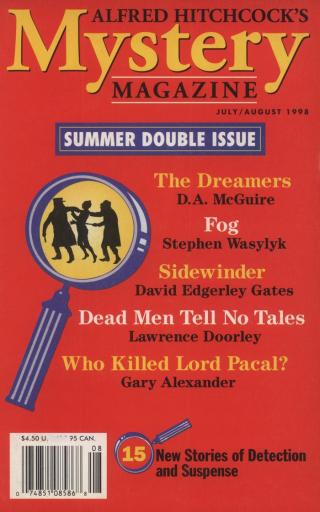
Alfred Hitchcock’s Mystery Magazine. Vol. 43, No. 7 & 8, July/August 1998
- Автор: Alexander Gary, Crawford Dan
- Год: 1998
- Язык: английский
- Год: Dell Magazines/Crosstown Publications
- ISBN: ISSN: 0002-5224
- Жанр: Другие детективы

Электронная книга - «Alfred Hitchcock’s Mystery Magazine. Vol. 43, No. 7 & 8, July/August 1998». Краткое содержание книги:
The temperature went up one Saturday morning in June. Her mother at the supermarket, Martha had tuned into the public TV station in Pittsburgh for the Books & Authors program.
There he was, the fat, pompous fraud, the ex-congressman.
“The old values — honesty, integrity, truthfulness — are all under attack,” he pontificated. “We who hold sacred our forefathers’ values must continue to fight the cynical forces... et cetera, et cetera, et cetera.”
Well. A violent emotion smote Martha. She leaped from her chair, brandished a clenched fist at the TV, and shouted, “Why, you unmitigated knave, you charlatan, you hypocrite. No wonder our beloved country is...” She suddenly stopped. Oh my goodness, listen to me. She fell back into the chair, listened to the remainder of the interview with her heart beating faster than normal. When it was over, she rushed upstairs and wrote a scathing letter to the congressman, telling him that unless he sent a check in full within ten days, she would not only write to his publisher but would find out in what city he would next appear and write to the editor of the paper there. “You can bet,” she told him, “I’ll have some harsh words to say about you.”
The check arrived six days later, the congressman “regretting that my secretary, who has been seriously ill, did not take care of this long before.”
“Horsefeathers,” Martha exclaimed, jubilantly, enormously proud of herself, all aglow. She was still aglow the next day, and when J. L. — a large, hail-fellow-well-met type — remarked that she hadn’t mopped the outer office floor lately, Martha, without even thinking, responded rather forcefully.
“I don’t think mopping the floors should be one of my duties, Mr. Henderson.”
At which J. L.’s chubby face turned red. He gulped three or four times, finally said, “I agree, Martha. Ah, I’ll arrange for a cleaning woman to handle all the... the extraneous duties from now on.”
With that he fled, mumbling that he had an appointment to show a large tract in the mountains. My goodness, thought Martha, I’m becoming a regular shrew. Martha Ainsley, everyone’s doormat, according to mother, beginning to assert herself. And it’s all due to that desperate venture, the manuscript typing. I’ve become proud of myself.
She had reason to be proud. Nearly every author on receiving the completed manuscript wrote back, praising her work. That’s how things stood in July 1977 prior to the arrival of Harpoons and Whalebones. Herman Means, her mother reported, had grumbled about the heavy manuscript box. Martha just smiled.
But when she examined the huge handwritten manuscript, she too reacted grumpily.
“For heaven’s sake, look at this mess,” she groaned. “Words are crossed out, others scribbled in, the margins overrun with corrections. And the penmanship, the misspelling, the hideous punctuation, and it’s at least a hundred and twenty-five thousand words. Well, I’m simply not going to waste my time on this mess. Back it goes tomorrow.”
It didn’t go back. She made the mistake of reading the cover letter. Harpoons and Whalebones was the first work of what the author, Harry Baxter, intended to be “a four-book saga of a hideously rich Boston family, the personification of Brahmin ruthlessness and fakery.”
Baxter said that he had grown up the poorest of the poor in New Bedford, Massachusetts. Since New Bedford was once a thriving whaling town, “I heard amazing stories of the incredible riches gained from the slaughter of those defenseless creatures.”
He had gone to college on a football scholarship, had watched “arrogant Back Bay families, whose obscene fortunes were rooted in killing whales, outdo one another in dismantling the Ten Commandments.” He was twenty-nine, barely surviving in Greenwich Village, waiting on tables and all too often “despairing that I would ever finish this manuscript, for which I have endured the agonies of the damned. I too often succumb to the intoxicating lure of that devilish fiend Bacchus. And I plan to write three more. I must be crazy.”
A check for two hundred dollars was enclosed. He said he had recently made friends with a literary agent who was opening his own office. The completed manuscript was to be sent to the agent, and he would pay the balance. He’ll pay before I send it, Martha said to herself.
Baxter apologized for his handwriting, “the general messiness. I simply couldn’t rewrite it. I wouldn’t blame you for sending it back. I await your decision.”
Intrigued by the author’s confession that he had “endured the agonies of the damned,” Martha began to read the messy manuscript, for she was experiencing her own agonies in trying to get past the first chapter of her novel.
And she had another reason for reading the manuscript, for her own novel was about Boston Brahmins rich from textile manufacture, sending their smooth-talking representatives to West Virginia in the late 1890’s and early 1900’s to talk the poverty-stricken hillbillies into leasing their coal lands for as little as a dollar an acre, their timber for a stumpage of fifteen cents a tree. Ashford County bordered West Virginia, and Martha had heard many stories of the rape of the beautiful state’s natural resources by rich Bostonians.
Harpoons and Whalebones was the story of the Easterfields of Boston, an arrogant tribe whose wealth began with Caleb Easterfield who sailed from New Bedford in 1820, returned two years later with his ship loaded with blubber and whale oil.
The manuscript was tough going; the handwriting would have shamed a fourth grader. But Martha kept reading. She was hooked — fascinated by the unique way Baxter built up tension. And there were wonderful characters. Sally Boggs became one of Martha’s favorites.
An illegitimate, illiterate, six-teen-year-old spittoon cleaner in a vile waterfront saloon, with nothing going for her but her “unbathed nubile carnality,” Sally ended up the owner of the most luxurious brothel in Boston, became a patron of the arts, and was highly esteemed by the gentry.
Ethan Easterfield was another favorite. Ethan, the youngest of the four boys (the other three were ship captains like their hard-driving father) was an idealistic person. He graduated from Harvard Divinity at nineteen and sailed with a group of fellow missionaries for the South Seas, eager to bring Christianity to the benighted heathens.
Alas, somewhere south of the Sandwich Islands on a gorgeous morning the dear boy, rushing to the rail to look at a huge whale, tripped over the box of Bibles on deck and went flying into the ocean, where he was immediately swallowed by the mammoth whale, an ironic twist of fate since poor Ethan had surreptitiously joined the Save the Whales fanatics at Harvard. “Oh poor Ethan, how awful,” Martha murmured.
She spent three long evenings reading the manuscript. When she came to The End, she let loose with the highest of encomiums: “Wow, what a writer, what a writer.” In spite of the sloppiness, the inconsistencies, the overall messiness, the rough draft possessed a vital spark, a unique, indefinable something that had held her spellbound. And this from someone who had read hundreds of books.
I’ve learned a lot from Harry Baxter, she told herself. I had to keep turning the pages no matter how tired my eyes were, had to see what happened next. That’s what I’m going to try to do with my novel if I ever get past Chapter One.
But now, woe is me, I have to begin to put this brilliant, chaotic mess into readable shape. But it really is a masterpiece. Wouldn’t it be wonderful if it became a bestseller?
It became a bestseller, an enormous bestseller. Book critics were almost unanimous in praising it, one eminent critic calling it “a tour de force, a Moby-Dickian masterpiece. Let us hope we hear more from Harry Baxter.”