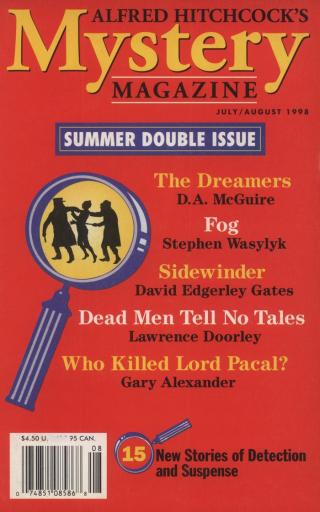
Alfred Hitchcock’s Mystery Magazine. Vol. 43, No. 7 & 8, July/August 1998
- Автор: Alexander Gary, Crawford Dan
- Год: 1998
- Язык: английский
- Год: Dell Magazines/Crosstown Publications
- ISBN: ISSN: 0002-5224
- Жанр: Другие детективы

Электронная книга - «Alfred Hitchcock’s Mystery Magazine. Vol. 43, No. 7 & 8, July/August 1998». Краткое содержание книги:
Martha had mixed emotions on reading the reviews. She was elated that “one of my authors” was such a spectacular success. But she would have loved to have her contribution recognized.
For not only had she spent many extra hours deciphering the scrawling handwriting and correcting the spelling, grammar, punctuation, she’d done an extraordinary amount of editing, something she had done very little of previously.
Writing in a white heat, Baxter frequently lost track of his dozens of characters. Ethan had departed in Chapter Three, permanently whalebound. Forty pages later, the dear innocent was duped by Sally Boggs. She whimpered that she was “with child.” Bewildered but gullible, poor Ethan married Sally, the nuptials performed by a ship captain, the waterfront evangelist responsible nowhere to be found.
Oh, for heaven’s sake, Martha had moaned, another flagrant mistake. She phoned Baxter. Let her marry one of the cousins, he told her (there were dozens of Easterfields). But major problems occurred again and again. Martha phoned, usually found Baxter with a chip on his shoulder. Finally he ordered her to type the manuscript just as it was.
“It’s not going to sell anyway,” he told her. “And if by some crazy chance it does, the editor will straighten it out. That’s what they get paid for.”
But conscientious Martha (“I’d be ashamed to send it to a literary agent like it is.”) kept bringing order out of chaos, which cost her many, many exasperating hours.
In 1991, before the fateful night when six million dollars went over the bridge, Lillian’s New York Style Hair Salon was going great.
Not only was it revered for excellence in hairdressing, it was held in high esteem for its preeminence in the field of scandal and gossip. Lil — a big, buxom, boisterous divorcee with a heart as big as her bosom — had a horde of relatives in city and county offices. They kept her up to date on the latest shenanigans in government. And her devoted patrons contributed their share. Very little happened in the whole county that escaped Lil’s network.
That took care of the local stuff. National and international high-jinks were covered by the four weekly tabloids to which Lil subscribed. Royals Cavort Topless or Batty Billionaire Marries Great-grandson’s Babysitter — Lil’s enthralled patrons got the news hot off the press. No wonder it was called Gossip Heaven.
Martha:
The metamorphosis was nearly complete. She was no longer the shy, skinny, slouchy, mousy-haired mollycoddle of December 1975. But while Virtue is its own reward had finally been overtaken by Charity begins at home, she still retained a steadfast belief in the fundamental virtues. Those virtues were about to be severely tested.
Proud of her accomplishments in the manuscript work and for having actually written a novel, she nevertheless still had feelings of insecurity, especially when thinking of Ginny Barnes. But she shouldn’t have felt insecure, for she was now an attractive woman. Lil had perfected a style that brought out the highlights in Martha’s brown hair but also pleasingly framed her high forehead, her brown eyes, her nice nose.
Lil had done more. She had nagged Martha into putting on weight, standing straight, and watching her carriage. Thus by early 1991 Martha had added eighteen pounds to her tall frame. Hardly voluptuous, she would still make some lucky man a well-rounded, cuddly, curvy armful. She hoped and prayed the man would be wonderful Walter.
There were other changes. The faithful Remington had been replaced by an “IBM Comp/HP Pmt.” Fees had gone to “$1.25 ds pg + P&H.” She was now “nationally known, accepts only novels,” but “handwrtn/rough type mss” were still accepted. One never knew what treasures lurked behind pathetic penmanship.
By the fateful night of April 15, 1991, Martha had twenty-five thousand six hundred seventy-five dollars in certificates of deposit in the bank. And if she hadn’t been forced to turn down manuscripts to work on her novel, she might have had the sixty thousand dollars for her mother’s condo.
Another change: since the whole town knew of Martha’s success, J. L., scared to death of losing his jewel, had raised her salary three times.
Martha had concentrated on her novel for the last four years, accepting only an occasional manuscript, one requiring a minimum of editing. She still couldn’t resign herself to being a mere typist. Every completed manuscript had to be one she could be proud of.
She had desperately hoped that the novel would sell; then there would be plenty of money for the condo. But it hadn’t sold. And she hadn’t hit the lottery (she played five dollars a week, the same numbers). But in the midst of all the gloom, there appeared the silver fining, Walter Foster taking over the West End route. His workweek was Tuesday through Saturday — a female substitute took over on Monday. And since Martha had the weekend off, she now had a heaven-sent opportunity to see him every week, even if for only a few moments. When word reached her that Walter would be taking over the route, she wrestled with her conscience. It lost. (“I’m losing all my principles,” she said sadly.) For though she received a lot of mail, it would be tragic if there was none on a particular Saturday.
She phoned the postmaster, said that she would always have stamped mail to be picked up on Saturday. Please have the mailman stop every Saturday.
Thus, beginning on the third Saturday of June 1990, her mother at the supermarket, Martha stood at the front window, peeping around the edge of the curtain, shivering all over in the pleasant summer heat. She was prepared. Lil had done her part, Martha having a nine A.M. appointment. She had bought a lovely blue blouse and a matching skirt but had reluctantly passed up Unbridled at the boutique in the mall in favor of a less potent perfume, Summertime.
The magic moment arrived, twelve fifteen. Her knight in postal armor opened the gate, came up the walk onto the porch, and rang the doorbell. Martha, smothering a little squeal, managed to open the door and come out on the porch, holding two letters in a shaky hand.
“My, Martha, how nice you look,” Walter exclaimed as he took the letters. “Well, I mean, that is... you do look nice.” Then he blushed. He was forty-six years old. He could still blush. No wonder all the women on his long route were crazy about him.
Martha giggled just like a teenager.
“Oh, how kind of you, Walter,” she said as she too blushed. “Isn’t it a gorgeous day?”
“Yes, it is,” agreed Walter.
Seventh heaven had come to 146 Chestnut Street. It was a brief seventh heaven. After all, there are regulations. But it was heavenly, out of this world. Walter always complimented Martha on how nice she looked. She glowed. Then they talked of the weather, then of books. What was he reading? And how was her novel coming?
Her novel, Appalachian Elegy, wasn’t doing well. It had undergone four rewrites; rewrite by rewrite, the writing became more and more akin to Harry Baxter’s style. It wasn’t intentional. It just began to come naturally.
Mr. Harry Baxter could almost accuse me of plagiarizing his style, she thought after the last rewrite. But it’s my plot. I’m proud of it. But I’m also getting pretty sick of it. I’m not going to change another word. Out it goes.
It went out five times, was rejected five times, each time with a short personal note, the gist being it didn’t meet “current needs.” She was wished well in “placing it elsewhere.”
Poor Martha, choking back her disappointment, always wrote a thank-you note. She sent it to a sixth publisher in the fall of 1990. It was gone for months, no word. In late February she wrote a pleading note, “Any news on my manuscript, Appalachian Elegy?” Yes there was news, bad. It came limping back in March, rejected once again. Another note: “We gave your manuscript a lot of thought. And though we regard it as a splendid effort, we just cannot take a chance on another first novel, since we already have an unusually large number on our schedule.”