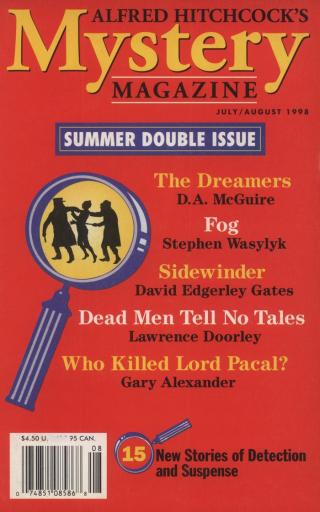
Alfred Hitchcock’s Mystery Magazine. Vol. 43, No. 7 & 8, July/August 1998
- Автор: Alexander Gary, Crawford Dan
- Год: 1998
- Язык: английский
- Год: Dell Magazines/Crosstown Publications
- ISBN: ISSN: 0002-5224
- Жанр: Другие детективы

Электронная книга - «Alfred Hitchcock’s Mystery Magazine. Vol. 43, No. 7 & 8, July/August 1998». Краткое содержание книги:
Poor Martha, wringing her hands, tried not to cry.
“Please, Mother,” she begged, “don’t you understand why I did it? It seems a wonderful way to earn extra money. And it wasn’t a spur of the moment thing. I thought about it for a long time. Why can’t we give it a chance? And just for once, Mother, can’t you compliment me for doing something that shows I do have some of the spunk you keep telling me I lack? Please, Mother, don’t be so terribly critical.”
Her daughter’s imploring tone caused Helen to ease up.
“Well, what’s done is done. I’m not saying another word except to predict that it will turn out to be a hundred and fifty dollars thrown away.”
“I hope not, Mother, I hope not,” poor Martha managed.
The ad appeared in the March 1976 issue. Martha cringed as she read it. How did I ever have the courage to take such a gamble? What if it turns out to be a failure? Will I ever have enough confidence to do anything out of the ordinary? Oh, dear Lord, please, please, please tell someone to send me a manuscript.
The poor Lord; he had his hands full elsewhere, everywhere. No manuscript appeared at 146 Chestnut Street. March sped by, April came, the little creek rose higher with the spring rains.
“Nope, nothing but junk mail,” was her mother’s curt greeting when Martha arrived home at five fifteen every evening.
“Maybe tomorrow will bring good news,” Martha would say.
“That’ll be the day,” her mother usually snapped.
By the middle of April it looked hopeless. The time was approaching for renewing the ad, giving it another three months. That was out of the question; the wonderful idea had turned into a pipe-dream. Never again would she have enough courage to take a chance.
Then, thank God, exactly a week before the deadline for renewal, Martha came home to stunning news. A manuscript had arrived.
“And Herman wasn’t too happy about it,” her mother said. “He’s already got enough packages.”
Herman was Herman Means, the grouchy mailman. The hell with Herman, a normal person would have exclaimed. Not Martha.
“Oh, poor Herman, it must be his bunions again. But, Mother, where is the package? And can it really be a manuscript?”
“There it is, on the table. It looks like a manuscript. Ten to one it’s from some deadbeat expecting you to type the thing for nothing.”
Helen was dead wrong. The beautifully scripted “handwrt ms” was from an eighty-eight-year-old widow of a West Virginia coal operator. It was entitled Grandma’s Wildcat Hollow Years.
In a witty, chatty letter Grandma explained that “my twenty-nine grandchildren have been after me for years to write down what it was like back in ‘the good old days’ when we were dirt poor but lived so far off the beaten path we didn’t realize how hard up we were.”
A check for five hundred dollars was enclosed. Martha let out a choked whoop.
“What’s wrong?” her mother demanded.
“Nothing, Mother. But look, the dear woman sent a check for five hundred dollars. I’m sure she overpaid. But isn’t it wonderful?”
Her mother saw it differently.
“Ha. That check will probably bounce.”
It didn’t bounce, thank goodness, for Martha had taken another gamble. Using her first earnings — Grandma’s payment — she sent another hundred and fifty dollars to the magazine.
It took Martha longer than it should have to type Grandma’s eighty thousand word manuscript. A less sentimental typist would have knocked off three or four hours. Soft-hearted Martha had to stop to wipe away the tears at such passages as:
“The rattlesnake bite proved fatal, and we buried the dear little four-year-old tomboy in a field of waving dandelions as a chorus of black crows cawed a requiem from a dying chestnut tree. We hollow dwellers would have starved without dandelions, but I never picked another one from that field.”
There were dozens of such stories. Grandma had a wonderful memory, a lively, uninhibited writing style. Deliriously happy, Martha mailed the completed manuscript — 320 ds pg — plus a check for two hundred sixty dollars, explaining that the bill came to only two forty. She thanked Grandma “from the bottom of my heart for trusting a total stranger with your beautiful reminiscences.”
Grandma wrote back. She praised Martha for a superb job, promised to send her a copy when the book came from the printer. And she returned Martha’s check, writing that “you deserve it for having far exceeded my expectations. And I can afford it. We had many tough years, but my dear, stubborn husband wouldn’t quit. I’m ashamed to say, Miss Ainsley, that I’m filthy rich.”
Martha cried for a long time after receiving Grandma’s letter. Maybe I’ve found my niche; maybe I can still amount to something. And wouldn’t Daddy be proud of his little girl?
In due time Grandma’s book arrived. It was a gorgeous book, with wonderful illustrations by Grandma. Martha clutched it to her small bosom as tears coursed down her cheeks. Thank you, dear Grandma, thank you. And thank you, dear Lord, thank you.
By the time Grandma’s book arrived, Martha had received and typed four more manuscripts. She was ecstatic. Her mother, doing her best to conceal her amazement at how well the mad idea seemed to be working out, reminded Martha that it was too early to call the venture a success.
“And I hope you’re not getting so carried away as to think about leaving your steady job. Remember, Martha, a bird in the hand is worth two in the bush.”
Martha, happy as a lark, knew that.
“Of course I have no intention of leaving the agency,” she said. “But you must admit that if I only type one or two manuscripts a month, the extra money will be a big help.”
“You’re forgetting the expense. There are the ribbons, the typing paper, the postage. It’s not all gravy.”
Martha shook her head. Will she ever change? she thought. She would.
In March 1977, a year after the ad first appeared, a jubilant Martha balanced the books. She had typed, corrected the “spl/punt/gram” of sixteen manuscripts. Eleven were novels, one a biography (Chester A. Arthur, Maverick Republican), two treatises by professors at Penn State, and of course Grandma’s delightful reminiscences of the good old days. The sixteenth was a rambling, amateurish tirade by a retired U.S. Congressman entitled The Decline of Integrity.
She had grossed two thousand nine hundred sixty-four dollars, been stuck for two hundred eighteen dollars by the congressman. Five letters to him — polite letters, the metamorphosis was still in the embryonic stage — had gone unanswered. Total costs, with six hundred dollars for the ads the largest expense, came to seven hundred twenty-one. Add in the uncollected two eighteen, the debits came to nine hundred thirty-nine dollars, leaving a profit of two thousand twenty-five.
The rash adventure had succeeded beyond Martha’s wildest dreams. And other benefits had accrued. Her mother had begun boasting about Martha at Lillian’s. And manuscript by manuscript, Martha was becoming more self-confident, and more amenable to Charity begins at home, a baleful refrain of her mother’s.
Having been cheated by the congressman, she now required payment before she mailed the completed work. And she had been inspired to finally start her novel.
Good heavens, she thought time after time as she labored through another pathetic manuscript, I can do better than that. In fact one of the novels — one hundred thousand dismal words — was so hopeless, so inept (Oh you poor, poor deluded person, she’d thought) that she came within an eyelash of returning it posthaste with the excuse that she was too busy.
But if I do that, it’ll simply be sent to another typist, and I’ll lose over three hundred dollars. She typed it. Slowly, ever so slowly, the metamorphosing stew was beginning to gurgle and simmer.