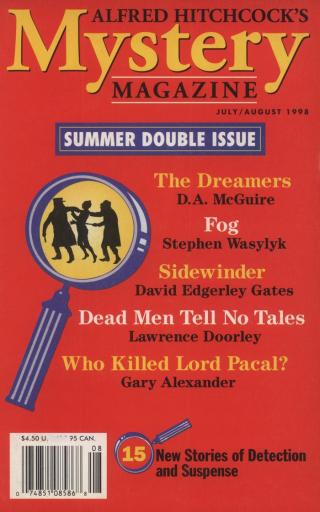
Alfred Hitchcock’s Mystery Magazine. Vol. 43, No. 7 & 8, July/August 1998
- Автор: Alexander Gary, Crawford Dan
- Год: 1998
- Язык: английский
- Год: Dell Magazines/Crosstown Publications
- ISBN: ISSN: 0002-5224
- Жанр: Другие детективы

Электронная книга - «Alfred Hitchcock’s Mystery Magazine. Vol. 43, No. 7 & 8, July/August 1998». Краткое содержание книги:
They bought a pretty Cape Cod on a tree-lined street near the city park. David loved his work, his students loved him. He volunteered at the library and the humane society, became a good Samaritan for old people too feeble to rake their autumn leaves or shovel the winter snows. And when their daughter was born in 1951, he devoted as many hours as possible to her. He began to think of writing a novel. Life was pleasant.
Not for Helen. Although she loved her little daughter and made determined efforts to be a happy housewife, she couldn’t keep from feeling that David had let her down.
As the years went by, father and daughter became dear friends. Helen went through the motions but couldn’t get over her bitterness. Then, on a hot sunny morning in August 1964 when Helen and Martha were at the supermarket, the phone rang. Mrs. Newcomer, an octogenarian widow who lived up the street, was distraught. Nameless, her cat, had once more climbed the big oak in her back yard and, as usual, was afraid to come down.
“He’s up there wailing pathetically, David,” Mrs. Newcomer said. “And I hesitate to call the police, they’re so shorthanded. Do you think...”
“I’ll be right up, Mrs. Newcomer,” David assured her, confident that, like the other times, he’d have no trouble getting Nameless down. But this time Nameless had gone higher. Meowing forlornly, he cowered at the end of a large limb. It looked strong. It wasn’t. With a crack like a bolt of lightning, it broke. Nameless landed safely. David wasn’t as lucky. He landed headfirst in the widow’s rock garden.
The whole town took it hard. Helen and Martha were grief-stricken, especially Martha. She cried for days. The poor girl — she’d lost the greatest father a girl ever had. She was thirteen, tall, shy, gangly, a bright girl with a high forehead, brown eyes, dull brown hair. There’d be many, many sad days ahead.
Helen’s grief soon turned to anger. David Ainsley, the brilliant catch, had proved a dismal failure. Not only was there no fortune, but he had been content to be an underpaid assistant professor at a backwater college while being a good Samaritan to every Tom, Dick, and Harry instead of writing the novel he had planned.
His death meant she had to go back to work. She became a lowly file clerk in the County Building, and was lucky to get even that. It was bad, but it could have been worse. David had mortgage insurance. That paid off the pretty Cape Cod on Chestnut Street. He also had a small life insurance policy with the college. When the funeral expenses were paid, there was twenty-two hundred dollars left. That didn’t make Helen any less bitter.
The years passed, bringing little joy to Hillsdale, to the whole county. The coal had all been worked out, the coke ovens shut down, and by December 1975, layoffs in all departments had reduced services to a dismal level. Even the library, a combination county-city facility, had suffered. It no longer opened at night, was down to three paid employees from a high of ten in the good old days, and was kept operating through the efforts of volunteers. It couldn’t afford to be computerized. If there had been any money, it would have gone to a new bookmobile (the current one was long overdue at the scrap yard). And year by year new leaks appeared in the roof; more and more buckets were required to catch the dripping drops.
Helen Ainsley hadn’t escaped downsizing. By the winter of 1975 she had reached the lowest point of her life. She was a part-time employee of the credit bureau, paid the minimum wage. She was tough to live with.
She was forty-nine, still a damn goodlooking woman, still had her hair done every ten days at Lil-Han’s New York Style Hair Salon (Martha went every two months). And though the pickings were pitiful in Ashford County, Helen had been wooed by two suitors. Neither had met her requirements: plenty of money, reasonable age and looks, and a desire to move to Florida. Besides, there was always that aching feeling for her first love, the boy she let get away; wonderful, wonderful Steve.
Martha was twenty-four in December 1975, a little taller, a little thinner, a little shyer, a little sadder. Only one boy had wooed her, a tall, shy assistant librarian at the community college. He had faded away, unable to cope with Helen, who regarded him as another dreamer, a duplicate of her failed husband.
With her father’s death Martha’s dreams of college vanished. She did well in high school, then took the year’s course at Miss Mason’s Business School, and in December 1975 was employed as the office manager and general factotum, which involved chores usually delegated to a cleaning woman — the sole employee at J. L. Henderson Real Estate and Insurance on Main Street.
It had been a bad year. In addition to Helen’s having sunk to the lowest rung on the ladder, the pretty Cape Cod had suffered some major blows. The furnace had expired in March and the washer in June, and an October storm had tom half the shingles off the roof. Then the ten-year-old car began making funny noises.
Helen was beside herself. They were doomed, they would be on food stamps by summer. Martha, cowering under the gloomy onslaught, nevertheless tried to put a better fight on the situation. In addition to a fine new furnace, the latest in washers, a lovely roof with a fifteen year guarantee, the car was sounding better than ever (it was the fan belt), and they still had over eight hundred fifty dollars in the bank.
No good.
“There you go again,” her mother snapped. “You’re your father all over, every cloud has a silver lining. But why do I waste my voice? I can’t even get you to stand up to that skinflint J. L. and demand he pay you what you’re worth. When are you ever going to realize that it’s a dog-eat-dog world, Martha, and if you don’t stand up for yourself, no one else will?”
So it went. Still, there was some justification for Helen’s complaints. Had Martha been employed in Pittsburgh, charged with the same duties, she would indeed have commanded a much higher salary. And J. L. could well afford to pay her more, for though the area’s boom days were long gone people still needed insurance, and affluent Pittsburghers were now buying second homes in the mountains east of town.
But it was not all woe and rue. The Cape Cod was only six blocks from the downtown office. Martha walked to work in all kinds of weather, the route taking her through the city park over the stone pedestrian bridge above the little creek.
In spring and summer birds sang, little animals scurried about, wildflowers bloomed. But when autumn came and the leaves began to fall, Martha often cried on her way to work. Another summer gone, I am a year older (her birthday was in June), just as miserable. Is this how I’m to spend the rest of my life? The poor dear girl.
Winter seemed to invigorate her. She began thinking about beginning a novel. And all during December 1975, goaded by her mother’s nightly jeremiad, she kept thinking of how she could earn extra money.
Then one cold morning it came to her. All bundled up, her step brisk, she suddenly thought of the Manuscripts Typed ads in the writers’ magazine to which she had subscribed to for years, just as her father had.
“That’s it,” she said, all excited. “I am an experienced typist, I’ve always been good in grammar. And think how exciting it would be, getting paid for typing manuscripts, mostly novels probably. Why, it might force me to finally begin my own novel. I’m going to do it. I am.”
She did. Now, the desperate deed done, came the dreaded moment when she had to tell her mother.
Helen was thunderstruck, absolutely thunderstruck.
“What? You mean to tell me that you, without consulting me, squandered a hundred and fifty dollars for an ad in that stupid writers’ magazine you and your father have wasted money on for years? I’m thunderstruck, absolutely thunderstruck.”