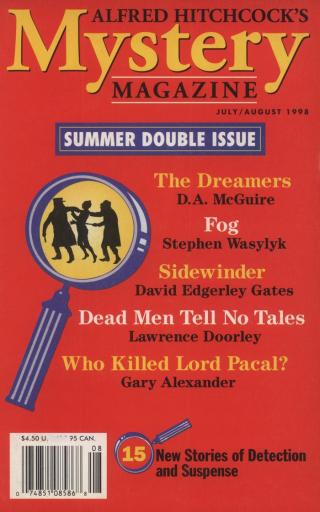
Alfred Hitchcock’s Mystery Magazine. Vol. 43, No. 7 & 8, July/August 1998
- Автор: Alexander Gary, Crawford Dan
- Год: 1998
- Язык: английский
- Год: Dell Magazines/Crosstown Publications
- ISBN: ISSN: 0002-5224
- Жанр: Другие детективы

Электронная книга - «Alfred Hitchcock’s Mystery Magazine. Vol. 43, No. 7 & 8, July/August 1998». Краткое содержание книги:
There was. She was almost forty. She was madly in love with Walter Foster, the wonderful mailman. She was close to losing him to a henna-haired hussy. With fate about to close the book on her last chance for happiness, she flung righteousness aside, spurred on by the terrifying realization that there would be no more chances.
All tales have a beginning. An arbitrary beginning for this tale would be December 1975, with most of the drama taking place in Hillsdale, the county seat of Ashford County in the worked-out bituminous coalfields of southwestern Pennsylvania. That was almost sixteen years before Martha became involved in the six million dollar scheme from which thirty-five thousand dollars would be hers. That, together with her savings, would be enough to buy her mother the Florida condo, plus leaving additional money to augment her mother’s Social Security.
With her mother no longer the obstacle in the battle for the divine letter carrier, Martha’s chances would be greatly improved. There had been frenzied competition for Walter Foster. No wonder. In a pathetic town like Hillsdale, mired in a permanent depression, a stalwart, handsome bachelor like Walter with a steady job, a fine pension someday, and a widowed mother with failing eyesight and a bad heart naturally attracted a lot of attention.
But by the spring of 1991 (Walter’s mother died in September 1989) there were only two candidates left. All the others — mainly motherly types, great cooks, super seamstresses, spick and span housekeepers — had bowed to bitter reality. Walter Foster (no mother ever had a more devoted son) did not want another mother. He was forty-seven, had led a monastic life. Who could blame him for wanting to make up for lost time?
Martha Ainsley and Ginny Barnes were the surviving candidates. By the crucial month of April 1991, the once shy, skinny, slouchy, mousy-haired Martha had undergone an extraordinary metamorphosis. She now had a lot to offer. But she still had her mother, a sixty-four-year-old millstone.
Ginny Barnes had a mother, but she lived in Florida with her third husband. Ginny had other things going for her. She was divorced, childless, a green-eyed, henna-haired vamp with outstanding physical attributes. In Walter Foster she saw everything that a twice-divorced, late thirty-something girl could hope for. She was determined to beat out Martha Ainsley.
The first step in Martha’s eventual transformation had been taken simply to earn some extra money. Just before Christmas 1975 (bleak as usual), her hand shaking, the dear girl wrote a check for a hundred and fifty dollars for a three-month ad — the minimum accepted — in the Manuscripts Typed section of a national writers’ magazine. A shrinking violet (“Just like your father,” her mother nagged, “afraid to toot your own horn.”) she squirmed and blushed before coming up with:
“Bus schl grad/yrs sect exp/prompt service/spl/punct/gram. 75¢ ds pg. All states welc/all types mss include handwrt/rough type. Free copies/free post.”
By charging only “75¢ ds pg,” promising “gram,” offering “free post” she hoped to gain an advantage over the other typists, all of whom advertised 85¢ ds pg plus post and only “some gram.”
That was the beginning of a long, tortuous metamorphosis, a metamorphosis involving her mother, Uncle Sam, Lady Luck.
Her mother began it. Forever bemoaning her late husband’s failure, endlessly predicting that the welfare office loomed ever closer, Helen Ainsley finally drove her fainthearted daughter to do something unheard of: spend a small fortune, a hundred and fifty dollars, without consulting her.
Uncle Sam contributed the most vital ingredient, the quiet, handsome, bachelor mailman. Lady Luck’s contribution to the brew was to nudge Walter into calling tails when the postmaster threw the coin to determine which of the two eligible carriers would win the coveted transfer from a steep, hilly route to the very desirable West End route after grumpy Herman Means retired in June 1990.
It had come up tails. That brought two literature lovers, two devoted bibliophiles, into precious propinquity, even if for only a few moments a week. Walter’s father had died when the boy was only five, and his mother, a high school English teacher, had raised her son and had inspired him to read from an early age. By the time Walter took over the new route he had read hundreds of books, and during the last three years of his mother’s life, as her accelerating blindness made it impossible for her to read even the large print books, he had been reading to her night after night.
And Martha loved books. For many joyous years she and her beloved father, hand in hand, giggling and laughing, jumped over the cracks in the sidewalk on their way to the library on Saturday mornings.
There had been precious propinquity between Walter and Martha prior to June 1990, but it had lapsed when evening hours at the library were eliminated in 1975. Before that Martha was an eager volunteer three nights a week and had often checked out Walter’s books. They’d exchanged a few memorable words about the books and the authors, he had smiled that dear, boyish smile and thanked her. Those moments at the library were precious memories. Of course, since Hillsdale was a small town, she had seen Walter once in a while in the years between 1975 and 1990; in the supermarket, the drugstore, walking his mother in the park. Her heart would pound. He would smile. His mother would say a few words. It was wonderful, but it happened much too infrequently.
Helen Walowsky was a beauty, a ravishing blonde. She came from a family of hardworking coal miners, and by the time she was a junior in high school, she had vowed she would have a better life than her mother and her married sisters.
After graduation she got a job in the Register of Wills office in the County Building. By then the college boys — scions of the rich coal and coke barons from the mansions of LaFayette Terrace — had discovered her. She was the belle of the ball at the country club dances and she selected the boy most likely to inherit a huge fortune.
Tall, blond, blue-eyed David Ainsley had graduated from Yale with a Ph.D. in English literature. He lived with his widowed father on one of the more imposing estates. It had been built by his grandfather, who had grown rich in the coke industry (coke, a vital ingredient in steel manufacturing, is coal with the impurities burnt off).
Helen snared David in June 1949. He was twenty-seven, she was twenty-three. The wedding was held in St. Mark’s Roman Catholic Church. Later, at the country club, quite a number of the guests thought that while the bride was gorgeous and the groom handsome, the little tears that suddenly appeared when the bride murmured, “I do,” appeared to be sad tears, not happy tears.
They were sad tears, for Helen was thinking of the boy next door, her high school sweetheart Steve Zablonsky. Sobbing her heart out in early September following high school graduation, she had told Steve it could never be. She would never marry a coal miner. The work was too uncertain, the danger constant.
He took it hard, called her a damned gold-digger, and vowed to make her eat her words. He became a miner, determined to save his money, go to college.
David and Helen honeymooned in New York. As they were flying back to the Pittsburgh airport, David’s father, his vast fortune gone from bad investments, committed suicide. Unknown to David, the LaFayette mansion had two mortgages. After the bank foreclosed and the estate was probated, all that was left was four thousand dollars.
Helen was devastated. David, mourning his father, tried to convince her they still had much to be thankful for. A new community college was opening in the next county, and he thought there’d be a fine opportunity for him there. Which there was; he was hired as an assistant professor in the Eng-fish department.