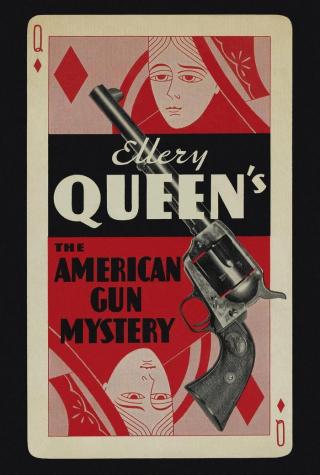
The American Gun Mystery (Death At the Rodeo)
- Автор: Куин (Квин) Эллери
- Серия: Ellery Queen #6
- Год: 1933
- Язык: английский
- Год: Frederick A. Stokes Company
- Жанр: Классические детективы

Электронная книга - «The American Gun Mystery (Death At the Rodeo)». Краткое содержание книги:
Sergeant Velie had just reported no luck in his ransacking of the room when there was a knock on the door, and Johnson opened it to reveal a badly frightened young man who wore the inevitable badge of servitude in his lapel, a carnation.
“Come in,” said Ellery heartily. “You say you were on duty yesterday evening. At what time do you come on?”
“Uh — at seven, sir!”
“Ah, at seven! How very fortunate. You’ve heard the news, I take it?”
The young man visibly shrank. “Y-yes, sir. About Mr. ... Mr. Horne. Frightful.” He glanced fearfully at Kit out of the corner of his eye.
“Well, now,” said Ellery expansively, “naturally we’re interested in possible visitors to Mr. Horne’s room during the past few days. Might give us a lead, you know. Were there any?”
Vanity being appealed to, the gentleman responded in the customary manner. He assumed a frowning air, scratched his forehead delicately with the tip of a womanish fingernail, and then the sun rose in his cheeks.
He exclaimed: “Yes, sir! Yes, I think... There was someone night before last, sir!”
“At what time?” asked Ellery quietly. Kit was very still, hands folded in her lap, and Curly did not stir on the bed.
“Oh, about half-past ten, sir. I—”
“Please. One moment.” Ellery turned to Kit. “What time did you say you returned to the Barclay night before last, Miss Horne?”
“Did I say? I don’t think — I said I got in late and found Buck already asleep. That’s true, Mr. Queen. I got in past midnight. I’d been out with Mr. Grant.”
“Mr. Curly Grant?”
“Yes.”
Mr. Curly Grant, who seemed to have something wrong with his throat, growled again.
“Go on, please,” said Ellery to the clerk. “There was a visitor at ten-thirty. And?”
“Mr. Horne entered the lobby about nine o’clock, sir, got his key at the desk — that’s how I know — and, I suppose, went upstairs. At ten-thirty a man stopped at the desk and asked for the number of Mr. Horne’s room. A man — I think it was a man, sir.”
“What d’ye mean — you think it was a man?” growled Sergeant Velie in his first oral contribution in some time. “Don’t you know the facts of life yet? Can’t you tell a man from a woman, or was there somethin’ queer about the guy?”
The clerk exhibited terror again. “N-no, sir, I don’t recollect anything but the — well, the vaguest kind of picture. You see, I was busy...”
“Can’t you recall anything of his appearance?” snapped Ellery.
“Oh, sir, he was sort of tall, I think, and big, and—”
“And?”
The clerk fell back against the door. “I can’t remember, sir,” he said feebly.
“Oh, botheration!” murmured Ellery. “Well! I suppose it can’t be helped.” Then hope glittered again in his eye. “Wasn’t one of your colleagues at the desk with you who might have noticed this man?”
“No, sir, I’m afraid not. I was alone at the time behind the desk.”
Sergeant Velie grumbled his disgust, and Ellery shrugged. “What else?”
“Why, I told him: ‘Mr. Horne’s in 841,’ and he picked up the house phone and talked. I heard him mention Mr. Horne’s first name in addressing him, and then I think he said: ‘I’ll be right up, Buck,’ and he went away.”
“First name? Hmm. That’s interesting. Went upstairs? To this room?” Ellery gnawed his upper lip. “But of course you wouldn’t know. Thank you. And please don’t mention this to a soul, man. That’s a command.”
The clerk backed out precipitately.
Ellery nodded to Sergeant Velie and to Johnson. “Ah... Miss Horne, we’ll leave you alone now. I hope I haven’t given you too bad a time. But it’s really been most helpful. Come along, boys.”
“I’m stayin’,” announced Curly defiantly.
“Please do, Curly,” whispered Kit. “I...I don’t feel like being alone. I don’t want to sleep...”
“I know, kid,” he muttered, and patted her hand.
Ellery and the two detectives silently left the room.
“Now, Johnson,” said Ellery with a snap, “don’t disturb those love-birds in there, and mind you keep an eye on both doors. You’ll have to park in the corridor all the rest of the night, I’m afraid. If there’s any irregularity call the Inspector at the Colosseum. He’ll send a relief soon.”
And Ellery tucked his arm between the Sergeant’s steer-like side and the Sergeant’s bludgeon-like arm, and the two men marched off like half of the four Musketeers.
11: The Impossible
It seemed to Ellery that several years had elapsed since he and Djuna and the Inspector had so blithely taken seats in Tony Mars’s box in anticipation of a naive evening. He paused to look at his watch as he and the Sergeant reentered the Colosseum. It was ten minutes past four.
“What on earth,” he demanded of his silent companion, “would we do without Herr Einstein? It took the incomparable Teuton to make us realize how fragile Time really is — what an insecure place it holds in the scheme of things, ‘Le moment ou je parle est deja loin de moi...’ I suppose you aren’t acquainted with Boileau? The seventeenth century satirist, ‘Le temps fuit, et nous traine avec soi—’”
“How you talk,” chuckled the Sergeant suddenly.
Ellery became silent with celerity.
They found — wonder of inestimable wonders! — the vast curving tiers of seats, which a few hours before had held twenty thousand, quite deserted. Except for the litter in the aisles, there was no sign of human occupancy. The fort had been evacuated — with trimmings — in something more than record time.
Except for the police, detectives, a few weary citizens, and the personnel of the rodeo, the Colosseum was empty.
“Wha’d you find?” croaked the Inspector, marble-gray with fatigue, as Ellery and the Sergeant entered the arena. Nevertheless he spoke with a certain eagerness.
“Nothing but this,” said Ellery, and produced the second revolver of the Horne pair. The Inspector seized it.
“Empty,” he muttered. “And it’s the twin, all right. Why’d he leave it in his room?” Ellery patiently explained. “Ah, then that’s out. Find anything else?”
“No papers or letters,” reported the Sergeant.
“A visitor,” reported Ellery; and repeated the testimony of the Barclay’s night-clerk. The Inspector went into the expected convulsion at the clerk’s deplorable lack of observation.
“Why, that visitor might have been Horne’s killer!” he cried, scowling ferociously. “And that mugg — Didn’t remember anything about him?”
“Tall and big,” said the Sergeant.
“Huh!”
“And now,” said Ellery, with a curious impatience, “tell me what’s happened here.”
The Inspector smiled bitterly. “Less than nothing. We’ve cleared the mob out, as you can see — got the last one on the street five minutes ago. And we didn’t find the .25 automatic.”
“You found no .25’s at all?” exclaimed Ellery.
“A half-dozen or so. Most of them about an hour ago. I sent ’em down to Knowles at Headquarters. He called me up a few minutes ago.”
“Yes, yes?”
“Not one of the .25’s we found in the crowd tonight, he says, could have fired the bullet that killed Horne!”
“Not one?”
“Not one. The right automatic hasn’t been found.”
“Well, well,” muttered Ellery, pacing up and down in the dirt. “A sweet state of affairs. I knew, I felt this would happen.”
“You know what I’m goin’ to do?” asked the Inspector presently, in plaintive tones.