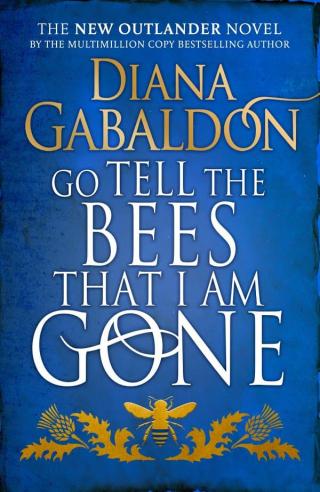
Go Tell the Bees That I Am Gone
- Автор: Гэблдон Диана
- Серия: Outlander #9
- Год: 2021
- Язык: английский
- Год: Delacorte Press
- ISBN: 978-1-473-51900-8
- Жанр: Исторические приключения

Электронная книга - «Go Tell the Bees That I Am Gone». Краткое содержание книги:
The past may seem the safest place to be . . . but it is the most dangerous time to be alive. . . .
Jamie Fraser and Claire Randall were torn apart by the Jacobite Rising in 1746, and it took them twenty years to find each other again. Now the American Revolution threatens to do the same. It is 1779 and Claire and Jamie are at last reunited with their daughter, Brianna, her husband, Roger, and their children on Fraser’s Ridge. Having the family together is a dream the Frasers had thought impossible. Yet even in the North Carolina backcountry, the effects of war are being felt. Tensions in the Colonies are great and local feelings run hot enough to boil Hell’s teakettle. Jamie knows loyalties among his tenants are split and it won’t be long until the war is on his doorstep. Brianna and Roger have their own worry: that the dangers that provoked their escape from the twentieth century might catch up to them. Sometimes they question whether risking the perils of the 1700s—among them disease, starvation, and an impending war—was indeed the safer choice for their family. Not so far away, young William Ransom is still coming to terms with the discovery of his true father’s identity—and thus his own—and Lord John Grey has reconciliations to make, and dangers to meet . . . on his son’s behalf, and his own. Meanwhile, the Revolutionary War creeps ever closer to Fraser’s Ridge. And with the family finally together, Jamie and Claire have more at stake than ever before.
“Vaguely.”
“Well, there are smaller things than that—subatomic particles—but nobody knows how many or exactly how they work. But while we were hearing about that in class, the instructor said something about how everything—everything in the universe and probably even if there’s more than one universe—everything is made of stardust. People, plants, planets … and stars, I suppose.
“‘Stardust’ not being a scientific term,” she added, just in case he’d thought it was. “Just that everything is composed of the same infinitesimal bits of matter.”
“Yes?”
“So what I’m thinking is … maybe that’s what happens when someone steps through a time place. I’m almost sure that it’s an electromagnetic phenomenon of some kind, because of the ley lines.”
“Ley lines?” He was surprised. “I wouldn’t think you’d be running into those in a physics class.”
She rolled a little, in order to look up at him. Her breath tickled the hairs on his chest and warmed his neck as she talked. She’d grown warm with talking; he could feel the vibration of words through her back as she spoke. It was curiously arousing.
“‘Ley line’ is kind of an informal term, but … you know that the earth’s crust is magnetic, right?”
“I can’t say I did, but I’m willing to take your word for it.”
“You may. And you do know that magnets are directional? Did you play with them as a kid?”
“You mean, positive end, negative end, and if you put the positive ends of two magnets together, they bounce apart? Yes, but what’s that got to do with ley lines?”
“That’s what a ley line is,” she said patiently. “The electromagnetism in the earth runs in parallel bands, and the bands alternate in the direction of their magnetic current. Though it’s not totally neat and tidy, of course. They diverge and overlap and like that. Haven’t I told you this stuff before?”
“Possibly.” He abandoned his half-formed amorous intentions, with a sense of regret. “But the ley lines I know about are … I don’t know what you’d call them, in terms of classification. Folklore, ancient builder stuff? At least in the British Isles, if you go looking at ancient hill forts and churches that are probably built on much older sites of worship and … well, things like standing stones, you often find that you can draw a straight—very straight, in most cases, as though it had been surveyed—line through two or three or four such sites. Archaeologists call those ley lines—though some folk call them spirit walks, because the dead are thought to … Oh, my God.”
A brief, uncontrollable shudder ran through him.
“Goose walking on your grave?” she asked, sympathy slightly marred by a look of satisfaction.
“Not everybody makes it,” he said, ignoring both sympathy and smugness. He pushed back the covers and sat up. “Through the stones. That’s what you mean? That the people who don’t go through, or don’t go through properly, turn up dead on these ley lines, leading to the not-unreasonable supposition that there’s something supernatural going on.”
“I hadn’t heard of spirit walks,” she admitted. “So I can’t say that’s what I mean—but it makes sense, doesn’t it?” She didn’t wait for him to admit it, but went on with her own line of thought.
“So … I’m thinking that the … time places … are maybe spots where different ley lines converge. If so, what happens to the electromagnetism in that spot would be really interesting, and it might be what … makes time be accessible? I mean, Einstein’s Unified Field Theory—”
“Let’s leave Albert out of it,” he said hastily. “At least for now.”
“All right,” she said agreeably. “Einstein never got it to work, anyway. All I’m saying is, maybe when you walk into one of those places—if you have the right genetics for it—you, um, die. Physically. You dissolve into stardust, if you want to call it that—and your particles can pass through stone, because they’re smaller than the atoms that make up the stones.”
Roger felt a distinct lurch in his insides at the memory of what it felt like. Being dead wasn’t putting it too strongly, but …
“But we come out again,” he pointed out. “If we die, we don’t stay dead.”
“Well, some of us don’t.” She’d sat up, too, arms curled around her knees. “If we believe Otter-Tooth’s journal and that skunk Wendigo Donner, some of their companions made it through the stones but came out dead. And there are all those incidents in Geillis Duncan’s journal—strange people, often in odd clothes—turning up dead near stone circles.”
“Aye,” he said, with the faint internal squirm that affected him when his green-eyed five-time-great-grandmother was mentioned. “So … you think you have a notion why that doesn’t happen to everybody.”
“I’m not sure it amounts to that much,” she admitted. “But it kind of goes along with what you were saying about what Christians believe—that we go on living after death. If you think about what it feels like”—she swallowed—“in there. You feel like you’re coming apart but you’re trying as hard as you can not to; to keep your—your sense of your body, I guess.”
“Yes,” he said.
“So maybe what we are in—there—is the immortal part of us; souls, if you like.”
“As a Christian minister, I like it fine,” he said, trying for some semblance of normality in this conversation. Like it or not, he was remembering that spectral cold, and the skin down his arms and legs prickled with gooseflesh. “So …?”
“Well, see, I think that’s maybe where the gemstones come in,” she explained. She moved closer to him, putting a warm hand on his bare and prickling leg. “You know what it feels like when they burn up—when the chemical bonds between their molecules, or maybe their atoms or subatomic particles, are breaking. And when you break a chemical bond, it releases a lot of energy. Since it’s releasing that energy inside our—our clouds of dissolving stuff, maybe …?”
“Maybe that’s what keeps the bits of our bodies together, you’re saying?”
“Mm-hm. And—this just occurred to me …” She turned to him, eyes widening. “Maybe you can lose a few bits in transit, but still make it out—just with a little damage. Like an irregular heartbeat.”
Neither of them spoke for a bit, contemplating.
“You are hiding that book, right?” he asked. This discussion was disquieting enough; thought of having the same discussion with Jemmy made his stomach turn over.
“Yes,” she assured him. “I was hiding it in the bottom of my sketchbox, but even Mandy knows how to open that now.”
“Maybe they wouldn’t be interested. I mean, it’s not got a title or pictures …”
She shot him a sharp glance.
“Don’t you believe it. Kids snoop. I mean, maybe you didn’t, being a goody-good preacher’s lad …” She was laughing at him, but dead serious underneath. “But I went through my parents’ stuff all the time. I mean, I knew what size my mother’s brassieres and panties were.”
“Well, that would have been well worth knowing … No, I did, too,” he admitted. “Not about the Reverend’s underpants—he wore long johns, with buttons, year-round—but I learned a lot of really interesting things I wasn’t supposed to know, mostly about the Reverend’s congregation. He gave me my dad’s letters from the War when I was about thirteen—but I’d read them two or three years before, from his desk.”
“Really?” she said, diverted. “Did you wear long johns with buttons, too?”
“Me and every other young lad in Inverness in the 1940s. You know how cold it gets up there in winter—but actually, when I was about thirteen, I found a trunk of my dad’s old RAF uniform stuff that they’d sent home when he—disappeared.” He swallowed, stabbed by the unexpected memory of the last time—and it was the last, he was sure—he’d seen his father. “There were a few pairs of underpants amongst the other things; the Reverend told me the fliers called them ‘shreddies,’ God knows why—but they looked like what you’d call boxer shorts. I took to wearing those, in the summers.”