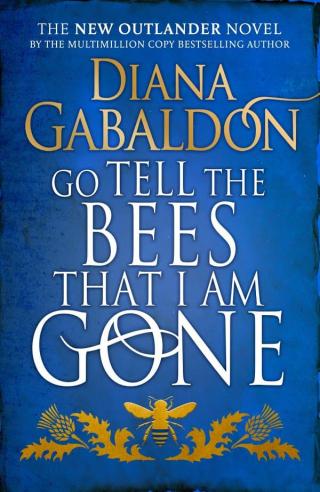
Go Tell the Bees That I Am Gone
- Автор: Гэблдон Диана
- Серия: Outlander #9
- Год: 2021
- Язык: английский
- Год: Delacorte Press
- ISBN: 978-1-473-51900-8
- Жанр: Исторические приключения

Электронная книга - «Go Tell the Bees That I Am Gone». Краткое содержание книги:
The past may seem the safest place to be . . . but it is the most dangerous time to be alive. . . .
Jamie Fraser and Claire Randall were torn apart by the Jacobite Rising in 1746, and it took them twenty years to find each other again. Now the American Revolution threatens to do the same. It is 1779 and Claire and Jamie are at last reunited with their daughter, Brianna, her husband, Roger, and their children on Fraser’s Ridge. Having the family together is a dream the Frasers had thought impossible. Yet even in the North Carolina backcountry, the effects of war are being felt. Tensions in the Colonies are great and local feelings run hot enough to boil Hell’s teakettle. Jamie knows loyalties among his tenants are split and it won’t be long until the war is on his doorstep. Brianna and Roger have their own worry: that the dangers that provoked their escape from the twentieth century might catch up to them. Sometimes they question whether risking the perils of the 1700s—among them disease, starvation, and an impending war—was indeed the safer choice for their family. Not so far away, young William Ransom is still coming to terms with the discovery of his true father’s identity—and thus his own—and Lord John Grey has reconciliations to make, and dangers to meet . . . on his son’s behalf, and his own. Meanwhile, the Revolutionary War creeps ever closer to Fraser’s Ridge. And with the family finally together, Jamie and Claire have more at stake than ever before.
I was nearly dead with fatigue and the aftermath of strong emotion; I couldn’t imagine how Brianna, let alone Roger, was still on her feet, but I’d seen them on my way back to the house, wrapped in each other’s arms and kissing in the shadow of a big black walnut. I wondered vaguely whether the profound emotion of ordination normally turned into sexual desire, if the legitimate object of it was at hand … and what young, new Catholic priests might do to express their own elation?
I shed my clothes and pulled a clean night rail over my head, sighing in quiet ecstasy at having nothing but air on my corset-constricted body. My head popped out and I saw Jamie, lying on the bed in his own shirt. His head was cocked toward the window and he looked rather wistful; I wondered whether he’d rather be down there dancing—but I couldn’t imagine why he wouldn’t be there, if that was the case.
“What are you thinking?”
He looked up and smiled at me. He’d undone his formal queue and his hair lay over his shoulders, sparking in the candlelight.
“Och … I was just wondering whether I shall ever hear Mass said again.”
“Oh.” I tried to think. “When was the last time? At Jocasta’s wedding?”
“Aye, I think so.”
Catholicism was prohibited in most of the colonies, bar Maryland, which had been founded specifically as a Catholic colony. Even there, the Anglican Church was the official Church, and Catholic priests were few and far between in the southern colonies.
“It won’t always be like this,” I said, and began to massage his shoulders, slowly. “Brianna’s told you about the Constitution, hasn’t she? It will guarantee freedom of religion—among other things.”
“She recited the beginning of it to me.” He sighed and bent his head, inviting me to rub the long, tight muscles of his neck. “‘We, the people …’ Brawly written. I hope to meet Mr. Jefferson someday, though I think he might have stolen the odd phrase here and there, and some of his ideas have a familiar ring to them.”
“Montesquieu might have had some minor influence,” I said, amused. “And I believe I’ve heard John Locke spoken of as well.”
He glanced over his shoulder at me, one brow raised.
“Aye, that’s it. I shouldna have thought ye’d read either one, Sassenach.”
“Well, I haven’t,” I admitted. “But I didn’t go to school in America; only medical school, and they don’t teach you history there, bar the history of medicine, where they point out horrible examples of benighted thinking and horrific practices—virtually all of which I’ve actually used now and then, bar blowing tobacco smoke up someone’s bottom. Can’t think how I’ve missed that one …” I coughed. “But Bree learned all about American history in the fifth and sixth grades, and more in high school. She’s the one who told me about Mr. Jefferson’s light-fingered ways with words.
“But then, there’s Benjamin Franklin—I think at least some of his quotes were original. I remember, ‘You have a republic … if you can keep it.’ That’s what he said—will say—at the end of the war. But they—we—did keep it. At least for the next two hundred years. Maybe longer.”
“Something like that is worth fighting for, aye,” he said, and squeezed my hand.
I put out the candle and slid into bed beside him, every muscle in my body dissolving in the ecstasy of simply lying down.
Jamie turned onto his side and gathered me against him and we lay comfortably entwined, listening to the sounds of celebration outside. Quieter now, as people began to stagger home or to find a peaceful tree or bush to sleep under, but the music of a single fiddle still sang to the stars.
129
The Pursuit of Happiness
IT TOOK WILLIAM ROUGHLY three seconds to conclude that he meant to go after Amaranthus, and the rest of the day was a search for the means of her departure. He didn’t know how long she’d been planning her disappearance—probably since I came back from Morristown, he thought grimly—but she’d done a good job of it.
He came home in the evening, having concocted a plan—if you could call it that—and proceeded to convince a very dubious uncle and father of its virtue over supper.
“Whether she went by horse, carriage, or ship, I think she must be heading for Charles Town.” He hesitated, but there was no reason not to tell them. “When I mentioned Banastre Tarleton—when Charles Town fell—she remarked that she knew him. Which I suppose means that he also knew—or knows—Ben.”
“He did—does,” Hal said, surprised. “Quite well, in fact. For a short time, they were in the same company—Ban and Ben, people called them. You know, for a joke.”
“Well, then,” William said with satisfaction. “Amaranthus knows that Ban is in Charles Town with Clinton. If she thought she needed help or protection on her way … would she not go to him?”
“It’s a thought,” said his father, though he looked dubious. “Clearly, she didn’t take much time to prepare.”
“I don’t know that she didn’t,” William said dryly. “She may have been planning it even before I came back. Or thinking about it, at least. Regardless of how she went, though, she can’t have got that far yet. I may be able to overtake her on the road, and if by chance I don’t, Ban may well have seen her—or contrived the next part of her passage. I don’t imagine he knows yet. About Ben, I mean. If not, and if she told him she meant to go to Ben—without saying exactly where he is—Ban would certainly help her.”
A brief stab of pain showed on Uncle Hal’s face, but was brutally suppressed in the next moment.
“And what do you propose doing, if you find her?” he said, his voice rasping. “Carry her back here by force?”
William lifted one shoulder, impatient.
“I’ll find out what the devil she actually means to do, for one thing,” he said. “She may be going to her father’s house in Philadelphia, and if she is—I’ll see that she gets there safely. If it’s Ben …” He paused, briefly recalling his harrowing escape from Morristown. “I’ll take her to Adam,” he concluded. “He’ll see that she’s safe, and if she does mean to go to Ben …”
“Jesus. Does Adam know?” Hal’s voice cracked and he coughed. William saw his father glance sharply at Hal and move toward the bell to summon a servant.
Hal frowned at him and made a sharp gesture to stop him.
“I’m fine,” he said shortly, but the last word had to be forced out, and his breathing was suddenly stertorous.
“The devil you are,” Papa said, and grabbed Uncle Hal by the elbow, hauling him to the sofa and pushing him down upon it. “Willie, go and tell Moira to boil coffee—very strong and lots of it—and now.”
“I’m—” Hal began, but broke off, coughing. He’d pressed his fist into his chest and was turning a nasty color that alarmed William.
“Is he—” he began. His father turned on him like a tiger.
“Now!” he shouted, and as William hurtled from the room, he heard his father call after him, “Get my saddlebags!”
The next few hours passed in a blur of activity, with people running to and fro and fetching things and making anxious, stupid suggestions, while Hal sat on the sofa holding Papa’s hand as though it were a rope thrown to a drowning swimmer, alternating between blowing air, gasping, and drinking black coffee with some sort of herb crumbled into it that Papa had dug out of his saddlebags.
William, not knowing how to help, but unwilling to just go to bed, had lurked in the kitchen, carrying more hot coffee as needed, but mostly listening to Moira and Miss Crabb, from whom he learned that the duke suffered from something called asthma and that (lowered voices, with a cautious glance over the shoulder) Lord John’s wife-but-she-wasn’t-really-and-the-things-folk-said-of-her was a famous healer and had given Lord John the little dry sticks to put in the coffee.