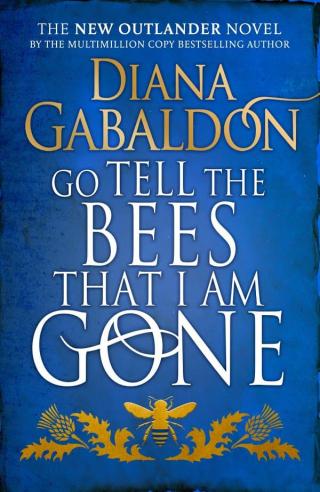
Go Tell the Bees That I Am Gone
- Автор: Гэблдон Диана
- Серия: Outlander #9
- Год: 2021
- Язык: английский
- Год: Delacorte Press
- ISBN: 978-1-473-51900-8
- Жанр: Исторические приключения

Электронная книга - «Go Tell the Bees That I Am Gone». Краткое содержание книги:
The past may seem the safest place to be . . . but it is the most dangerous time to be alive. . . .
Jamie Fraser and Claire Randall were torn apart by the Jacobite Rising in 1746, and it took them twenty years to find each other again. Now the American Revolution threatens to do the same. It is 1779 and Claire and Jamie are at last reunited with their daughter, Brianna, her husband, Roger, and their children on Fraser’s Ridge. Having the family together is a dream the Frasers had thought impossible. Yet even in the North Carolina backcountry, the effects of war are being felt. Tensions in the Colonies are great and local feelings run hot enough to boil Hell’s teakettle. Jamie knows loyalties among his tenants are split and it won’t be long until the war is on his doorstep. Brianna and Roger have their own worry: that the dangers that provoked their escape from the twentieth century might catch up to them. Sometimes they question whether risking the perils of the 1700s—among them disease, starvation, and an impending war—was indeed the safer choice for their family. Not so far away, young William Ransom is still coming to terms with the discovery of his true father’s identity—and thus his own—and Lord John Grey has reconciliations to make, and dangers to meet . . . on his son’s behalf, and his own. Meanwhile, the Revolutionary War creeps ever closer to Fraser’s Ridge. And with the family finally together, Jamie and Claire have more at stake than ever before.
“I did.” Lord John was swaying a little on his feet—clearly the inch of brandy just consumed was only the icing on his evening’s cake—but his eyes were clear, if bloodshot, and met William’s with a quizzical approval. “You should be certain, though.”
“I know,” William said. “I’m only thinking.”
“It’s not a bad time to rejoin,” his father said judiciously. “You want to get in before the fun’s over, I mean. Cornwallis says the Americans won’t last another winter. Bear that in mind.”
“I will,” said William, smiling. His own level of intoxication wasn’t much below his father’s and he felt a warm benevolence for the army, England, and even my lord Cornwallis, though he normally considered that gentleman to be a tiresome nit. “Good night, Papa.”
“Good night, Willie.”
THE BEGINNING OF a battle is usually much better defined than its ending, and even though Charles Town concluded with a formal and unconditional surrender, the aftermath was, as usual, long, drawn out, complicated, and messy.
The flood of dispatches did not abate, though the ratio of excitement to tedium dropped considerably. More parts of the Savannah garrison were indeed carved off and sent north—but to guard prisoners and escort them to prison hulks or other insalubrious quarters, rather than to join in glorious battle.
“At least at the end of our siege, Lincoln took his army off with him,” William remarked to his father and uncle. “Less to tidy up, I mean.”
“Took them off north so Cornwallis could bag them all, you mean.” Uncle Hal was inclined to be snappish, but William had been around soldiers for the majority of his life and recognized the poisonous slow sapping nature of tension that could not be discharged in a good fight, resulting in prickliness and disgruntlement.
“At least Ben wasn’t there,” Uncle Hal added, in a tone that made Papa look sharply at him. “Save me having to shoot him myself to keep him from being hanged.” One corner of his mouth jerked up, in an apparent attempt to make this sound like a joke. Neither his brother nor his nephew was fooled.
A muffled gasp from the door made all three men glance round, to see Amaranthus in her calico jacket and straw hat, she having evidently been out. She had a hand pressed over her mouth, either to keep from saying whatever she was thinking—or perhaps to keep from vomiting, William thought. She was white as one of Lord John’s porcelain figurines, and William moved to take her arm, in case she was about to faint.
She took her hand away from her mouth and let him lead her to a chair, giving Uncle Hal a horrified look as she went. He went a dull red and cleared his throat with a strong harumph.
“I didn’t mean it,” he said, unconvincingly.
Amaranthus breathed for a few moments, her bosom stirring the folds of her pale-blue fichu. She shook her head slightly, as though rejecting the advice of an angel on her shoulder, and clenched her gloved hands upon her knee.
“Do you truly mean you would prefer him to be dead?” she said, in a voice like cut glass. “Is his being a traitor more important than his being your son?”
Hal closed his eyes, his face going blank. Lord John and William exchanged uneasy glances, not knowing what to do.
Hal grimaced slightly and opened his eyes, pale blue and cold as winter.
“He made his choice,” he said, speaking directly to Amaranthus. “I can’t change that. And I would rather have him killed cleanly than captured and executed as a traitor. A good death might be the only thing I still could give him.”
He turned and left the room quietly, leaving no sound but the hissing of the candles burning behind him.
WILLIAM WAS DRESSING to go down for breakfast the next morning when a frenzied pounding on his door interrupted him. He opened it to see Miss Crabb in her wrapper and curling papers, holding Trevor, who was in a red-faced passion.
“She’s gone off!” the housekeeper said, and shoved the howling child into his arms. “He’s been bellowing for nearly an hour, and I couldn’t stand it, I really couldn’t, so I went down and found this!” He hadn’t a hand to spare, but she waved a folded note at him in accusation, then stuffed it between his chest and Trevor, unwilling to suffer its touch any longer.
“Er … you’ve read it?” he asked, as politely as possible, shifting Trev to one arm in order to pluck the note out of his shirtfront.
The housekeeper puffed up like an angry, if scrawny, hen.
“Are you accusing me of impertinence, sir?” she demanded, above the noise of Trevor’s wail of “Mamamamamamamamama!” Then she looked down and noticed that William, who had not assumed his breeches yet, was standing there unshaved and barefoot, in nothing but his shirt. She gasped, turned, and fled.
William was beginning to wonder whether perhaps he hadn’t awakened at all and was in the midst of a nightmare, but Trevor put paid to that notion by biting his arm. He hoicked Trevor onto his shoulder, patted his back in a business-like manner, and carried him downstairs—still shrieking—in search of assistance.
He felt oddly calm, in the way that one sometimes is during nightmares, merely watching as terrible things transpire.
She’s gone. He hadn’t the slightest doubt that Miss Crabb was right. He couldn’t get beyond the simple fact of Amaranthus’s disappearance, though. She’s gone. The part of his mind capable of asking questions and making speculations was either still asleep or shocked into paralysis.
He pushed the door to the dining room open and went in. Lord John was sitting at the table in his purple-striped banyan, dipping toast into the yolk of a soft-boiled egg, but at sight of William and his burden, he dropped the toast and shoved back his chair.
“What the devil’s happened?” he asked sharply, coming to William at once. He reached for Trevor. “Where’s Amaranthus?”
“She’s gone,” William said, and the speaking of the words aloud opened a sudden hollow inside his chest, as though someone had scooped out his heart. He carefully unclenched his hand and dropped the crumpled note on the table. “She left this.”
“Read it,” Lord John said shortly. He had thrust an eggy toast soldier into Trevor’s mouth, magically silencing him, and now sat down, balancing the child on his knee.
Dear Uncle John, William read, conscious of his heartbeat thumping in his ears.
It distresses me beyond Measure to leave you in this Way, but I cannot bear to remain longer. I thought of saying that I was going off to drown myself in the Marshes, but I should not like Trevor to believe his Mother a Suicide—though I should not mind his Grace suffering the Pangs of Conscience in believing he had driven me to such an Expedient.
I have made Arrangement to return to my Father’s House in Philadelphia. I leave my Darling in your Care, knowing that he will be safe with you. It tears my Heart to leave him, but the Journey is not safe. Beyond that, Trevor is the Heir to his Grace’s Estates and Title; he should be brought up with the Knowledge of his Heritage and the Responsibilities that go with it. I trust his Grace to provide that—I trust you to provide the constant Love and Security that a Child requires.
Please believe that I am Grateful, beyond my Ability to say, for all your Kindness and Care of me and my Son. I will write as soon as I have reached my Destination.
I will miss you.
I feel as though I write this farewell with my own Heart’s Blood,
but I remain