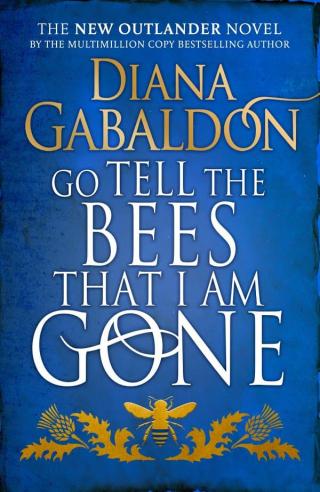
Go Tell the Bees That I Am Gone
- Автор: Гэблдон Диана
- Серия: Outlander #9
- Год: 2021
- Язык: английский
- Год: Delacorte Press
- ISBN: 978-1-473-51900-8
- Жанр: Исторические приключения

Электронная книга - «Go Tell the Bees That I Am Gone». Краткое содержание книги:
The past may seem the safest place to be . . . but it is the most dangerous time to be alive. . . .
Jamie Fraser and Claire Randall were torn apart by the Jacobite Rising in 1746, and it took them twenty years to find each other again. Now the American Revolution threatens to do the same. It is 1779 and Claire and Jamie are at last reunited with their daughter, Brianna, her husband, Roger, and their children on Fraser’s Ridge. Having the family together is a dream the Frasers had thought impossible. Yet even in the North Carolina backcountry, the effects of war are being felt. Tensions in the Colonies are great and local feelings run hot enough to boil Hell’s teakettle. Jamie knows loyalties among his tenants are split and it won’t be long until the war is on his doorstep. Brianna and Roger have their own worry: that the dangers that provoked their escape from the twentieth century might catch up to them. Sometimes they question whether risking the perils of the 1700s—among them disease, starvation, and an impending war—was indeed the safer choice for their family. Not so far away, young William Ransom is still coming to terms with the discovery of his true father’s identity—and thus his own—and Lord John Grey has reconciliations to make, and dangers to meet . . . on his son’s behalf, and his own. Meanwhile, the Revolutionary War creeps ever closer to Fraser’s Ridge. And with the family finally together, Jamie and Claire have more at stake than ever before.
“I only want to say that I didn’t suggest divorce from any motive of self-interest,” he said quietly. “I thought you might suppose …”
She’d been fixedly looking out at the water, but turned at that and met his eyes, her look straight and serious, eyes gray as the overcast sky.
“I might have,” she said softly. She was close enough that her skirts, stirring in the breeze, wrapped round his naked calves, and kissing his knuckles lightly she let go his hand.
“We should—” she began, but then stopped dead, staring. “What’s that?”
He turned to look and saw a naval cutter, ensign flying in the wind, tearing down the river toward them. As it passed, he caught a flash of army uniforms aboard.
“News,” he said. “From Charles Town. Let’s go!”
THEY SAW THE cutter at the quay as they hurried back, then a small group of army and naval officers laboriously climbing the slippery stone stairway to Bay Street.
William inflated his lungs and bellowed, “Has Charles Town fallen?”
Most of the officers ignored him, but a young ensign trailing at the end of the group turned and shouted, “Yes!” with a beaming countenance. The young man was hastily grabbed by the arm and dragged along, but the group was plainly in too much hurry to waste time on official rebuke.
“Oh, dear God.” Amaranthus was panting, pressing the heel of her hand into her corset. William had quite forgotten her, in the excitement, but at once took the shoes and stockings from her other hand and urged her to sit down and let him help re-shoe her.
She did, and laughed, in small breathless spurts.
“Really. William. What do you think me? A … mare?”
“No, no. Certainly not. A filly, maybe.” He grinned at her, and pulled her last stocking up to her knee. He had to leave her shoe buttons undone, having no buttonhook and no clue how to use one if he had, but he tied her garters briskly and she could at least walk.
“They’ll have gone to Prévost’s headquarters,” he told her, as they reached Oglethorpe Street. “I’ll see you to Papa’s house, then I’ll go find out the details.”
“Come back as soon as you can,” she said. She was windblown and panting, with red splotches on her cheeks from trotting over the cobblestones. “Please, William.”
He nodded and, handing her in at the gate, strode off in the direction of General Prévost’s headquarters.
By the time he returned, it was well after teatime, but Moira and Amaranthus and Lord John’s new housekeeper, a tall, irritable woman aptly named Miss Crabb, had kept some cake for him and were all waiting impatiently to hear the news.
“Partly it was the slaves,” William explained, licking a crumb from the corner of his mouth. “Sir Henry had already put out a proclamation, offering freedom to any slave of a rebel American who might choose to fight for the British army—and when this was reiterated to the countryside around Charles Town, there was quite an outpouring of men from both countryside and the city. And as these were men with a strong knowledge of the terrain, as you might say …”
Moira refilled his teacup, eyes gleaming over the squat gray teapot.
“Ye mean to say as how ’twas black men that turned upon their masters, and that’s how the city fell? Good on ’em!”
“Mrs. O’Meara!” Miss Crabb exclaimed. “You cannot mean that!”
“The divil I don’t,” Moira replied stoutly, plunking the pot back on the table with such force that tea sputtered across the cloth. “And ye’d mean the same, if ye’d ever been a ’denture, like I was. Death to the masters, says I!”
Amaranthus uttered a shocked laugh and tried to turn it into a coughing fit by burying her face in a handkerchief.
“Well, I do gather that Lord Cornwallis and his regulars had some hand in the surrender,” William said, keeping his countenance with some difficulty. “He led his troops onto the mainland, while Sir Henry was capturing the offshore islands, and besieged the city with cannon and trenches.
“And whilst all this was going on, in mid-April, Sir Henry sent two of his officers to take a place called Monck’s Corner. Banastre Tarleton—I know him, very vigorous officer—and Patrick Ferguson. They—”
“You know Ban Tarleton?” Amaranthus said, surprised. “I know him, too. How funny! I—trust he escaped injury?”
“So far as I know, yes,” William said, surprised, too. He was reasonably sure that nothing short of a cannonball at close range would have made a dent in Tarleton; he’d had a brief passage with the man—over Jane, and the thought conjured up a host of feelings he didn’t want to deal with. He swallowed tea and coughed a little. “I’ve not heard of Ferguson—do you know him?”
He supposed it wasn’t odd that she should. Prior to turning his coat, Ben had been a major in the British army, and his battalion was—so far as William knew—still with Clinton.
She shrugged a little. “I met Major Ferguson once. A small, pale Scottish creature with a crippled arm. Very intense, though, with those sort of pale gooseberry eyes.”
“I suppose he is. Intense, I mean. Sir Henry sent him out to collect Loyalists for a provincial militia, and I understand he’s done quite well. His Loyalists fought with Major Tarleton’s troops to take Monck’s Corner—and that cut off the main line of retreat for the Americans. So then—”
Before he had told them all he’d heard, the table was a wreck of empty plates, spilled saucers, and lines of sugar, pepper, and salt, illustrating the movements of Clinton’s army.
“And so Charles Town fell, day before yesterday,” William ended, slightly hoarse from talking. “Lincoln had offered to give up the city three weeks before, if his men were allowed to walk out unharmed. Clinton knew he had the stronger hand, though, and kept up the bombardment, until Lincoln finally surrendered unconditionally. Five thousand men, they said, all taken prisoner. A whole army. Is there more tea, please, Moira?”
“There is,” she said, getting ponderously to her feet. “But if it was my choice to make, son, I’d be gettin’ out the fine brandy. Seems as though such a victory’s deservin’ of it.”
This notion passed by general acclamation, and by the time Lord John arrived home, well past midnight, there were no more clean glasses and only an inch of brandy left in the last bottle.
Lord John eyed the shambles of his sitting room, shrugged, sat down, and, picking up the bottle, drained it.
“How are you, Papa?” William had stayed up, leaving the women to make their separate ways to bed, and had sat by the fire, thinking. Sharing the general glow of the victory, to be sure—but envious, too, of the men who had won it.
He missed the camaraderie of the army, but more than that, he missed the sense of shared purpose, the knowledge that he had a part to play, people who depended upon him. The army had its strictures, and not inconsiderable ones, either—but by contrast, his present life was shapeless and lacking … something. Everything.
“I’m fine, Willie,” his father said affectionately. Lord John was plainly exhausted, held up mostly by his uniform, but clearly in good spirits. “I’ll tell you everything tomorrow.”
“Yes, of course.” William got up, and, seeing his father put his feet under him but then hesitate as though uncertain what came next, smiled and bent to hoick Lord John out of his chair. He held on to his father’s arm for a moment, to make sure he was steady, and felt the solid warmth of his body, got the smell of a man, a soldier, sweat and steel, red wool and leather.
“You asked whether I might consider buying a commission,” William said abruptly, surprising himself.