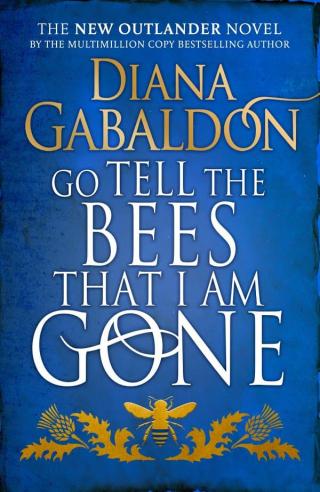
Go Tell the Bees That I Am Gone
- Автор: Гэблдон Диана
- Серия: Outlander #9
- Год: 2021
- Язык: английский
- Год: Delacorte Press
- ISBN: 978-1-473-51900-8
- Жанр: Исторические приключения

Электронная книга - «Go Tell the Bees That I Am Gone». Краткое содержание книги:
The past may seem the safest place to be . . . but it is the most dangerous time to be alive. . . .
Jamie Fraser and Claire Randall were torn apart by the Jacobite Rising in 1746, and it took them twenty years to find each other again. Now the American Revolution threatens to do the same. It is 1779 and Claire and Jamie are at last reunited with their daughter, Brianna, her husband, Roger, and their children on Fraser’s Ridge. Having the family together is a dream the Frasers had thought impossible. Yet even in the North Carolina backcountry, the effects of war are being felt. Tensions in the Colonies are great and local feelings run hot enough to boil Hell’s teakettle. Jamie knows loyalties among his tenants are split and it won’t be long until the war is on his doorstep. Brianna and Roger have their own worry: that the dangers that provoked their escape from the twentieth century might catch up to them. Sometimes they question whether risking the perils of the 1700s—among them disease, starvation, and an impending war—was indeed the safer choice for their family. Not so far away, young William Ransom is still coming to terms with the discovery of his true father’s identity—and thus his own—and Lord John Grey has reconciliations to make, and dangers to meet . . . on his son’s behalf, and his own. Meanwhile, the Revolutionary War creeps ever closer to Fraser’s Ridge. And with the family finally together, Jamie and Claire have more at stake than ever before.
“And what His Grace will do if he has another o’ them fits on the boat,” Moira said, shaking her head, “I don’t know!”
“Boat?” asked William, looking up from his third piece of apple pie. “Is he meaning to go somewhere?”
“Oh, yes,” Miss Crabb said, nodding wisely. “To England.”
“For to speak to the House o’ Lords,” Moira added.
“About the war,” Miss Crabb said quickly, before Moira could steal any more of her thunder. William hid a smile in his napkin, but was curious. He wondered whether Uncle Hal really had opinions on the conduct of the war that he felt obliged to share with the House of Lords or whether he had sought a good excuse to go home to England—and Aunt Minnie.
He did know—from his father—that Hal hadn’t been able to bring himself to write to his wife about Ben.
“When does he mean to go?” he asked.
“In a month,” Miss Crabb said, and pursed her lips.
“Does Lord John mean to go as well?” William half-hoped the answer was no. While he didn’t want Uncle Hal to choke to death alone on a ship, he much preferred to have Papa here, holding things together while he, William, pursued Amaranthus.
The two women shook their heads, both looking grave. They might have said more, but at that moment Papa’s quick footsteps came down the hall, and a moment later his disheveled fair head poked through the door.
“He’s better,” he said at once, catching William’s eye. “Come and help me; he wants to go up to his bed.”
THE DUKE SPENT much of the next day in bed, but when William went up to check on his state of health, he was sitting upright, a writing desk on his knees, scribbling away. He looked up at William’s advent and forestalled any queries by saying, “So, you still mean to go after her.”
It wasn’t posed as a question, and William merely nodded. So did Hal, and took a clean sheet of paper from the quire on his bedside table.
“Tomorrow, then,” he said.
AT DAWN OF the next day, William fastened his stock, buttoned his buff waistcoat, pulled on the red coat he’d thought he’d never wear again, and went downstairs, his step firm in his freshly polished boots.
His father and uncle were already at breakfast, and despite his impatience to be off, the smell of buttered corn bread, fried eggs, fresh ham, peach jam, crab fritters, and grilled sea trout was enough to make him sit down without argument. Both Papa and Uncle Hal viewed him with exactly the same look of mixed approval and veiled anxiety, making him want to laugh, but he didn’t, instead inclining his head briefly—neither one was talkative in the mornings, but apparently today was an exception.
“Here.” Uncle Hal pushed two folded documents with wax seals across the table to him. “The red one’s your commission and the other’s your orders—such as they are. I’ve given you the rank of captain, and your orders say you’re to be given free passage essentially anywhere you want to go, without let or hindrance, and you may call upon the assistance of His Majesty’s officers and troops as needed and available.”
“You think I might need a column of infantry to help drag Amaranthus back?” William asked, biting into a warm slice of fresh buttered corn bread, thick with peach jam.
“You think you won’t?” his father said, arching an eyebrow. Lord John got up and, coming behind William, undid his hasty plait and rebraided it, tight and neat, before doubling it into a queue and binding it with his own black ribbon. The touch of his father’s hands on his neck, warm and light, moved him.
Everything this morning had a freshness about it and a sense of moment that made him feel he would recall every object seen or touched, every word spoken, for as long as he lived.
He’d barely slept, his mind pulsing with energy, the stultification and petrifaction of the last month gone as though it had never existed. His statement that he was going after the girl had met with no opposition; Papa and Uncle Hal had exchanged a long glance and then set to making plans.
“She said she’d made arrangements,” Papa was saying, frowning over a forkful of sea trout. “What sort of arrangements, do you suppose?”
“So far as any of the servants can tell,” Hal replied, “she made a raid on the pantry and absconded with enough food for three or four days, took her plainest clothes—and most of her jewelry. She—”
“Did she take her wedding ring?” William interrupted.
“Yes,” Lord John said, and William shrugged.
“Then she’s heading for Ben. She’d have left it if she was done with him.”
Uncle Hal gave him the sort of look he would have given a performing flea who’d just turned a somersault, but Papa hid a smile behind his napkin.
“We wouldn’t let her go alone, even if we were positive that she is headed for her father’s house,” he said. “A young woman alone on the road—and we do think she’s alone,” he added, more slowly. “Though I suppose it’s possible that …”
“More than possible,” Uncle Hal said grimly. “That young woman—”
“Is your daughter-in-law,” Lord John interrupted. “And the mother of your heir. As such, we have every obligation to ensure her safety.”
“Mmphm.” William heard the grunt of agreement he’d made and stopped dead for an instant, a forkful of egg suspended, dripping yolk over his plate. “You probably don’t want to hear this … but Da makes that sort of noise all the time.” He glanced swiftly from his father to his uncle, but neither of them seemed to have noticed anything odd in his response, and the party relapsed into a silent, steady engulfment of breakfast.
William’s new mare, Birdie, was happy to see him and nosed him in search of apples—which he’d brought—and crunched them with evident pleasure, slobbering juice down his sleeve as he pulled the bridle over her ears. She sensed his own excitement and pricked her ears and snorted a little, bobbing her head as he tightened the girth. He wondered just how Amaranthus had managed her vanishing act; none of the horses belonging to the household were missing, not even the elderly mare Amaranthus was accustomed to ride.
Either she’d taken a public coach—unlikely; he thought Uncle Hal had probably sent directly to the coaching inn to have inquiries made, and she would have known he’d do that—or she’d hired a private carriage or a livery horse. Or she’d had help in absquatulating and her bloody assistant had provided her transportation. He was running moodily through a list of local gallants that she might have seduced to her purposes but was interrupted by the appearance of Lord John, with a purse in one hand and a small portmanteau in the other.
“A plain suit, stockings, and a fresh shirt,” he said briefly, handing over the latter. “And money. There’s a letter of credit in there as well—you might put that away in your pocket, just in case.”
“In case I’m obliged to ransom her from a band of highwaymen?” William asked, taking the purse. It was pleasantly heavy. He tucked it into his greatcoat, and, taking one of the pistols from his saddlebag, tucked that into his belt.
“Haha,” said his father, politely. “William—if she is going to Ben, and she gets to him … don’t—I repeat, don’t make any effort to take her away from him. Next time—if there is a next time—he probably will kill you.” There was enough blunt finality in that opinion that decided William not to argue with it, though his pride thought strongly otherwise.