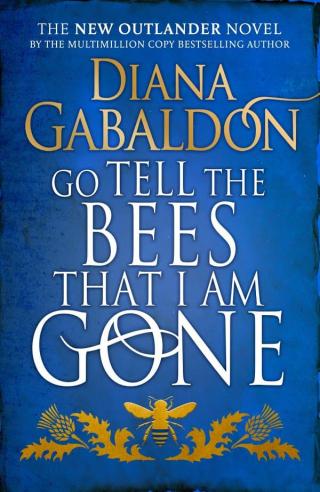
Go Tell the Bees That I Am Gone
- Автор: Гэблдон Диана
- Серия: Outlander #9
- Год: 2021
- Язык: английский
- Год: Delacorte Press
- ISBN: 978-1-473-51900-8
- Жанр: Исторические приключения

Электронная книга - «Go Tell the Bees That I Am Gone». Краткое содержание книги:
The past may seem the safest place to be . . . but it is the most dangerous time to be alive. . . .
Jamie Fraser and Claire Randall were torn apart by the Jacobite Rising in 1746, and it took them twenty years to find each other again. Now the American Revolution threatens to do the same. It is 1779 and Claire and Jamie are at last reunited with their daughter, Brianna, her husband, Roger, and their children on Fraser’s Ridge. Having the family together is a dream the Frasers had thought impossible. Yet even in the North Carolina backcountry, the effects of war are being felt. Tensions in the Colonies are great and local feelings run hot enough to boil Hell’s teakettle. Jamie knows loyalties among his tenants are split and it won’t be long until the war is on his doorstep. Brianna and Roger have their own worry: that the dangers that provoked their escape from the twentieth century might catch up to them. Sometimes they question whether risking the perils of the 1700s—among them disease, starvation, and an impending war—was indeed the safer choice for their family. Not so far away, young William Ransom is still coming to terms with the discovery of his true father’s identity—and thus his own—and Lord John Grey has reconciliations to make, and dangers to meet . . . on his son’s behalf, and his own. Meanwhile, the Revolutionary War creeps ever closer to Fraser’s Ridge. And with the family finally together, Jamie and Claire have more at stake than ever before.
“Your breath is sweet,” he said politely, and straightened up. “How did you learn his name? Did he come back and tell you?”
“No. He left behind a journal that he had written, while living with the Mohawks near Snaketown. He wrote down who he was—his English name was Robert Springer, but he had taken the name ‘Ta’wineonawira.’ Do you read Latin?”
He laughed, which relieved the tension a little. “Do I look like a priest?”
That surprised me somewhat. “Aren’t you one? Or something like that? A—a healer?” I had vague memories of Ian telling me about the False Face Society, healers who would gather to offer prayers and songs over a sick person.
“Well, no.” He rubbed a knuckle lightly over his upper lip, and I thought he was—for once—trying not to laugh at me. But no; he’d only been making up his mind what to say.
“Do you not know what the word ‘sachem’ means?”
“Rather obviously not,” I said, a little miffed. “What’s it mean, then?”
He straightened up, half consciously. “A sachem is an elder of the people. A sachem might advise and lead a great number of his people. I did.”
Well, that accounted for his self-confidence.
“Why aren’t you a sachem anymore?”
“I died,” he said simply.
“Oh.” I looked around us. We had come to the trout lake, which was glimmering with a cold bronze light; the sun was coming down, and the forest surrounding us was mostly pine and birch trees, dark against the sky. There was no sign of any human habitation. I took a deep breath of the wind and the coming dark. I’d taken his arm coming down the hill; his flesh had been warm and solid; I’d felt the hardness of his bones.
“You’re not a ghost, are you?” I said, and thought, oddly, that I would have believed either answer.
He looked at me for several moments before answering.
“I don’t know,” he said.
We found a fallen log and sat down. At the far end of the lake, a family of beavers had built a lodge that dammed the small creek leading out of it. I could see a beaver on top of the lodge, its stocky form silhouetted against the light, head raised to the breeze.
“Jamie says they mostly come out at night,” I said, nodding toward it. “But we see them often in the daytime, too.”
“They feel safe, I suppose. I have not heard many wolves. Other than small Hunter; he howls very well but is not big enough to hunt beaver yet. And his parents don’t let him out at night.”
“Haha,” I said politely. “How did you come to die? An accident?”
He grinned at me, showing teeth that were visibly worn but mostly present.
“Few people do it on purpose. A snake bit me.” He pushed back his left sleeve and showed me the scar on the underside of his arm: a deep, irregular hollow in his flesh, about two inches long. I took his hand and turned it for a better look. He was very lean, and well hydrated; the larger blood vessels were clearly visible, firm under the skin.
“Good Lord, it looks as though it bit you right in the radial artery. What sort of snake was it?”
“You would call it a rattlesnake.” He didn’t remove my hand, but put his other hand over it. “I knew at once that it had killed me; there was great pain in my arm, and an instant later, I felt the poison strike my heart like an arrow. I grew hot and then so cold that my teeth chattered, though the day was warm. My eyes went dark, and I curled up like a worm, hoping that it wouldn’t last too long.”
It had lasted three days and three nights.
“This was not pleasant,” he assured me. “The False Face Society came, they put poultices upon the wound and danced … I still see their feet, sometimes, when I dream—moccasins shuffling past my face, one after another, on and on … and the masks bending over me, a small drum beating; I can hear that, too, sometimes, and my own heartbeat unsteady, stopping and starting and the drum still beating …”
He stopped for a moment, and I put my free hand over his. After a moment, he took a deep breath and looked at me.
“And I died,” he said. “It was in the deep part of the third night. I must have been asleep when it happened, for I found myself standing by the door of the hut, looking out into the forest and seeing the stars—stars as I have never seen them before or since,” he added softly. “It was so peaceful, so beautiful.”
“I know,” I said, just as softly. We sat for a few moments together, remembering.
The beaver slid down the side of the lodge and swam off, making an arrow of dark water in the shining lake, and the Sachem sighed and let go of my hands.
“I walked—I suppose you would call it walking, though I didn’t seem to have feet—but I went into the woods and walked away from … everything. I was going somewhere, but I didn’t know where. And then I met my second wife.” He paused, an expression of warmth and longing lighting his face.
“She told me she was glad to see me, and would see me again, but not now. I wasn’t meant to come yet; there were things that I needed to do; I had to go back. I didn’t want to,” he said, glancing at me. “I wanted to go with her, toward …” He broke off, shrugging.
“But I did go back. I woke up and I was in the medicine hut and my arm hurt a lot, but I was alive. They told me I had been dead for hours, and they were shocked. I was … resigned.”
“But you weren’t exactly the same person you were before,” I said.
“No. I told them I was not the Sachem anymore; I could see that my nephew was able to lead men in battle and I would be his adviser, but that it was to him that they must look now.”
“And … now you see ghosts?” Jenny had told me what he’d said about Ian the Elder and his leg. Raised every hair on my body, she’d said, and my own nape was prickling.
“Now I see ghosts,” he said, quite matter-of-factly.
“All the time?”
“No, and I am thankful that I don’t. But now and then, there they are. Mostly they have no business with me, nor I with them, and they pass by like a flash of light. But then again …”
He was looking at me in a thoughtful way that raised a few more hairs.
“Do I … have ghosts?” I said, hoping that it wasn’t like having fleas.
He tilted his head to one side, as though inspecting me.
“You lay your hands on many people, to try to heal them. Some of them die, of course, and some of those, I think, follow you for a short time. But they find their way and leave you. You have a small child sometimes near you, but she is very faint. The only other one I have seen with you more than once is a man. He wears spectacles.” He made circles of his thumbs and middle fingers and held them up to his eyes, miming glasses. “And a peculiar hat, with a short brim. I think he must be from your place across the stones, for I have never seen anything like that.”
I honestly thought I was having a heart attack. There was an immense pressure in my chest, and I couldn’t breathe. The Sachem touched my arm, though, and the pressure eased.
“You shouldn’t worry,” he assured me. “He is a man who loved you; he means you no harm.”
“Oh. Good.” I’d broken out in a cold sweat and groped for a handkerchief. I was wiping my face and neck with it when the Sachem got to his feet and offered me a hand.
“What is strange,” he said as I rose, “is that this man often follows your husband, too.”
WHEN I GOT back to the house, I went straight to Jamie’s study. Jamie wasn’t in it; he’d gone to check operations at the still, as he did twice weekly. I didn’t hear anyone in the house, but found myself walking as softly as a cat burglar, and wondered exactly whom I was sneaking up on. The answer to that was obvious, and I resumed my normal firm step, letting the echoes fall where they might.