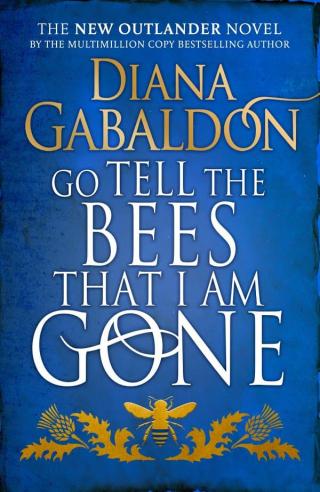
Go Tell the Bees That I Am Gone
- Автор: Гэблдон Диана
- Серия: Outlander #9
- Год: 2021
- Язык: английский
- Год: Delacorte Press
- ISBN: 978-1-473-51900-8
- Жанр: Исторические приключения

Электронная книга - «Go Tell the Bees That I Am Gone». Краткое содержание книги:
The past may seem the safest place to be . . . but it is the most dangerous time to be alive. . . .
Jamie Fraser and Claire Randall were torn apart by the Jacobite Rising in 1746, and it took them twenty years to find each other again. Now the American Revolution threatens to do the same. It is 1779 and Claire and Jamie are at last reunited with their daughter, Brianna, her husband, Roger, and their children on Fraser’s Ridge. Having the family together is a dream the Frasers had thought impossible. Yet even in the North Carolina backcountry, the effects of war are being felt. Tensions in the Colonies are great and local feelings run hot enough to boil Hell’s teakettle. Jamie knows loyalties among his tenants are split and it won’t be long until the war is on his doorstep. Brianna and Roger have their own worry: that the dangers that provoked their escape from the twentieth century might catch up to them. Sometimes they question whether risking the perils of the 1700s—among them disease, starvation, and an impending war—was indeed the safer choice for their family. Not so far away, young William Ransom is still coming to terms with the discovery of his true father’s identity—and thus his own—and Lord John Grey has reconciliations to make, and dangers to meet . . . on his son’s behalf, and his own. Meanwhile, the Revolutionary War creeps ever closer to Fraser’s Ridge. And with the family finally together, Jamie and Claire have more at stake than ever before.
“And do you think the dead concern themselves with the living?”
I hesitated for a moment, but while I was in total ignorance of the mechanics, I didn’t doubt the fact.
“Yes, I do. So do most Highlanders. They have a very intimate relationship with their dead.” Out of curiosity, I asked, “Do you? Think that the dead concern themselves with the living?”
“Some of them do.” Rising, he beckoned me to follow him. The fungus in question was growing a short distance away, in a crevice in a dead beech log. There was a large cluster, the individual mushrooms balanced on long, delicate stems, both crimped caps and stems a noticeable shade of purplish crimson.
“I’ve seen these before,” I said, gathering up my skirt in order to squat beside him in front of the log. “People call them bleeding fairy helmets, or sometimes just blood-spots.” They were, in fact, just about the shade of venous blood, and if you cut the stems, a very convincing bloodlike liquid oozed out of them.
“I don’t know if they’re poisonous, but I wouldn’t feed them to anyone.” Assuming any of the Highlanders on the Ridge would try one. Having grown up in a food-deprived habitat where oatmeal was not just for breakfast, most of the older people were deeply suspicious of anything strange-looking or unfamiliar—particularly things of a vegetable nature.
“No,” the Sachem said thoughtfully. “Their blood is sticky—like real blood, you know—and I’ve seen that used to help seal small wounds, but I’ve never seen animals eat them. Not even pigs.”
“So you are familiar with them?”
“Oh, yes. It’s that, that I have never seen before.” Crouching beside me, he extended a long, knobbly finger toward an isolated patch of the mushroom. The caps had opened fully, like tiny umbrellas, but each one sported a tangled headdress of thin, slightly iridescent pale spikes, as though the cap had suddenly grown a crop of tiny needles.
I didn’t touch them, but took out my spectacles for a closer look.
The Sachem smiled at me. “You know the big owls?” he said, sticking his forefingers up beside his ears. “The ones who call Hoo-hoo, and then another answers Hoo? You hear them most in the early days of winter, when they breed.”
“Hoo,” I said gravely, and bent closer. Seeing in better focus, I could just make out tiny ball-shaped sporangia at the ends of the tiny spikes.
“I don’t know what it’s called, but it looks like a parasite—you know what a parasite is?”
He nodded gravely.
“I can see little … fruiting things … on the ends here. It might be a different kind of fungus that feeds off the larger ones.”
“Fungus,” he said, and repeated it happily. “Fungus. What a pleasant word.”
I smiled.
“Well, it is rather better than ‘saprophyte.’ That means a … they’re not quite plants … but growing things that live on dead things.”
He blinked and looked speculatively from the blood-spots to me.
“Do not all living things live on the dead?”
That made me blink.
“Well … I suppose they do,” I said slowly, and he nodded, pleased.
“Even if you were to swallow oysters—which are often alive when you eat them—they die in your stomach very quickly.”
“What a very disagreeable notion,” I said, and he laughed.
“What does it mean to be dead?” he asked.
I’d risen to my feet and crossed my arms, feeling just slightly unsettled.
“Why are you asking me?”
He’d stood up, too, but was quite relaxed. At the same time, something new had entered his eyes. They were still lively, and undoubtedly friendly—but there was something else behind them now, and my hands felt suddenly cold.
“Wolf’s Brother said to Thayendanegea that his uncle’s wife was a Wata’ènnaras. But he also said that you have walked through time and that you have walked with a Mohawk ghost. Wolf’s Brother does not lie, no more than his Quaker wife nor his virtuous mother, so I believe that he thinks this is a true thing that you have done.”
Under the circumstances, I wasn’t sure whether his belief was a good thing or not, but I managed a small nod.
“It’s true.”
He nodded back, unsurprised but still interested. “Thayendanegea told Wolf’s Brother to tell this to me, and he did. That’s why I said I would come with him when he returned here. To hear this from your own lips, and to know whatever else you can tell me.”
“Rather a tall order,” I said. I felt cold and breathless, and my inner ears rang with the aftermath of thunder. “Let’s … walk while I tell you. If you don’t mind.”
He nodded at once and offered me his arm, calico-shirted and ringed with silver bracelets, with as much style as Lord John or Hal might have done it, and I laughed, despite my unease.
“A story for a story. I’ll tell you what happened, and you tell me why you went to London.”
“Oh, that’s simple enough.” He handed me carefully over one of the small gravelly rivulets that ran down this part of the mountain. “I went because Thayendanegea went. He would need a friend to talk with in a strange place, someone who could counsel him, judge men for him, guard him in case of danger, and … perhaps offer another view of the things we saw and heard.”
“And why did he go?”
“The King invited him,” the Sachem said. “When a King invites you to go somewhere, it’s not usually a good idea to refuse, unless you already know you will make war against him. And that is not something we knew.”
“Sound judgment,” I said. It had been, on the King’s part, as well as Brant’s. The King—or at least the government—wanted to keep the Indians on their side, as help in suppressing an incipient rebellion. And Brant, naturally, would like to be on the winning side of that rebellion, and at the moment of going to press, the British undeniably looked like the best bet.
We had reached level footing, and I led the way onto a trail that wound gently down toward the small lake where we fished for trout.
“So,” I said, and took a deep breath. “It was a dark and stormy night. Isn’t that how ghost stories usually begin?”
“Do your people often tell such stories?” He sounded quite startled, and I looked over my shoulder. The trail had narrowed at this point, and he was walking behind me.
“Ghost stories? Yes, don’t yours?”
“Yes, but they don’t usually start that way. Tell me what happened next.”
I did. I told him all of it, from my being trapped in a storm at night on the mountain, to coming face-to-face with Otter-Tooth; what I had said to him, and he to me. And with some hesitation, I told him about finding Otter-Tooth’s skull, and with it, the large opal that he had kept as his ticket back—his token of safe return through the stones.
And then, of course, I had to tell him about the stones. It isn’t, in the nature of things, possible for a person possessing epicanthic folds to actually grow round-eyed, but he made a good attempt.
“And the reason why I knew that the ghost—I didn’t know his name until much later—why he was from … er … my time, was that his teeth had silver fillings: metal that’s put in the tooth to strengthen it after you remove a pocket of decay. That’s not done now; it won’t be done commonly until … I forget, but more than … say, two or three generations from now. But look …”
I opened my mouth and leaned toward him, hooking my cheek away with a finger so he could see my molars. He leaned down and peered into my mouth.