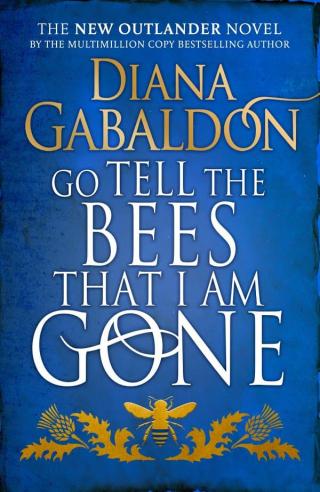
Go Tell the Bees That I Am Gone
- Автор: Гэблдон Диана
- Серия: Outlander #9
- Год: 2021
- Язык: английский
- Год: Delacorte Press
- ISBN: 978-1-473-51900-8
- Жанр: Исторические приключения

Электронная книга - «Go Tell the Bees That I Am Gone». Краткое содержание книги:
The past may seem the safest place to be . . . but it is the most dangerous time to be alive. . . .
Jamie Fraser and Claire Randall were torn apart by the Jacobite Rising in 1746, and it took them twenty years to find each other again. Now the American Revolution threatens to do the same. It is 1779 and Claire and Jamie are at last reunited with their daughter, Brianna, her husband, Roger, and their children on Fraser’s Ridge. Having the family together is a dream the Frasers had thought impossible. Yet even in the North Carolina backcountry, the effects of war are being felt. Tensions in the Colonies are great and local feelings run hot enough to boil Hell’s teakettle. Jamie knows loyalties among his tenants are split and it won’t be long until the war is on his doorstep. Brianna and Roger have their own worry: that the dangers that provoked their escape from the twentieth century might catch up to them. Sometimes they question whether risking the perils of the 1700s—among them disease, starvation, and an impending war—was indeed the safer choice for their family. Not so far away, young William Ransom is still coming to terms with the discovery of his true father’s identity—and thus his own—and Lord John Grey has reconciliations to make, and dangers to meet . . . on his son’s behalf, and his own. Meanwhile, the Revolutionary War creeps ever closer to Fraser’s Ridge. And with the family finally together, Jamie and Claire have more at stake than ever before.
115
Little Wolf
THE RAIN RESUMED WITH uncommon force, and it was some time before Gilbert Bembridge was completely excavated, cursorily treated for shock, diagnosed with a minor concussion, and his wound—a long but shallow slash over one shoulder blade, where his friend had tried to stab him—field-dressed. Oliver Esterhazy was treated for shock of various kinds and several cracked ribs. Luckily Kenny Lindsay and Tom MacLeod appeared at this point with two canvas-wrapped rifles and a mule, rain pouring from their hats, and took charge of the two lieutenants with the intent of removing them to Kenny’s cabin, which was no more than a mile away.
“Dinna fash, Missus,” Kenny said, wiping the back of his hand under his big red nose. “My wife can see to them until the rain stops. You’d best go home before Himself has an apoplexy, if he hasna already done it.”
“He hasn’t got enough blood left for a good apoplexy,” I said, and Kenny laughed, apparently thinking I was being witty.
Ian’s party, reassembled from the woods, had trooped down to the road where they’d left their wagon, and were huddling—with the unhitched horses—under the meager protection of a broad limestone shelf and a few pieces of waxed canvas.
I had reached the point of total saturation long since, my hands were a mottled blue with cold, and I couldn’t feel my feet. Even so, I felt a surge of joy at seeing Rachel’s face peering out of the tiny shelter. Her look of anxiety flowered into happiness and she ran out into the rain to grasp my frozen hands and tow me into a warm jumble of bodies, which all burst into questions, exclamations, and intermittent shrieks from what seemed like a large number of children.
“Here,” said a familiar voice beside me, and Jenny handed me a canteen. “Drink it all, a leannan, there’s no much left.” Despite being so wet externally, I was parched with thirst and gulped the contents, which seemed to be a dilute spiced wine mixed with honey and water. It was divine and I handed back the empty canteen, now in sufficient possession of myself as to look round.
“Who …?” I croaked, waving a hand. “All the women,” Ian had said—and that’s what he’d meant, allowing for age. In addition to Rachel and Jenny, there was a pale, stick-thin woman huddled beside one of the horses, two round-eyed young girls soaking wet and plastered against her legs, and another, perhaps two years old, in her arms.
“This will be Silvia Hardman, Auntie,” Ian said, ducking into the shelter and handing Oggy off to Rachel. “Uncle Jamie asked me to see to her needs in Philadelphia, and what wi’ one thing and another, I thought she and the bairns had best come along wi’ us. So … they did.”
I caught an echo behind that casual “one thing and another,” and so did Mrs. Hardman, who flinched slightly but then drew herself up bravely and did her best to smile at me, her hands on her skinny little daughters’ shoulders.
“I met thy husband two years ago, by chance, Friend Fraser. It was most kind of him to have sent his nephew to inquire as to our circumstances, which were … difficult. I—I hope our momentary presence here will not discomfit thee.”
This last was not quite a question, but I managed a smile, though my face was stiff with cold and fatigue. I could feel a lukewarm trickle of water running slowly down my spine, finding its way through the layers of sodden cloth sticking to my skin.
“Oh, no,” I said. “Um. The more the merrier, don’t they say?” I blinked hard to clear water from my lashes, but it didn’t seem to help. Everything was gray and blurring round the edges, and the wine was a small red warmth in my stomach.
“Claire,” said Jenny, grabbing my elbow. “Sit down before ye fall on your face, aye?”
I DIDN’T FALL on my face, but did end up being transported by wagon with my head in Rachel’s lap, surrounded by soggy but cheerful children. Lizard, who so far had not uttered a word, chose to walk with Ian, Silvia, and the Sachem, while Jenny drove the wagon and kept up a running stream of commentary over her shoulder, pointing out things of interest to the little girls and reassuring them.
“Ye’ll have a wee cabin to live in with your mam,” she assured them. “And no man will trouble her, ever again. My brother will see to it.”
“What happened?” I said to Rachel. I spoke in a low voice, but one of the ragged little girls heard me and turned to look at me seriously. She wasn’t pretty, but both she and the sister close in age had an odd dignity about them that was at odds with their years.
“Our father was taken by Indians,” she said to me, speaking precisely. “My mother was left with no way to keep us, save her garden and small gifts from men who came to call.”
“Some of them were not kind,” her sister added, and they both pursed their lips and looked out into the dripping woods.
“I see,” I said, and thought I probably did. Jamie had told me, very briefly, about the Quaker widow who had taken care of him for a day or two when his back had seized up while he was in her house, having met there with George Washington—and I did wonder what the hell George Washington had been doing there, but hadn’t asked, owing to the press of events at the time.
“Mrs. Murray is right,” I assured them. “Mr. Fraser will find a place for you.” After all, we would shortly have a number of cabins vacated by Jamie’s evicted tenants …
Patience and Prudence—those were the oldest girls’ names, and the little one was Chastity—glanced at each other and nodded.
“We told Mummy that Friend Jamie would not see us starve,” one of them said, with a simple confidence that moved me.
“It would have been fun to stay with the Indians,” her sister said, a little wistfully. “But we couldn’t do that, because of Father.”
I made a sympathetic noise, wondering exactly what had happened to their father. Rachel wiped my face with the edge of her flannel petticoat, which was damp but not sopping.
“Speaking of Friend Jamie,” she said, smiling down at me, “where is he? I can’t wait to hear how you came to be in a landslide with two English— Are they soldiers? I think one said he was a lieutenant. But is Jamie at home, then?”
“I sincerely hope so,” I said. “There was what he’d call a stramash of sorts last night, and he was wounded. But it isn’t bad,” I added hastily. “Everything’s all right. For the moment.”
Hearing this, Jenny turned round and gave me a piercing look. I looked as reassuring as possible, and she snorted slightly and turned back, snapping the reins to hurry the horses along.
I sat up, cautiously, bracing myself against the side of the wagon. My head swam briefly, but then things steadied. The sky was still dark gray and turbulent, but at ground level, the air had stilled, and I heard the cautious chirps and calls of birds pulling their heads out from under their wings and looking about to see what of the world was still left.
“I seem to recall someone telling me that Oggy’s finally got a name,” I said to Rachel, nodding toward Oggy himself, who was curled up with his head in the lap of either Patience or Prudence. The other girl had a large, thick-haired puppy in her lap, also soaking wet with its coat in spikes, but sound asleep. Rachel laughed, and I thought how pretty she was, her face fresh from the cold air, and her lightness of spirit rising with the road toward home.
“He has,” she said, and touched the round of his bottom affectionately. “His name is Hunter James Ohston’ha Okhkwaho Murray. ‘James’ for his great-uncle, of course,” she added.