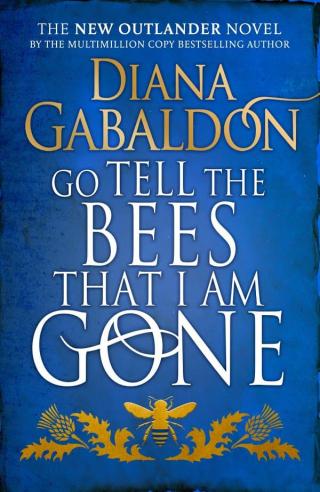
Go Tell the Bees That I Am Gone
- Автор: Гэблдон Диана
- Серия: Outlander #9
- Год: 2021
- Язык: английский
- Год: Delacorte Press
- ISBN: 978-1-473-51900-8
- Жанр: Исторические приключения

Электронная книга - «Go Tell the Bees That I Am Gone». Краткое содержание книги:
The past may seem the safest place to be . . . but it is the most dangerous time to be alive. . . .
Jamie Fraser and Claire Randall were torn apart by the Jacobite Rising in 1746, and it took them twenty years to find each other again. Now the American Revolution threatens to do the same. It is 1779 and Claire and Jamie are at last reunited with their daughter, Brianna, her husband, Roger, and their children on Fraser’s Ridge. Having the family together is a dream the Frasers had thought impossible. Yet even in the North Carolina backcountry, the effects of war are being felt. Tensions in the Colonies are great and local feelings run hot enough to boil Hell’s teakettle. Jamie knows loyalties among his tenants are split and it won’t be long until the war is on his doorstep. Brianna and Roger have their own worry: that the dangers that provoked their escape from the twentieth century might catch up to them. Sometimes they question whether risking the perils of the 1700s—among them disease, starvation, and an impending war—was indeed the safer choice for their family. Not so far away, young William Ransom is still coming to terms with the discovery of his true father’s identity—and thus his own—and Lord John Grey has reconciliations to make, and dangers to meet . . . on his son’s behalf, and his own. Meanwhile, the Revolutionary War creeps ever closer to Fraser’s Ridge. And with the family finally together, Jamie and Claire have more at stake than ever before.
The book was still behind the ledgers. I turned it over with the distinct feeling that it might explode, or the photograph leap from the cover and accost me. Nothing happened, though, and the photograph remained … just a photograph. It was certainly an image of Frank, much as I remembered him, but I didn’t feel Frank’s presence. As soon as the thought occurred to me, I glanced over my shoulder. Nothing there.
Would you know, if there was? That thought raised goose bumps on my forearms, but I shook it off.
“I would,” I said firmly, aloud, and took the book to the window, so the sun shone on it. Frank was wearing his normal black-rimmed glasses in the photo—but he wasn’t wearing a hat.
“Well, assuming he’s right,” I said accusingly to the photo, “what the hell are you doing, following either me or Jamie around?”
Getting no answer to this, I sat down in Jamie’s chair.
The Sachem had said Frank—always assuming it was Frank he saw, though I was becoming sure of this—was “a man who loved you.” Loved, past tense. That gave me a small double pang: one of loss, the other of reassurance. Presumably there was no question of postmortem jealousy, then? But if not …
But you don’t even know that Jamie’s right about this damned book!
I opened the book, read a page without taking in a word of its meaning, and closed it again. It didn’t bloody matter. Whether by Frank’s intent—malign or not—or only a figment of Jamie’s imagination, stimulated by the pressure of current events or the stirrings of a mistaken sense of guilt … Jamie thought what he thought, and nothing short of Divine Revelation was likely to change that.
I closed my eyes and sat still. We didn’t yet own a clock, and yet I could hear the seconds tick past. My body kept its own time, between my heartbeat and the pulsing of my blood, the ebb and flow of sleep and wakefulness. If time was eternal, why wasn’t I? Or perhaps we only become eternal when we stop keeping time.
I’d nearly died three times: when I lost Faith, when I caught a great fever, and—only a year ago!—when I was shot at Monmouth. It wasn’t that I didn’t remember, but I remembered only small, vivid flashes of each experience. I felt very calm, thinking of death. It wasn’t something I was afraid of; I just didn’t want to go while there were people who needed me.
Jamie had come to the verge of death more frequently—and a lot more violently—than I had, and I didn’t think he was afraid of it, either.
But you still have people who need you, dammit!
The thought made me angry—at both Frank and Jamie—and I got up and shoved the book back behind the ledgers. Even without a clock, I knew it was nearly suppertime. I had a sort of chowder going, made with potatoes and onions and a little dried corn, but it wasn’t very good … Bacon! Yes, definitely bacon.
I was coming out of the smoke shed with several rashers on a plate when a bit more of what I was determinedly not thinking about bubbled up. Bree had told me—and Jamie—about the letter Frank had left for her. An extremely disturbing letter, on multiple levels. But what was echoing in the back of my mind just now was the last paragraph of that letter:
And … there’s him. Your mother said that Fraser sent her back to me, knowing that I would protect her—and you. She thought that he died immediately afterward. He did not. I looked for him, and I found him. And, like him, perhaps I send you back, knowing—as he knew of me—that he will protect you with his life.
For the first time, it occurred to me that even if Jamie was right, and Frank was making an attempt to tell him something—it might be a warning, rather than a threat.
118
The Viscountess
WILLIAM DIDN’T GO DIRECTLY to Lord John’s house when he arrived in Savannah. Instead, he stopped at a barber on Bay Street and had a much-needed shave and his hair trimmed and properly bound. That was as much as he could do for the moment, bar digging a halfway-clean shirt out of his saddlebag and changing into it in the shop. Face raw and stinging with razor burn and bay rum, and deeply aware of his own residual stink beneath it, he left his horse at the livery, walked to Oglethorpe Street, and after a moment’s thought circled his father’s house and walked into the cookhouse out back.
Lord John was out with his brother. Gone to the camp, the startled cook informed him. And the viscountess? In the parlor, doing needlework.
“Thank you,” he said, and went into the house, pausing briefly to kick his boots against the step, in order to knock off some of the dry mud.
He made no attempt to quiet his footsteps; they hit the painted floorcloth in the hallway with the regular thump of a muffled drum. When he reached the parlor door, she was sitting bolt-upright and wide-eyed, a large piece of half-embroidered white silk spilling over her lap and a needle threaded with scarlet floss motionless in her hand.
“William,” she said, and cocked her head to one side. She didn’t smile; neither did he. He leaned against the jamb and crossed his arms, looking steadily at her.
“I found him.”
She looked at him for a long moment, then shook her head violently, as though attacked by gnats.
“Where?” she asked, her voice a little husky, and he saw that her free hand had closed on the silk, crushing it.
“A place called Morristown. It’s in New Jersey.”
“His grave? That was in New Jersey, but you said he wasn’t in it …”
“He’s definitely not in his grave,” he assured her, not trying to keep the cynical tone out of his voice.
“You mean … he’s … alive, then?” She kept her face under control, but her cheeks were pink, not white, and he could see the thoughts darting like minnows at the back of her changeable eyes.
“Oh, yes. But you knew that.” He considered her for a moment, then added, “He’s a general now. General Raphael Bleeker. Did you know that?”
She took a long, slow breath, holding his eyes with hers.
“No,” she said at last. “But I’m not surprised.” Her lips compressed briefly. “He’s with Washington, then,” she said. “Father Pardloe said the rebels had gone to winter quarters in New Jersey.”
She’d dropped the silk; it slithered to the ground, unregarded. She stood up abruptly, fists closed at her sides, and turned her back on him.
“He said it was your idea,” William said mildly. “That he should pretend to be dead.”
“I couldn’t stop him.” She spoke to the yellow toile de Jouy wallpaper, through her teeth by the sound of it. “I begged him not to do it. Begged him.” She turned around then and glared at him. “But you know what they’re like, these Greys of yours. Nothing matters to them when they’ve made up their minds—nothing. And nobody.”
“I wouldn’t say that,” William said. His heart had slowed down a bit after his first sight of her, but it was speeding up again. “It’s true that you can’t change their minds—but they do care, sometimes. Ben cared.” He cleared his throat. “For you.” He had the bruises to prove it.
And still does. He didn’t say it out loud, but he saw from her face that he didn’t need to.
“Not enough,” she said shortly, though there was a quiver in her voice. “Not nearly enough. It was only my telling him what it would do to Trevor—having a traitor for a father—that finally made him agree to disappear quietly, instead of having a blazing row with his father and stamping off to glory with his precious rebels. That’s what he would have liked,” she added, with a twitch of the mouth that might have been either bitterness or reluctant amusement.