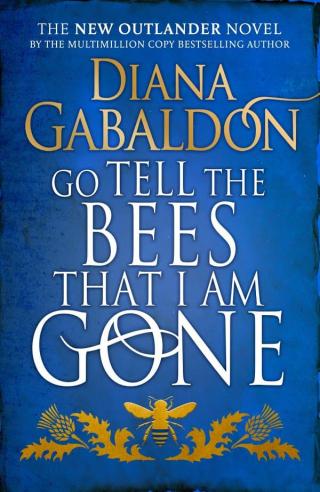
Go Tell the Bees That I Am Gone
- Автор: Гэблдон Диана
- Серия: Outlander #9
- Год: 2021
- Язык: английский
- Год: Delacorte Press
- ISBN: 978-1-473-51900-8
- Жанр: Исторические приключения

Электронная книга - «Go Tell the Bees That I Am Gone». Краткое содержание книги:
The past may seem the safest place to be . . . but it is the most dangerous time to be alive. . . .
Jamie Fraser and Claire Randall were torn apart by the Jacobite Rising in 1746, and it took them twenty years to find each other again. Now the American Revolution threatens to do the same. It is 1779 and Claire and Jamie are at last reunited with their daughter, Brianna, her husband, Roger, and their children on Fraser’s Ridge. Having the family together is a dream the Frasers had thought impossible. Yet even in the North Carolina backcountry, the effects of war are being felt. Tensions in the Colonies are great and local feelings run hot enough to boil Hell’s teakettle. Jamie knows loyalties among his tenants are split and it won’t be long until the war is on his doorstep. Brianna and Roger have their own worry: that the dangers that provoked their escape from the twentieth century might catch up to them. Sometimes they question whether risking the perils of the 1700s—among them disease, starvation, and an impending war—was indeed the safer choice for their family. Not so far away, young William Ransom is still coming to terms with the discovery of his true father’s identity—and thus his own—and Lord John Grey has reconciliations to make, and dangers to meet . . . on his son’s behalf, and his own. Meanwhile, the Revolutionary War creeps ever closer to Fraser’s Ridge. And with the family finally together, Jamie and Claire have more at stake than ever before.
The horse had trampled about, trying—he later realized—to avoid stepping on him, but he still remembered the huge black hooves coming down so near his head that he could see the nails in the shoes, and one of them had scraped his cheek. Once he’d got enough breath to scream with, there’d been a great fuss, his father and Mac the groom rushing down the stable aisle in a clatter of boots and calling out.
Mac had crawled into the stall, speaking calmly to the horse in his own strange tongue, and pulled William out by the feet. Whereupon Lord John had quickly checked him for blood and broken bones, and finding none, smacked him a good one on the seat of his breeches, then pulled out a small flask and made him take a gulp of brandy for the shock. The brandy itself was nearly as big a shock, but after he’d got done wheeking and coughing, he had felt better.
He was actually feeling slightly better now, finishing his second glass. Papa saw that his glass was nearly empty and, without asking, picked up the bottle and refilled it, then did the same for himself.
Amaranthus had barely sipped hers and was sitting with both hands wrapped about the small goblet. She was still pale, but she’d stopped shaking, William saw, and seemed to have regained some of her usual self-possession.
Papa was also watching her, William saw, and while a small tingle of apprehension went down his spine, he realized that his sense of restored calm had as much to do with Lord John’s presence as with his brandy. Whatever was about to happen, Papa would help deal with it, and that was a great relief.
Amaranthus seemed to think so, too, for she put down her goblet with a small clink and, straightening her back, looked Lord John in the eye.
“It’s true,” she said. “I told William that I knew about Ben—I mean, I told him just now; he didn’t know before. That really is what happened to Ben.” She took a visible gulp of air, but finding no further words to expel with it, breathed audibly through her nose and took another minuscule sip of brandy.
“I see,” Lord John said slowly. He rolled his own cup to and fro between his palms, thinking. “And I suppose that you were afraid to tell us—to tell Hal, rather—because you thought he mightn’t believe you?”
Amaranthus shook her head.
“No,” she said. “I was afraid to tell him for fear he would believe me.” The dark indigo of her gown had turned her eyes to a pure, pale blue. The picture of sincerity, William thought. Still, that didn’t mean she was lying. Not necessarily.
“Ben had told me a lot about the family,” she said. “After we met. About his mother, and his … his brothers, and you. And about the duke.” She swallowed. “When Ben made up his mind—to—to do what he did, he sent for me. I came to meet him in Philadelphia; Adam was with Sir Henry there, and Ben meant to tell him—Adam, I mean, not Sir Henry—as well.”
“Did he, indeed.” It wasn’t a question. Lord John’s gaze was fixed on Amaranthus’s face. It was a perfectly pleasant expression, but William recognized it as his father’s chess-playing face, rapidly envisioning possibilities and just as rapidly discarding them.
“Ben and Adam … fought.” She looked down and William saw her hands clench briefly, as though she would as soon have joined in that fight. Likely she would, he thought, aware of a mild amusement, in spite of everything. “With their fists, I mean. I wasn’t there,” she added, raising her head and looking apologetic, “or I would have stopped them. But when Ben came to me afterward, he looked as though he’d gone a few rounds with a professional boxer.” The corner of her mouth twitched.
“You’ve seen a professional boxing match?” Lord John asked, diverted. She looked surprised, but nodded.
“Yes. Once. A boxing barn in Connecticut.”
“Well, I hadn’t thought you to be squeamish,” Papa said, breaking into a smile.
“No,” she said, with a small, rueful smile of her own. “Benjamin said I was tough as shoe leather—though he didn’t mean it as a compliment.” She noticed the half-full glass at this point, picked it up, and drank deeply.
“Anyway,” she said hoarsely, putting the glass down, “he’d told me about his father, and after the fight with Adam, he said a lot of things about his father, and how it would serve the old man right when Washington wiped his eye in battle, and how wild he’d be—the duke, I mean—especially when he realized that his own bloody heir had … I’m sorry,” she added apologetically. “I’m quoting Ben, you see.”
“So I assumed,” Lord John said. “But when you said you were afraid that Hal would believe you if you told him about Ben …?”
“What do you think he’d do?” she asked simply. “Or rather, what do you think he will do, if I—if I go ahead and tell him?” She’d started looking pale again, and William leaned forward to snag the bottle and top up her glass. Without asking, he refilled his father’s glass, as well, and then poured the dregs of the bottle into his.
Lord John sighed deeply, picked up his fresh glass, and drained it.
“To be honest, I don’t quite know what he’d do. But I do know how he’d feel.”
There was a brief silence. William broke it, feeling that someone had to say something.
“You mean you thought that if you’d told him the truth about Ben, he might become so distressed—well, insanely angry—that he might just toss you and Trevor out on your … um … ears. Tell you to go to the devil with Ben, I mean. I suppose he might disown Ben, for that matter; he has other sons.”
Amaranthus nodded, her lips pressed tight.
“Whereas,” William went on, not without sympathy, “if you were Ben’s widow, he’d be more likely to receive you with open arms.”
“And an open purse,” Lord John murmured, looking into the depths of his brandy.
Amaranthus turned her head sharply toward him, eyes gone suddenly dark.
“Have you gone hungry a day in your life, my lord?” she snapped. “Because I have, and I would happily become a whore to keep that from happening to my son.”
She rose, turned on her heel, and hurled her glass very accurately into the hearth. Then she stamped out, leaving blue flames behind her.
119
Encaustic
DONE. BRIANNA STOOD IN the quiet light of a late afternoon, slowly cleaning her brushes and taking leave of her work. It was an odd process, letting go of something that had lived in her for months, gradually pulling free of the growing tentacles that had gripped her brain, her heart, her fingers.
People—people who didn’t usually do such things—likened it to childbirth. Writing a book, painting a picture, building a house—or a cathedral, she supposed, smiling a little. There were for sure metaphorical parallels, especially the mingled sense of relief and exultation at the conclusion. But to her, having painted pictures, built things, and given birth, the difference was pretty noticeable. When you’d finished a work of art or substance … it was finished, while children never were.
“Right there,” she said, with a deep sense of satisfaction, pointing the handle of a damp brush at the four portraits lined up against the wall before her. “You’re all right there. You’re done. You’re not going anywhere.” She heard the echo of her father’s voice, and laughed.
Meanwhile, her more mobile creations were yelling in the back garden and would shortly be clattering in with demands to be fed, cleaned, re-dressed, soothed, listened to, fed again, read books, undressed, and finally crammed into beds, where she could only hope they would stay for a good long time.