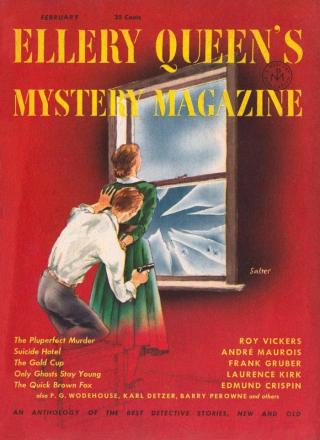
Ellery Queen’s Mystery Magazine. Vol. 19, No. 99, February 1952
- Автор: Грубер Фрэнк, Кемельман Гарри
- Год: 1952
- Язык: английский
- Год: American Mercury
- Жанр: Другие детективы

Электронная книга - «Ellery Queen’s Mystery Magazine. Vol. 19, No. 99, February 1952». Краткое содержание книги:
“ ‘I do not know precisely when it began to dawn on Holmes that for years he had been gulled by his crony, but I am satisfied that he was in possession of the true facts of the matter by the time they reached the Meiringen Hotel. On the instant (just several years too late) Holmes realized that he was in a peculiarly humiliating situation. It takes little effort to imagine how he would have been greeted by, say, Lestrade if he returned to London and admitted the success of Watson’s deception. Sooner than make himself such a laughingstock, Holmes would disappear — and finally.
“ ‘Or, at least, with the appearance of finality. He did not relish the idea of disappearing forever. But in a year or so, three at the outside, things would have blown over, and he could reappear in his old haunts.
“ ‘But what was to happen to Watson during this period? Obviously, he could not be permitted to continue terrorizing London in his guise as Moriarty. The great criminal must vanish for good.
“ ‘In addition, Holmes had to make certain that the cause of Watson’s criminal tendencies — that dreadfully weak moral fibre of his — disappeared too. His vicious tastes were acquired rather than inherent, and would in time respond to treatment. I have no doubt that Watson, on the advice and entreaty of Holmes, entered some sort of institution. Certainly, it is curious that Watson never mentioned precisely where he was during Holmes’s three-years’ absence.
“ ‘When the plans were settled, the pair staged the comedy at the Reichenbach Fall. Holmes carefully planted the alpenstock and cigarette case to be “discovered” later. The man “seen” by Watson walking towards the Fall was seen by nobody else, and was merely an invention. The doctor himself admitted that the message from the sick Englishwoman, his excuse for leaving the Fall, was a fake. But I have sometimes wondered about the messenger from the hotel, the Swiss lad who was never seen again. Did they, to add verisimilitude to the tale Watson was to tell, perhaps push—?
“ ‘The rest is soon told. In three years Watson is back in London. But so too is the human tiger, Colonel Moran, and, mark this well, Moran was the only man left who knew the criminal king by sight. What happened? Most opportunely — in fact, suspiciously so — Holmes reappears from the dead, and Moran is removed in short order.
“ ‘That ends my case, members of the Examining Body, against the greatest of them all — the king of the kings of crime, Dr. John H. Watson. If I may add a final word, Experto crede. (Signed) T. A. LaMont’.”
“Well!” said Miss Jane. “Well!” The priest clapped his hands delightedly. The Frenchman caressed his beard. The doctor wheezed happily, the Virginia squire nodded his great head approvingly, and the silver-eyed American wore a charmed smile. Sam made himself another cigarette.
His lordship spoke. “I don’t want to be accused of influencing you unduly, but I do want to say that if you don’t elect this man immediately, you’re blithering asses.”
“One of the benefits of a liberal education” — the American detective fiddled dreamily with his pince-nez — “is that it makes one adept at solving simple anagrams.”
“You don’t miss much, do you? Well, let’s put it to the vote. All those in favor of the election of Mr. T. A. LaMont? Those against? No Nos? Excellent. Then I have the pleasure and privilege of awarding a Doctorate of Crime to my great teacher, Mr.—”
“T. A. LaMont,” warned the Body hurriedly.
His lordship groaned, then sighed happily. “Thanks. Nearly upset things at the last minute, didn’t I? To Mr. T. A. LaMont. The meeting is now adjourned — until next year.”
Strychnine in the Soup
by P. G. Wodehouse {Copyright, 1930, 1931, 1932, 1933, by Pelham Grenville Wodehouse}
Late in 1949, Pocket Books published THE BEST OF WODEHOUSE, selected and with an Introduction by Scott Meredith. In this “sampler” — “a million dollars’ worth of enjoyment” which went on to sell more than a million copies — Mr. Meredith included what he considered the best short story about each of Wodehouse’s best-known characters. Thus, the sampler contains some of the finest tales about Jeeves (played in the movies by Arthur Treacher), Freddie Widgeon, Mr. Mulliner, Ukridge, Lord Emsworth, Bingo Little, and others. Mr. Meredith’s choice of a Mulliner story was “Strychnine in the Soup,” and if it isn’t the best Mulliner, surely it is top-grade, A No. 1, nonpareil, one of the fairest flowers of the flock, and generally five-star of its bind.
In his Introduction, Scott Meredith tells more about P. G. Wodehouse than you will find in all the standard biographical tomes. He points out, for example, that “Wodehouse is the only writer in the world who can cause other writers to stop raving about their own work and rave about his”; that “Wodehouse is one of those rare, genuinely modest people... who turns around to see who is standing there when the applause begins for him”; that “the secret of Wodehouse’s magic art is about as easy to pin down as a strip of quicksilver in a pool of water”; and last, but decidedly not least, that all Introductions to Wodehouse are sheer lunacy, since “only a lunatic would continue to read this writer when he can be reading P. G. Wodehouse.”
Mr. Meredith is a dyed-in-the-wool devotee — and who can blame him?
From the moment the draught Stout entered the bar parlor of The Anglers’ Rest, it had been obvious that he was not his usual cheery self. His face was drawn and twisted, and he sat with bowed head in a distant corner by the window, contributing nothing to the conversation which, with Mr. Mulliner as its center, was in progress around the fire.
From time to time he heaved a hollow sigh.
A sympathetic Lemon and Angostura, putting down his glass, went across and laid a kindly hand on the sufferer’s shoulder.
“What is it, old man?” he asked. “Lost a friend?”
“Worse,” said the Draught Stout. “A mystery novel. Got halfway through it on the journey down here, and left it on the train.”
“My nephew Cyril, the interior decorator,” said Mr. Mulliner, “once did the very same thing. These mental lapses are not infrequent.”
“And now,” proceeded the Draught Stout, “I’m going to have a sleepless night, wondering who poisoned Sir Geoffrey Tuttle, Bart.”
“The Bart was poisoned, was he?”
“You never said a truer word. Personally, I think it was the vicar who did him in. He was known to be interested in strange poisons.”
Mr. Mulliner smiled indulgently.
“It was not the vicar,” he said. “I happen to have read The Murglow Manor Mystery. The guilty man was the plumber.”
“What plumber?”
“The one who comes in Chapter Two to mend the shower bath. Sir Geoffrey had wronged his aunt in the year ’96, so he fastened a snake in the nozzle of the shower bath with glue; and when Sir Geoffrey turned on the stream the hot water melted the glue. This released the snake, which dropped through one of the holes, bit the baronet in the leg, and disappeared down the waste pipe.”
“But that can’t be right,” said the Draught Stout. “Between Chapter Two and the murder there was an interval of several days.”
“The plumber forgot his snake and had to go back for it,” explained Mr. Mulliner. “I trust this revelation will prove sedative.”
“I feel a new man,” said the Draught Stout. “I’d have lain awake worrying about that murder all night.”
“I suppose you would. My nephew Cyril was just the same. Nothing in this modern life of ours,” said Mr. Mulliner, taking a sip of his hot Scotch and lemon, “is more remarkable than the way in which the mystery novel has gripped the public. Your true enthusiast, deprived of his favorite reading, will stop at nothing in order to get it. He is like a victim of the drug habit when withheld from cocaine. My nephew Cyril—”