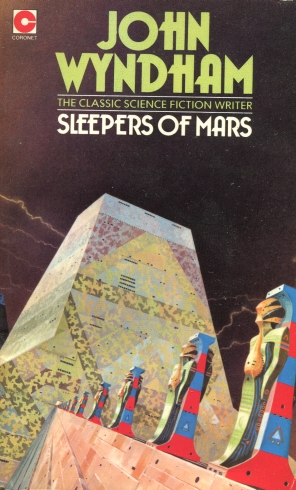
Sleepers Of Mars
- Автор: Уиндем Джон Паркс Лукас Бейнон Харрис
- Год: 1977
- Язык: английский
- Год: Coronet Books/Hodder & Stoughton Ltd
- ISBN: 0340173262
- Жанр: Научная фантастика

Электронная книга - «Sleepers Of Mars». Краткое содержание книги:
Of course, we are now well used to the idea of Man On The Moon, we have become blasé as to the possibilities of inter-planetary travel. But imagine two expeditions to Mars, one British, the other Russian, both in the process of discovering a mechanical race, invented and produced by the Martians as they believe their specie to be dying.
The other four novellas in this collection give further evidence of John Wyndham’s genius at invention, characterisation and sense of movement.
‘ “Can’t you think,” I demanded, “in any terms but gun and gases?”
‘ “They might have ignition rays,” he assented. I groaned.
‘ “Of course they might have, but can’t you see what I’m getting at? They simply haven’t been developing along those physical lines.”
‘ “They seem to have developed physically a great deal, if your description is accurate.”
‘ “Their present form was probably reached tens of thousands of years ago—to them, that is. It’s their minds which have progressed since then. If only you could meet them, you’d begin to feel that terrifying force. Man alive! It was as much as thirty of us, most of them brilliant men, could do to overthrow the mental suggestion of one of their inferior servants.’’-‘The official smiled.
‘ “And their flyer…. Do you realise that there was no one save the Committee on board—no pilot, no crew? The whole blasted thing was worked by a telepathic control of some kind.”
‘ “We also have radio control,” he reminded me gently.
‘I began to admit to myself what I had known from the first— that it was hopeless. But still I hammered on.
‘ “You don’t realise what they are working for. We speculate mildly about the future of mind—they know its future. They are out for discarnate intelligence. They know that, given time, they can achieve it.”
‘ “Nonsense! There can’t be a mind without a brain.”
‘ “Why not? The brain is only the organ of the mind, a sort of central control for the other organs. Already they can project their minds, but they still have to use the body as a base for operations.”
‘ “You seriously expect me to believe that?”
‘ “There’s proof of it. Did you hear the voice which issued their ultimatum?”
‘ “Yes.”
‘ “And it came from the loudspeaker?”
“Yes.”
‘ “Then perhaps it will surprise you to know that in London they took a record of one of the messages. When they put it on the machine, not a sound was to be heard—the thing was blank. Those messages never came out of the loudspeaker; but the dwarfs, for some reason of their own, made you think —made us all think they did.”
‘In the evening, when I met Mary, I was tired and discouraged. Nothing I had been able to say had even dented that wall of mechanical materialism. My most trenchant arguments had either bounced off or missed fire. The final blow had been when, in the middle of my efforts to convey my impressions of mental strength, he had asked, with the air of one who draws the conversation back to realities, whether I thought they might have tanks hidden in the neighbourhood.
‘ “It isn’t,” I said to Mary, “for or against acceptance of the dwarfs’ terms—as for that, I only know that I, personally, am going to no dying world. My job was to try to make the fools realise they really were terms. For over two hours I tried to tell that smug know-all that an overwhelming danger threatens him, the nation and the whole world. But I made just as much impression as I would throwing snowballs at a pyramid.”
‘Mary gazed at me intently. “It’s very difficult to grasp,” she said. “Even yet I don’t really understand what this great danger is, if they haven’t got any weapons.”
‘ “That’s the devil of it. They may even have some weapons in the way you mean—though I don’t think so—but that is nothing to do with their strength. Oh, if I could only convey that sensation which scared us all, something might be possible, but I’m utterly incompetent. If you asked a horse to explain the activities of men, he’d be no more helpless than I am over this business.”
‘ “But, dear, if there are so few of them, why should they want the whole world? Surely they could make a sort of colony somewhere?”
‘ “I don’t know, but I think this is a sort of advance guard— supervisors of emigration and immigration; we don’t even know how many of them there are. Probably the world couldn’t support both populations at once, so that the only way is a complete change-over. Half the worry about this affair is that we know nothing of the details—we’re just expected to do as we’re told.”
‘Mary bent towards me, and tried to smooth out the furrows of anxiety.
‘ “Darling,” she said firmly, “you must stop worrying about it. Put it all away for the present.”
‘She took my arm and we strolled out on to the terrace. A soft breeze pressed the trees so that they swayed gently. Slips of torn cloud were gliding across the Moon. Far, far away, we could see the misty outline of the hills.
‘ “It’s all so beautiful,” she whispered, her eyes on the dim distance. “I think it makes me afraid.” My arm went round her.
‘ “Our lovely world,” said my voice.
‘“But how long ours?” asked my mind.
‘A month later, we were given a glimpse of hell. We were shown our civilisation for what it was worth; how all our vaunted progress had taken us no farther than the first rung of the ladder; and with that rung broken, we were back where we had started.
‘For a day and a night, a whole twenty-four hours, the dwarfs stole our power, took away the essential prop of our lives. By what means they made the Lestrange batteries go dead, I can’t guess, but they did; and with that our world stopped. Save in the great tide-stations, which still made power for the useless batteries, not a wheel could turn.
‘It was chaos…. Planes fluttered from the skies, ships wallowed in the seas, airships floated away on the winds, factories were silent, elevators dropped, trains were checked, ovens cooled, radios died, cars were pulled up and every light failed. ‘It was nine o’clock at night when the great stoppage came, and it was the darkness which caused the panic. Across the world, in the sunlight, they cannot have had that catastrophic madness in which crowds rushed, milled and swirled without reason, without object. How it was done, nobody knew. Perhaps it was a ray against which they shielded their travellers. Perhaps … but what is the use of speculating on the possibilities of such minds?
‘I was in the city; the roar of the city’s life rose through my open windows. One moment, busy hubbub and bright lights; the next, silence and darkness. I stumbled across the room and looked out into a pitchy gulf which might have led to the bowels of the Earth, it was so quiet. It was a quiet which seemed to wait—a quiet during which men died; during which cages dropped down mines, divers got no more air, loads fell from cranes, acrobats missed trapezes, surgeons cut too deep.
‘From below there came a scream and, as if at that signal, a murmuring rose: the voice of the crowd growing louder and louder, wilder and wilder. My eyes could see nothing, but my mind saw devilish things happening in that streeet. Bodies crushing at the walls, ribs cracking under pressure, eyes bursting from their sockets, lungs labouring for air, corpses trampled underfoot and corpses unable to fall; while above it all rose now the senseless roar of that wild beast, the mob, destroying itself.
‘I moved back and sought the telephone, only to find it as dead as the lights. It was not until then that the full meaning of the crisis came to me. At first it had seemed only an unusual failure of current. Now I realised, in a flash, just what it meant, and knew it for the dwarfs’ master stroke.
‘They had been roused from their patience at last. Of the several messages sent out on their worldwide system since our useless investigation, I had heard only one. It was almost pleading in tone.
‘ “Our destinies must be worked out; nothing shall stop that. We wish you no harm—we are not butchers—but you are leaving us no alternative.”
‘The voice went on to appoint “stations” for transportation. In the northern plains of Italy; North and South France; near Johannesburg, South Africa; Salisbury Plain in England; in Florida, California and Illinois for the United States; and so on, to the number of sixty or more.