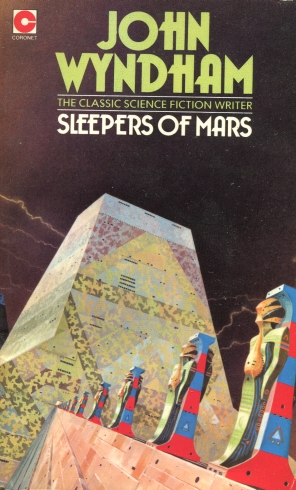
Sleepers Of Mars
- Автор: Уиндем Джон Паркс Лукас Бейнон Харрис
- Год: 1977
- Язык: английский
- Год: Coronet Books/Hodder & Stoughton Ltd
- ISBN: 0340173262
- Жанр: Научная фантастика

Электронная книга - «Sleepers Of Mars». Краткое содержание книги:
Of course, we are now well used to the idea of Man On The Moon, we have become blasé as to the possibilities of inter-planetary travel. But imagine two expeditions to Mars, one British, the other Russian, both in the process of discovering a mechanical race, invented and produced by the Martians as they believe their specie to be dying.
The other four novellas in this collection give further evidence of John Wyndham’s genius at invention, characterisation and sense of movement.
‘Exclamations of surprise rose from the party. There can hardly have been one of us who did not realise, in that moment, that we now faced a living replica of those two bodies which had puzzled the medical world. The same massive neck supported the same front-heavy head, from which two intelligent eyes examined us. For clothing he wore nothing but a brown, shapeless tunic and a pair of soft boots.
‘As we stared, a voice commanded us to follow, but the dwarf’s lips showed no movement. We passed into a large hall lit by some sourceless, diffused radiance. In rows of chairs, we seated ourselves as if for a lecture. The five-foot figure took a chair in front of us.
‘It was curious that, in facing the man, I felt none of the distaste one has for an abnormality. It became forgotten that by our standards he was stunted, malformed, hairless, toothless and deaf. He was of another race—no more abnormal than a pygmy or a Tibetan. He addressed us, but still no movementbroke his lips.
“‘People of the Twenty-Second Century,” he formally began, “you are evidently less advanced than we had anticipated; So far, it would appear that you do not accept our offer of transportation, but neither do you reject it—you completely fail to understand it. You must, therefore, be treated like children to some simple demonstrations of our power. First, you shall see the world we offer.’
‘Upon the wall behind him, a scene “faded in.” Not like a picture, but rather as if we gazed at a real, if fantastic countryside. A level plain stretched away to the distant mountains. In the foreground stood buildings; a city of gleaming metal, each structure beautiful in line and proportion, but none rising higher than two or three floors.
‘ “The town of Cyp,” said the voice. “It stands on the bottom of the old Mediterranean Sea, close by Mount Cyprus. You will notice that it is low-built. This is necessary, as the air at such high altitudes is rarefied. On the Atlantic or Pacific beds”—here the scene changed—“the towns are loftier, since the atmosphere remains dense at such depths. Though the oceans have dried, it is no barren world. The great deeps still contain enough water, and will do so for some hundreds of years. After that is gone, there are the machines.”
‘A gloomy-looking tarn flashed before us. Deep in its darkness was a reflected glimmer of the red ball of fire above.
‘ “The Sun is getting old,” said the voice. “Slowly he is dying, as he must, but there is a long time yet before his end.”
‘View began to chase view rapidly across the screen. The voice went on:
‘ “All this is what we offer in exchange for your world. Buildings which will still be standing proudly when the Earth has become cosmic rubbish as the Moon. Machines to make food, supplement air, create warmth and produce water, all are waiting for you. Machines which are proof against wear, proof against breakdown; wheels which will go on turning when the untenanted world snuffs out the last smouldering fragment of her fiery life.
‘ “Though much of it will defy your minds, you will have all the accumulation of wisdom and invention that the wit of man has produced since he began. All save one thing—the secret of Time; that is our safeguard, which even we must use with care lest order become chaos.”
‘Still the scenes flashed and faded before us. Mighty machines, beautiful cities, intricate flowers, limitless plains, vast halls, huge flying cylinders: a panorama of a world shown to us half a million years before it should exist. Most of us were dazed, but we did not doubt. Conviction that this was the truth came not entirely from the voice nor yet entirely from the pictures, but from some power which seemed to accompany both.
‘In the presence of the dwarf, the fantastic ceased to be fantastic, and any thought of bluff had long been banished. The case was stated with plain force. He had made us feel that the plan was as feasible as for two nations to change territories —as feasible, and as inconceivable.
‘That our population could, if it chose, move half a million years, we had no doubt; but that it would not so choose, we were certain. If the invaders thought that they had but to say the word and we would relinquish our healthy, middle-aged world for one tottering on the brink of senility, they could not know much of our stubbornness.
The tall professor Toone, of Harvard, rose from his seat.
‘ “On behalf of all of us, I should like to know the reason for this plan,” he said. ‘‘You appear to offer us much. What do you gain that we lose?”
‘ “You lose,” replied the voice, “nothing but familiar surroundings. We offer better surroundings.”
‘ “But,” objected someone, “what about our children? Several generations are safe, you say, but you condemn the rest to extinction?”
‘ “Some, but not all. You ensure for the others an infinite future—if you understand such a term. That is the object of the plan.”
‘ “But-”
‘ “Do you not yet realise that we are your descendants—the descendants of your children? We are the race your stock has bred and, though we have climbed far, the end is too near for us. Were we to stay in our age we should die when the Earth died.
‘ “Instead we shall take the more youthful Earth, for our need is the greater. From it we shall climb to infinity, as life climbed from the sea to the land. Thus will we, your children, approach the closer to our destiny. It was not meant that life should cease with the Earth—evolution was delayed. Do you understand?”
‘ “Hanged if I do,” murmured the man next to me. “What he getting at? Is it religion?”
‘I did not answer him. I was trying to understand. The speech had been far longer than the repetition I have give you. Much of it I still cannot grasp. The vista was too big, the muddle of time too involved, but I thought I had the main drift. The next speaker almost voiced one of the questions which troubled me, though his manner was facetious. He was an Englishman, whose voice sounded tired as he asked:
‘ “Am I to understand that, though we are at present your ancestors, you are shortly likely to become your own ancestors?”
‘ “Yes,” said the voice, “and no.” The Englishman looke helplessly around.
‘ “I give it up,” he announced, in tones even more tired than before.
‘ “You cannot understand that until you know the nature of time,” was the reply. “While you continue to imagine time in terms of progression, you put more stumbling blocks before you than did ever the flat-Earth theorists.”
‘Professor Toone arose again to put a question. I cannot remember what it was, for at that point the discussion started to leave me behind. Voices went on wriggling into an abstruseness beyond my mental grasp. It was a kind of knock-out contest—the survival of the mentally fittest. When Sir Henry Deen rose to his feet, a long time later, there can only have been two or three of the company who retained any pretensions to following the slender thread of explanation. He broke the spell.
‘ “Can we be shown something of your works, something concrete upon which we can report? So far, we have done nothing which will profit either you or those who sent us. The public we represent will scarcely be impressed by hearing merely of a philosophical discussion which most of us have failed to follow. Any intimation we could give them of the forms of armament upon which you rely to carry out this plan would be vastly more impressive than an unlimited amount of discussion.”
‘ “You shall look around our building, though there is little to see. In the matter of armament, we must disappoint you,” the voice replied. Sir Henry grunted.
‘ “Intending to keep that secret, eh? Very sensible too, from our point of view; but if you could give a demonstration of your weapons’ power ..
“You mistake us,” the voice reproved. “We cannot show armament because we have none.”