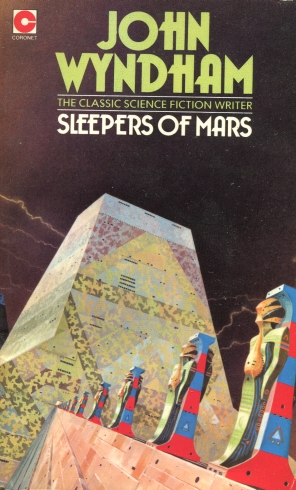
Sleepers Of Mars
- Автор: Уиндем Джон Паркс Лукас Бейнон Харрис
- Год: 1977
- Язык: английский
- Год: Coronet Books/Hodder & Stoughton Ltd
- ISBN: 0340173262
- Жанр: Научная фантастика

Электронная книга - «Sleepers Of Mars». Краткое содержание книги:
Of course, we are now well used to the idea of Man On The Moon, we have become blasé as to the possibilities of inter-planetary travel. But imagine two expeditions to Mars, one British, the other Russian, both in the process of discovering a mechanical race, invented and produced by the Martians as they believe their specie to be dying.
The other four novellas in this collection give further evidence of John Wyndham’s genius at invention, characterisation and sense of movement.
‘He had become separated from his unit and was heading for home, in accordance with the regulations that single planes must not be risked, when he saw almost below him the shining building for which all the world was searching. Whether his mind was not susceptible to their control, as was found to be the case with a few, or whether they were off their guard, never was known and did not really matter. What did matter was that his five great bombs flashed down together.
‘It must have been a rude shock to that pilot when, during his congratulations and celebrations, the voice spoke again.
‘“People of the Twenty-Second Century,” it began, with usual formality, “we appealed to you first as reasoning creatures. You failed to reason. You even failed to understand, that, if we are not successful, man will count for nothing—will have lived in vain. Then we treated you as children who must be led, and you spoke of it as a tragedy. You described as “casualties” men and women who are now living in the future, not one cell’s life the worse for the journey.
‘ “Now you have taught us to know you for savages. Your ridiculous bombs did no harm to our building, but you killed thirty of our people who were outside. Those thirty were worth a thousand of you, and you killed them by an action no more reasoned than that of a frightened brute. We shall not kill you in revenge—the art of living is not killing—but we warn you that those who remain here three weeks from now will start to kill one another. For the rest, the transporters will be at their stations. Make good use of them.”
‘Hundreds of thousands laughed. “We’ve killed some of ’em—we’ll beat the lot,” was their attitude. But other thousands heeded the warning, surging in crowds to the machines.
‘Mary and I were of neither party. I suppose it was sentiment which held us. The road to safety was plain, for the dwarfs never lied, yet the call of familiar things was too strong. We were standing by the world we loved till the last, going down with our civilisation.
‘All governments published futile edicts forbidding approach to the transporters. Planes were headed off, trains stopped, roads blocked, but still the crowds swept forward on foot. Infantry and tanks, sent to turn the stream, only joined it. The authorities reached their wits’ end.
‘The English sent rocket-shells against the Salisbury Plain station. Hundreds of their own people died. The transporter was scarcely scratched. In California, two men, finding themselves immune from the dwarfs’ influence, attempted to steal a small time-traveller—and were never seen again. Thereafter, the dwarfs arrived in pairs, one to work the transporter while the other guarded their travellers.
‘For the full three weeks, the huge machines made their two or three journeys a day, but the hundreds of thousands they carried were like a few spoonfuls from a full bucket.
‘And now, standing in my dark room, I knew that the end had come. Men and women had started to fight insanely, in a frenzy of fear. Soon they would become hungry. They would prowl like famished beasts, ready to eat even each other. It would not be long now, before the multitudes were besieging the only means of escape from a maddened world—the transporters.
‘In my mind a plan was growing; a slender chance. First I must get out of this crazy city and find Mary….
‘Together we lay in a clump of low bushes. Not far from our hiding-place, a line of haggard men and women was struggling towards a transporter.
‘ “The evacuation of a world,” I heard Mary murmur.
‘Some dragged barrows of possessions; some could barely drag themselves. There was no need, now, for suggestion to impel the crowds. They were striving their utmost towards those feared or despised machines, which had become glittering symbols of rescue. Many staggered from fatigue, to fall in their tracks.
‘ “If the dwarfs use suggestion to help on the fallen ones, count,” I said. “They won’t need much power, and if you keep your mind full it can’t touch you. Fill it up with figures. Multiply and multiply, so that there’s room for nothing else. It’s our only safeguard.”
‘Luckily, there was no test of our concentration. Friends pulled the stragglers up and urged them along the last lap of the journey. At last, the transporter was filled; the entrances clicked together. Those who were shut out retired, to throw themselves on the ground. They would have to wait for the next load.
‘ “Get ready,” I whispered to Mary, as I drew a rocket-pistol from my pocket.
‘The two small time-travellers appeared. One dwarf ran to the transporter; the other sat on the ground in his saddle. I reckoned that the big machine would be away about twenty minutes, since it would take that long for the weary crowd to file out. As the first dwarf vanished with the transporter, I drew my aim on the second.
‘It is a horrible thing to kill a man who is off his guard, but it was necessary. Merely wounded, he might bring his friends about us in a few seconds.
‘ “Now !” I cried. And together we sprang for the travellers, as the dead dwarf rolled from his seat. “Get on,” I ordered, setting the dials. I put Mary’s hand on the level. “Pull!” I said. But, instead, she leaned out and pressed her lips to mine.
‘ “I love you,” she said. She said it as though she knew the end had come. Then her hand flew back to the lever. I shouted to stop her, but it was too late—she had gone.’
Jon paused in his tale. We did not interrupt; the grief in his face held us silent.
‘Where is she now, I wonder?’ he said slowly.
‘When she drew back her hands, it brushed one of the dials. I had been so careful, had worked out the position of each to a hair, so that there might be no delay in our coming here; so that we might travel together far away from our world of chaos, far away, too, from the threat of a dying world. One hasty move she made, which may have carried her farther than the Earth’s death or beyond its birth. She is a castaway somewhere in the jumble of Time and Space….’
‘But you?’ asked Lestrange. ‘How-?’
‘Oh, I jumped on the other machine. The crowd had seen us. A hundred or more of them were pelting across the field. It was as though I had the one lifebelt on a sinking ship. They jumped at me. The traveller rocked as they hit it. It was falling as I pulled the lever—it fell in your laboratory.
‘But what’s the good of it all? I’m alone. Better to have gone on to the end with the people of my time. Why did I come here when I knew she couldn’t be here? If I’d kept the machine, I might have searched—I’d have searched all Time to find her.’
A bell on the wall shrilled suddenly.
‘Quick, Wright !’ said Lestrange, jumping from his chair. ‘The laboratory alarm. Somebody’s spying—take this.’
He handed me a pistol, and held one himself. Silently we raced to the laboratory wing, and flung back the door. A familiar silver framework glittered at us. Beside it stood a figure, clad like our visitor.
‘Mary, by heaven! ’ said Jon’s voice behind us.
‘Jon! Jon! ’ the figure cried, and ran towards us.
A few moments later, Jon Lestrange walked over to the traveller and examined its controls curiously. He looked up with a smile.
‘Obviously, Mary,’ he said, ‘some patron saint guides your hand. You might have altered the setting by six hundred years, or six thousand, but you did only alter it by six hours.’
He turned towards Professor Lestrange.
‘If you please, great-great-great-grandfather,’ he said, ‘I should like another piece of string.’
INVISIBLE MONSTER
CHAPTER ONE