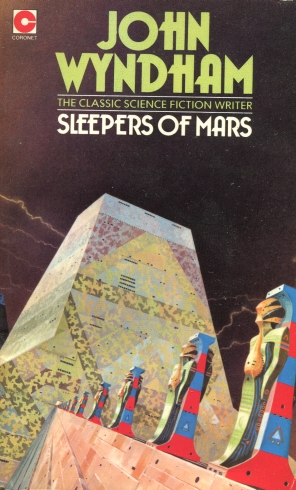
Sleepers Of Mars
- Автор: Уиндем Джон Паркс Лукас Бейнон Харрис
- Год: 1977
- Язык: английский
- Год: Coronet Books/Hodder & Stoughton Ltd
- ISBN: 0340173262
- Жанр: Научная фантастика

Электронная книга - «Sleepers Of Mars». Краткое содержание книги:
Of course, we are now well used to the idea of Man On The Moon, we have become blasé as to the possibilities of inter-planetary travel. But imagine two expeditions to Mars, one British, the other Russian, both in the process of discovering a mechanical race, invented and produced by the Martians as they believe their specie to be dying.
The other four novellas in this collection give further evidence of John Wyndham’s genius at invention, characterisation and sense of movement.
‘Neither Mary nor I knew what to make of it—indeed, we heard it only subconsciously. Tomorrow would explain. Tonight, we had more important matters to discuss.
‘The next day did not explain; it only complicated. Where did the voice originate? How had it compassed all wavelengths? How was it of equal strength at antipodes? Why did no picture of the speaker come through on the television screens? It caused a vague uneasiness. Though no one understood nor took much interest in the message itself, the curious form of transmission was disturbing to a world unused to new inventions.
‘The general attitude of science had resulted in the feeling that things were very well as they stood and that tamperers should be put down with a firm hand. Even the type who immediately attributes the incomprehensible to a form of practical joke felt that easy solution to be inadequate. The mass of the people wondered unintelligently, suggesting hazily that “something ought to be done about it.” Governments officially disregarded it, and privately, did not know what to make of it.
‘A few days later came the second world wide call. Mary and I were sitting at the open window when the voice made us jump round.
‘ “But I shut the radio off,” said Mary in surprise.
‘I crossed the room and inspected the switches. Undoubtedly they were out—though there might be a short somewhere. I pulled the leads from the speaker, and then stared at the thing in amazement, for the voice still continued:
“… seems, in view of the fact that no preparations have been made, that you have not understood our intentions…
It was uncanny. I picked up the speaker and carried it across the room. I know a few tricks to make an unattached speaker work, but none of them was being used here. The voice went on:
“‘… not our wish to hurt anyone, but such as do not accede to our demands must be eliminated. It is suggested that, for the purpose of convincing yourselves that this is no empty threat, a committee shall be appointed to visit us and report its findings to the world. Thus you shall be convinced that obedience to our will is the only course not leading to elimination. This committee will gather at the Paris Air Station, whence we will provide a means of travel one week from today at exactly this hour.”
‘I looked at Mary, and she at me. There was trouble in our eyes. There was something behind that unemotional voice which told us that this affair was far from a practical joke. Feeling, not reason, told us it was serious.
‘ “I am going on that committee,” I said at last. “Somehow or other, I’ll join it and find out what’s at the bottom of all this.”
‘Mary nodded. “Good, Jon; that’s like you,” she approved. Then a little frown appeared. “You don’t think it’s dangerous?”
‘ “Not a bit,” I assured her. “There’d be no point in assembling a committee just to kill its members—or ‘eliminate’ them, as the voice puts it. They might just as well start ‘eliminating’ right away. No; I think, whoever they are, they’re on the square, and though the whole show sounds insane, there’s something pretty big behind it.”
‘Far below, we had seen the coast of France slip away from beneath our queer craft. Now, through the thick glass windows, the blue waves of the Mediterranean twinkled at us. Around me, as I gazed down, buzzed the tentative suggestions of a puzzled committee.
‘Such influence as I possessed had been exerted with successful results. A large air liner had carried me rapidly from home to drop our gliding tender at Le Bourget, the Paris airport. There I had found a group awaiting the craft promised by the radio voice. It was a cosmopolitan collection of Americans, Germans, English, French, Japanese, Chinese, Indian and most other nationalities.
‘Not one of them officially represented his government. The rulers assumed an ignorance of the ultimatum; nevertheless they had assisted brilliant men to attend. The unknown had managed to infuse into his short speeches some quality which attracted many intellectuals.
‘I had left myself a narrow margin, for within an hour of my arrival our craft was sighted. At a great height the watchers saw a silver cylinder hurling itself towards us. At that moment I believe, some began to realise the possibility of a menace. All eyes gazed up.
‘Only random guesses as to the size of the craft could be made at such a distance, but as it drew nearer we judged it to be about equal to one of our larger airships. Built of silvery metal, it tapered at each end, and along the sides were rows of windows. Nothing more was to be seen; it gave no clue to the manner of the propulsion.
‘Suddenly from all the loudspeakers, both in the control tower and around the ground, snapped the one word: “Landing.” The ground crew rushed for the lighter-than-air machines hurriedly assembled, and then found that there was nothing for them to do. Down and down the great cylinder dropped, to land as lightly as a leaf.
‘ “The Committee will come aboard,” said the voice we were beginning to know so well. Simultaneously, sections of the hull opened outwards, the hinges being at the bottom, so that the doors themselves formed ramps.
‘For a moment, we looked at one another in hesitation, then we stepped forward as though by common consent. There was no one to welcome us on board. Into a great saloon, seemingly the full length of the ship, we flocked. With a click, the doors closed and we were off to heaven knew where. Thousands of feet above the ordinary traffic levels, we turned and sped to the south.
‘After the first surprise of departure had worn off, we found our tongues again. It seemed as though most of us found them at the same moment.
‘“I do not like this affair; not at all—no!” said a little Frenchman whom I recognised as M. Duvain of the French Air Roads. “It is all too mysterious. Are we children that they make to us the effect of the stage thrill? It is a bad begin, such nonsense, for the serious investigation, no?”
‘ “Damn ridiculous, the whole thing,” replied Sir Henry Deen, standing near. “Silly scare by some jokers, in my opinion. However, they’re in for it now. We’ll soon show ’em what’s what!
The Frenchman nodded his agreement. “And you, m’sieur,” , turning to me. “Do you not think it is an insult to treat a so distinguished party as a flock of sheep? No reception, no speeches?”
“If it is a practical joke,” I suggested, “you don’t want to be made more of a fool, do you?”
“Then you, too, think that it may be a practical joke?” asked Sir Henry. I informed him that I had come to observe and to draw conclusions from those observations. I had no intention of muddling myself by prejudice, nor of building theories without foundation. Not a polite answer, but the pair irritated me.
‘ “The desert!” shouted someone. I turned back to the window, and saw that we were heading over miles of rolling sands towards the heart of the Sahara.
CHAPTER THREE
THE SENILE WORLD
‘Three quarters of an hour later, the familiar voice gave its laconic “Landing.” Below us lay a building. It was shorter than the craft we were in; some three hundred feet by one hundred and fifty, and rising about sixty. The whole place was entirely constructed of the silvery metal.
‘The ship settled without a jar. The doors fell open and we walked out, to find ourselves face to face with a seamless, shining wall, in which one patch of darkness framed a waiting figure.