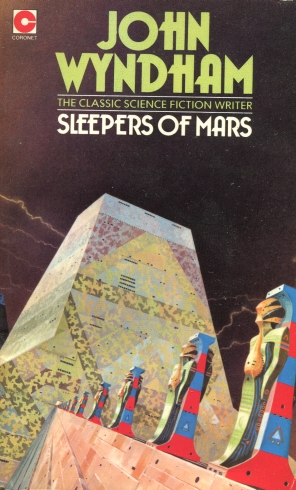
Sleepers Of Mars
- Автор: Уиндем Джон Паркс Лукас Бейнон Харрис
- Год: 1977
- Язык: английский
- Год: Coronet Books/Hodder & Stoughton Ltd
- ISBN: 0340173262
- Жанр: Научная фантастика

Электронная книга - «Sleepers Of Mars». Краткое содержание книги:
Of course, we are now well used to the idea of Man On The Moon, we have become blasé as to the possibilities of inter-planetary travel. But imagine two expeditions to Mars, one British, the other Russian, both in the process of discovering a mechanical race, invented and produced by the Martians as they believe their specie to be dying.
The other four novellas in this collection give further evidence of John Wyndham’s genius at invention, characterisation and sense of movement.
‘This relationship …?’
‘Our family has been proud of its direct descent from you and your wife, Joy.’
Lestrange and I looked at one another. Now, there was no doubt that the man was off the rails somewhere.
‘But I’m not married. I-’
‘Please let me go my own way. It is a difficult situation, but I hope I shall convince you. Very few men can have had the chance of convincing their great-great-great grandfathers of anything…. But I am now an anachronism. You see, I was born in the year a.d. 2118—or should it be, I shall be born in 2118?—and I am—or will be—a refugee from the twenty-second century. I assure you that you will be married shortly, but I can’t remember when—I think I told you I was not very good at dates.
‘It will probably be easier for you if I tell you the story in the past tense. Certainly, it is a past life for me. You saw me burn my bridges when I tied the string to that machine….
‘Of the nature of time, we of the twenty-second century knew little more than you of the twentieth. Habit of thought still caused us still to think of it in terms of progression along a straight line. We were aware, of course, that this was inaccurate, yet for all practical purposes it serves us as well as it had served the world for thousands of years before.
‘Because I am here now, I know that time is somehow folded or circular so that it is all co-existent, or non-existent; but of the working principle of that machine which brought me here, I am as ignorant as you. I set the dials, pulled the lever—and there was your laboratory. And I daren’t keep the thing to examine it. It’s almost certain that the owners had some way of tracing it, and that wasn’t a risk worth taking.
CHAPTER TWO
A VOICE FROM THE FUTURE
‘The world I was living in was not all you twentieth-century men expected. It would have disappointed Wells and his fellow prophets to have had a true vision of a.d. 2145. We were on another swing of the pendulum. Scientific progress in the sense of physics, chemistry and engineering, had slowed its advance to a minimum while the world caught up and readjusted. By the end of the twentieth century science was so far advanced that civilisation was becoming seriously lopsided, so that nature tended to restore the balance.
‘Even today I expect you can begin to see how large-scale production has begun to upset politics and social conditions which were designed to cope with a simpler way of life. It is making war no longer the solution of difficulties; it is uprooting the old order of things but not reorganising. So you will see that I come from a world in which Mr. Wells’ “Sleeper” might awake, but from an age which had spent the previous century improving its institutions rather than its machines.
‘Since the year 2000 the Lestrange battery, of which you have heard me speak, had been almost the only driving agent for machinery. In 2000, Mr. Lestrange, the internal combustion engine will have passed away. The whole world’s trains, ships, planes, radios, cranes, everything save the most ponderous machines will be depending upon your discovery.
‘It is strange to tell a man of his results before the experiment has been made. Nevertheless I assure you that your little storage battery is going to have a greater effect upon the whole world than any other single invention in the history of mankind. Even the machine which brought me here depended upon a modified form of your battery to carry it across half a million years.’
‘But you said-’
‘Oh, yes, I have taken only a little local trip on it. A mere jaunt of a couple of centuries….
‘Looking back, I can see that the first sign of the crisis we were to face occurred about a year ago—to me—in the summer of 2144. An account was published, by newspapers and radio, of the derailing of a train—it was still more economical for heavy, imperishable goods to be carried by rail. An investigation of the accident, so far from clearing up the reason, had obscured it.
‘Among the debris was found the crooked frame of what we later learned to call a “time-traveller.” Attention was first attracted to the silvery bars by their strength: though the joints of the structure had been strained by the impact, rods a quarter of an inch thick were found to be supporting tons of wreckage without a bend. This unknown, silvery metal itself set a problem, but a greater puzzle was the body found lying near the track.
‘There could be no doubt that the corpse was human, though to us, whose standards were still those of ancient Greece, the thing appeared a travesty. In height, it must have stood about five feet. The head had twice the volume of ours, though the enlargement was mainly frontal. The neck was thickened to support the weight, until the shoulders barely projected. Puny arms ended in small hands, of which no finger carried a nail and none was longer than two inches. Each foot was just a pad showing no articulation of the toes.
‘When the dissectors got to work on the body, they noticed many other curious malformations, such as abbreviated intestines, an atrophied aural system and absence of teeth. Speculation ran rife. Everyone made the creature’s origin a sort of guessing game. It was suggested that the thing was a natural freak, a product of vivisectional experiment, a sensational hoax, an attempt at artificial creation and a dozen other things all equally wide of the mark.
‘The only explanation which attempted to account for the machine was offered by an ingenious gentleman who claimed that the body was that of an interplanetary explorer who had selected a singularly unfortunate spot for his landing. It was curtly pointed out that a metal framework is not the best protection against a vacuum. It nevertheless transpired, later, that the only thing seriously wrong with this explanation was the inclusion of the word “interplanetary.”
‘As the controversy began to cool, it suddenly received fresh fuel from the finding of a similar body in a coastal rock-pool. The boy who reported it said there had been a shiny machine near, but when he touched a lever, it had disappeared. Again the crop of surmise sprouted. Every suggestion which could be made, was made; save the right one—that the people of 2144 had gazed on the bodies of their own remote descendants. But could we have read in the mystery the warning it carried, it would have been useless to us.
‘Three months ago, the curtain rose on the last act of our drama—only three months.’
Jon paused, and looked at us with bitterness in his eyes.
‘Then,’ he said, ‘it was a happy world. A civilisation progressing serenely, as it thought, to its appointed goal. Now, it is swept away. All time and space are warped, distorted and incomprehensible….
‘It was my happiest night. A dream had started its flow towards reality—now Fate has ordained that the dream remains a dream. Somewhere in the intricate tissues of time, Mary may still live, but the dream can never be fulfilled, now.
‘Across that evening, which surely was made for lovers to, plan their future, clashed the voice of our doom. Over the whole broadcast belt, in all the world, those unemotional tones were heard.
‘ “People of the Twenty-Second Century,” the voice began, ‘‘We of the five thousand and twenty-second century offer peace. We come from a period in the world’s history which holds no hope for us. We have conquered time that we may gain the Earth. We offer two kinds of peace: one is elimination, the other, submission to our will.
‘ “We are not cruel. We do not wish to kill you, our ancestors. Instead, we give transportation—you will exchange your world for ours. We will carry you across the gulf of half a million years to a world in which you, a short-lived race, will be well suited, as will your sons and your sons’ sons. For us who count our years by thousands as you count by tens, the end is too near. We have broken through time that we may continue our work. Prepare yourselves and your possessions, that you may be ready for the time and places we shall appoint.”