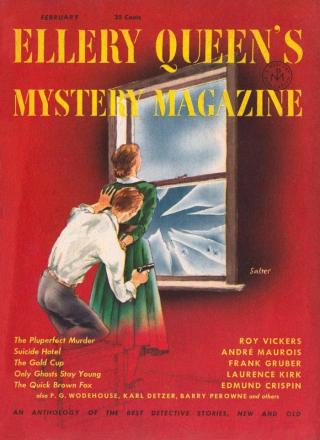
Ellery Queen’s Mystery Magazine. Vol. 19, No. 99, February 1952
- Автор: Грубер Фрэнк, Кемельман Гарри
- Год: 1952
- Язык: английский
- Год: American Mercury
- Жанр: Другие детективы

Электронная книга - «Ellery Queen’s Mystery Magazine. Vol. 19, No. 99, February 1952». Краткое содержание книги:
“Does that count against him?”
“It’s not supposed to,” he said, and then he laughed.
I sauntered over to the other side of the room where Professor Hawthorne was standing. Hawthorne was a small, tidy man, with more than a touch of the dandy about him. He had pointed mustaches, and he was one of the few men in the university who wore a beard, a well-trimmed imperial. He also went in for pince-nez on a broad black ribbon, and even sported a cane, a slim ebony wand with a gold crook. All this since his discovery of The Byington Diary some few years ago, during a summer’s study in England. He had been an ordinary enough figure before that, but the discovery of The Byington Papers had been hailed by enthusiasts as of equal importance to the deciphering of the Pepys Diary, and honors had come to him: a full professorship, an editorial sinecure with a learned publication, and even an honorary degree from a not too impossible Western college. And with it had come the imperial and the cane and the pince-nez on a ribbon.
“George Korngold being amusing at my expense?” he asked with seeming negligence.
“Oh, no,” I said quickly. “We were talking about the candidate. George said something about his having funked the examination once before.”
“Yes, I suppose Professor Korngold would regard Bennett’s request for a postponement as funking it,” Hawthorne said ironically, raising his voice so that it was just loud enough to be heard across the room. “I happen to know something about it. And so does Professor Korngold, for that matter. It so happens that Bennett was working on The Byington Papers. Our library acquired the manuscript just a few days before Bennett was scheduled to stand for examination. As a real scholar, naturally he wanted a chance to study the original manuscript. So he asked for a postponement. That’s what Korngold calls funking an exam.”
From across the room the voice of George Korngold boomed out, “It’s ten o’clock, Nicky.”
Hawthorne glanced at his watch and squeaked, “It’s only five of.” Korngold laughed boisterously, and I realized that he had only been baiting Hawthorne.
When five minutes later the clock in the chapel chimed the hour, Korngold said, “Well, it’s ten o’clock now, Nicky. Do we wait till noon?”
Hawthorne waved his stick excitedly. “I protest, Nicky,” he cried. “From the general attitude of one member of this committee the candidate has already been prejudged. I think in all fairness that member should disqualify himself. As for the candidate, I am sure he will be along presently. I stopped by at his hotel on my way down and found that he had already gone. I suppose he has dropped in at the library for a last minute check-up of some point or other. I urge that in all decency we should wait.”
“I think we can wait a while, Emmett,” said Nicky soothingly.
By a quarter past, however, the candidate had still not arrived, and Hawthorne was in a panic of anxiety. He wandered from one window to another looking out over the campus towards the library. Korngold, on the other hand, was elaborately at ease.
I think we all felt a little sorry for Hawthorne, and yet relieved, somehow, when Nicky finally announced, “It’s half-past ten. I think we have waited long enough. I suggest we adjourn.”
Hawthorne started to protest, and then thought better of it, and remained silent, gnawing on his mustache in vexation. As we all moved to the door, Korngold rumbled loud enough for all to hear, “That young man had better not plan on standing again for examination in this university.”
“He may have an adequate excuse,” Nicky ventured.
“The way I feel right now,” said Korngold, “it would have to be something more than just an adequate excuse. Only a matter of life and death would justify this cavalier treatment of the examining committee.”
Nicky had some work to do at the library, so I went back to my office. I had been there less than an hour when I was informed of the reason for Bennett’s seeming negligence. He had been found dead in his room — murdered!
My first reaction, I recall, was the idiotic thought that now Bennett had an excuse that would satisfy even Professor Korngold.
I felt that Nicky ought to be notified, and my secretary tried to reach him several times during the afternoon but without success. When, at four o’clock, Lieutenant Delhanty, our Chief of Homicide, accompanied by Sergeant Carter who had also been working on the case, came to report on his progress, she still had had no luck.
Carter remained outside in the anteroom, in case he should be needed, while I led Delhanty into my office. Delhanty is a systematic man. He brought forth his notebook and placed it carefully on my desk, so that he could refer to it when necessary. Then he carefully drew up a chair and after squinting through his eyeglasses he began to read.
“At 10:45 we were notified by James Houston, manager of the Avalon Hotel, that one of his guests, a Claude Bennett, twenty-seven, unmarried, graduate student at the university, had been found dead by the chambermaid, a Mrs. Agnes Underwood. He had obviously been murdered. The call was taken by Sergeant Lomasney who ordered Houston to close and lock the door of the room and to await the arrival of the police.
“The Medical Examiner was notified and came out with us. We arrived at 10:50.” He looked up from his notes to explain. “The Avalon is that little place on High Street across from the university gymnasium. It’s more of a boarding house than a hotel, and practically all the guests are permanent, although occasionally they take a transient. There was a car parked in front of the entrance, a Ford coupe, 1937, registration 476–921. The key was in the ignition switch.” He looked up again. “That turned out to be important,” he said. He made a deprecatory gesture with his hand. “It’s the sort of thing a policeman would notice — a parked car with the key in the switch. It’s practically inviting someone to steal it. I made inquiries of the manager, Houston, and it turned out to be Bennett’s car.”
“Bennett’s room was one flight up, just to the right of the stairs. The shades were drawn when we entered, and Houston explained that they had been found that way. Bennett was lying on the floor, his head bashed in by half a dozen blows from some blunt instrument. The Medical Examiner thought the first one might have done the trick, and the rest were either to make sure or were done out of spite. Near the body was a long dagger, the haft of which was covered with blood. A few strands of hair adhered to the sticky haft and were readily identified as the victim’s.”
He reached down and drew from the brief-case he had brought with him a long, slim package. He carefully unfolded the waxed-paper wrapper and exposed to view a dagger in a metal sheath. It was about a foot and a half long. The haft, which was stained with dried blood, was about a third of the over-all length, about an inch wide and half an inch thick, with all the edges nicely rounded off. It appeared to be made of bone or ivory, and was engraved with swastikas.
“That was the weapon, I suppose,” I said with a smile.
He grinned back at me. “Not much doubt about that,” he said. “It fits the wounds just right.”
“Any fingerprints?” I asked.
Delhanty shook his head. “None on the weapon, and only the ones you’d expect in the room.”
I picked up the dagger gingerly by the sheath.
“Why, it’s weighted in the haft,” I said.
Delhanty nodded grimly. “It would have to be,” he replied, “to have done the job it did on Bennett.”
I put it down again. “Well, a dagger like that shouldn’t be too hard to trace,” I said hopefully.
Delhanty smiled. “We had no trouble with that. It belonged to Bennett.”
“The chambermaid identified it?”
“Better than that. The mate to it was right there hanging on the wall. Here, let me show you.” Once again he reached into his brief-case and this time came up with a large photograph showing one side of a room. There was a desk against the wall and a typewriter on a small table beside it. But it was the wall above the desk that attracted my attention, for arranged symmetrically on hooks was a veritable arsenal of weapons, each with a little card, presumably of explanation, tacked underneath. By actual count, there were two German sabres, three pistols, two weapons that looked like policemen’s nightsticks (at my puzzled look, Delhanty murmured, “Taken from guards of a concentration camp — nasty weapons — almost as thick as my wrist”) and one dagger, the twin of the weapon lying on my desk. But there was another card and an empty hook where the other dagger should have been, and it was just possible to discern its outline as a lighter area in the faded wallpaper.