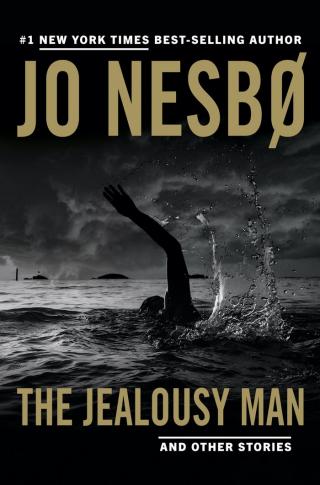
The Jealousy Man and Other Stories
- Автор: Несбё Ю
- Год: 2021
- Язык: английский
- Год: Alfred A. Knopf
- ISBN: 978-0-593-32100-3
- Переводчик: Robert Ferguson
- Жанр: Криминальные детективы

Электронная книга - «The Jealousy Man and Other Stories». Краткое содержание книги:
A detective with a nose for jealousy is on the trail of a man suspected of murdering his twin; a bereaved father must decide whether vengeance has a place in the new world order after a pandemic brings about the collapse of society; a garbage man fresh off a bender tries to piece together what happened the night before; a hired assassin matches wits against his greatest adversary in a dangerous game for survival; and an instantly electric connection between passengers on a flight to London may spell romance, or something more sinister.
With Nesbø’s characteristic gift for outstanding atmosphere and gut-wrenching revelations, The Jealousy Man confirms that he is at the peak of his abilities.
‘African... rock python?’
‘Aggressive and unpleasant, but not poisonous.’ His father sits up and rolls his neck. ‘You’re right, I’m absolutely fine. But how are you? Do you notice how your throat is beginning to constrict, son? In a little while the cramps will come, and that really isn’t something to look forward to.’
‘But we...’
‘Were bitten by the same snake. Mysterious, isn’t it? Maybe what you took is a little different from what’s in me.’
Ken’s mind clouds over. He looks at the empty test tube on the ground, tries to get up but his legs won’t carry him. His armpits have started aching.
‘If you’d been paying attention in class you would have checked the cork on the test tube before injecting yourself, Ken.’
Red, thought Ken. Red cork. He’s injected poison into his own arm.
‘But there were no other test tubes for the Egyptian cobra, I checked them all. None with a blue cork, no antidote...’
His father shrugs. Ken gasps for air. The buzzing of insects has become a steady pressure against his eardrums.
‘You knew it all along. You knew... why... I came.’
‘No, I didn’t know. But I’m not stupid so I didn’t completely exclude it either. And of course, I would have stopped you had you tried to inject me with it.’
Ken can’t feel the tears coursing down his cheeks.
‘Father... drive me back now. Time is...’
But his father seems not to have heard him. He is on his feet now and peering across to the other side of the river.
‘Adolf says they’re good swimmers, though I’ve never seen it myself.’
Ken slides down and remains lying on his back, staring up at the sky. The sun is still high above the trees on the hilltop, but he knows that come seven o’clock it will be as though someone cuts an invisible thread, and the sun will tumble in free fall below the horizon and within fifteen minutes all will be pitch-black. The white bird screeches again. It flaps its wings and two seconds later Ken sees it crossing his field of vision. It’s so beautiful.
‘Time to be getting back,’ says his father. ‘Adolf will have dinner ready soon.’
Ken hears his father pick up the bag with the serum inside and then hears him move away. For a few seconds there is silence. Then he hears splashing sounds from the water. Ken Abbott knows he hasn’t a chance.
Black Knight
Part 1: The Opening
‘You can feel your eyelids getting heavy,’ I said.
The pocket-watch — maker unknown but weighted by sufficient gold to keep it swaying steadily for some time — had been in the family’s possession since 1870.
‘You are feeling tired. Close your eyes.’
The silence was complete. The street-facing windows were triple-glazed, so that not even the chiming from the mighty bells of the Duomo di Milano penetrated. It was so quiet that the absence of ticking was noticeable. The hands were splayed out on each side from the moment the watch breathed its last. Now the mute object was minus the function a watch is meant for.
‘When you wake up you will not remember that you were gravid or that you’ve had an abortion. The child never existed.’
I felt suddenly on the verge of tears. When I lost my own child I also lost what we psychologists call my affective control, meaning that I could whimper and blubber over the slightest thing that reminded me of it. I pulled myself together and continued: ‘It will seem to you as though you came here to be cured of a nicotine addiction.’
Ten minutes later I carefully woke Fru Karlsson from her trance.
‘I don’t feel any craving at all,’ she said as she buttoned her mink coat and looked at me.
I was sitting behind my desk and taking notes with the Montegrappa pen I had come across many years ago in an antiques shop. Patients like to see you making notes, it makes them feel a little less like something on a conveyor belt.
‘Tell me, Dr Meyer, is hypnosis difficult?’
‘It depends what you’re hypnotising,’ I said. ‘As film directors say, the hardest to work with are children and animals. And it’s easiest with a receptive and creative spirit like yours, signora.’
She laughed.
‘There are rumours that you once managed to hypnotise a dog, Dr Meyer. Is that true?’
‘Just rumours,’ I smiled. ‘And even if I had, I have a vow of confidentiality as regards all my patients.’
She laughed again. ‘But what power it gives you!’
‘I’m afraid I’m as powerless as anyone else,’ I said, searching through the desk drawer for an ink cartridge to replace the one in the pen, now empty. The leader of a local chess club I used to belong to once said to me that the reason I always lost was not that I didn’t know what I was doing, but that I sabotaged my own chances of winning through my bewildering weakness for the weak. He suspected that I would prefer to sacrifice a castle rather than a knight because I liked the knight better. Or because I thought of myself as a knight.
‘They’re pieces, Lukas,’ he said. ‘Pieces! The knight is the least valuable, and that is a fact, not preferences.’
‘Not in every position. The knight can get himself out of some pretty tight situations.’
‘Knights are slow and always arrive too late to save anyone, Lukas.’
I found the ink cartridge, a narrow metal sleeve the same length as the pen, and with a thin steel tip like a hypodermic syringe. I realised it would be my last one, that Montegrappa pens and cartridges were no longer produced. Like so many other uselessly beautiful quality products it had vanished beneath the merciless pressure of global competition.
I wrote slowly, reverently, careful not to waste my words. Fru Karlsson would start smoking again. And she’d tell all her friends that Dr Meyer was no good so I’d spared a rush from that quarter. She wouldn’t remember she’d had an abortion. If she ever did it would be because something had overridden the hypnosis. A special word, a mood, a dream, it could be anything. As in my case. At times I’ve thought I might like to obliterate Benjamin and Maria from my memory. At other times not. Anyway, it’s been a long time now since I had the ability to hypnotise myself. One learns too much about it. Like the conjuror no longer able to enjoy being fooled, even when one wants to be.
Once Fru Karlsson had gone I packed my beautiful black leather Calvino bag. I’d bought it because it had the same name as the anti-Fascist rebel Italo Calvino. And, of course, because I could afford it.
I knotted my Burberry scarf and walked into the reception area. Linda, who was the receptionist for me and the two other psychologists in our joint practice, looked up.
‘Have a nice day, Lukas,’ she said with an almost inaudible sigh and a scarcely noticeable glance at her watch which showed, as usual, that it was still only three. She used this Americanism not, primarily, to bless the remaining hours of daylight, or until I went to bed, but to point out the injustice in the fact that my working day was so much shorter than that of my two colleagues, and therefore hers. I think she believed — or thought she believed — that my not taking on more patients showed a lack of solidarity, but there was no way she could know that in recent years the psychology practice had become secondary and functioned more or less as a cover for my other, real job. Which was to kill people.
‘Have a nice day, Linda,’ I said as I strolled out into the lovely December sunshine.
I’ve never quite been able to make up my mind whether or not Milan is a beautiful city. It has been in the past, you only need to look at the pictures from back then, when Milan was a city in Italy, and not in Capitalia, as I call the stateless condition the world is in today. Of course, before the last of the physical world wars it had been almost supernaturally beautiful, but even after the bombs the city has preserved a discreet but distinct elegance in which the fashion houses in particular had influenced the style and taste, and vice versa. In the days before the sixteen giant business cartels assumed control of Europe, North America and Asia, factory emissions were subject to central authority regulations, which meant that even in Milan, with one of the worse air-pollution problems in Europe, one could still on a good day see all the way to the white peaks of the Dolomites. Now it lay over the city in a constant veil, and those who could not afford the overpriced air conditioners now in the hands of a monopoly lived lives that were short and sickly.