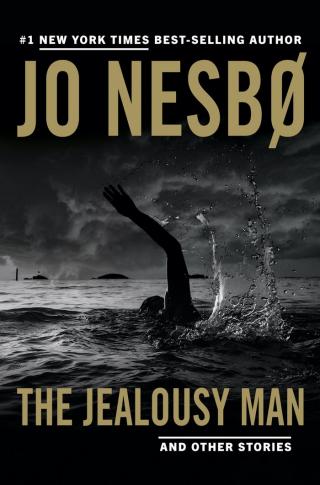
The Jealousy Man and Other Stories
- Автор: Несбё Ю
- Год: 2021
- Язык: английский
- Год: Alfred A. Knopf
- ISBN: 978-0-593-32100-3
- Переводчик: Robert Ferguson
- Жанр: Криминальные детективы

Электронная книга - «The Jealousy Man and Other Stories». Краткое содержание книги:
A detective with a nose for jealousy is on the trail of a man suspected of murdering his twin; a bereaved father must decide whether vengeance has a place in the new world order after a pandemic brings about the collapse of society; a garbage man fresh off a bender tries to piece together what happened the night before; a hired assassin matches wits against his greatest adversary in a dangerous game for survival; and an instantly electric connection between passengers on a flight to London may spell romance, or something more sinister.
With Nesbø’s characteristic gift for outstanding atmosphere and gut-wrenching revelations, The Jealousy Man confirms that he is at the peak of his abilities.
‘Hello...’ he said, in that familiar, slow, clear, sing-song voice.
I forced myself to keep my eyes open and watch the screen.
A spasm passed through Oscar and his hand went up to his breast pocket, took out the Montegrappa pen clipped there and opened it in a single, fluid practised movement. Greco observed him with an amused smile.
‘...I’m Greco,’ he concluded, stressing each syllable.
Oscar had taken out the needle-shaped cartridge and was holding it upside down in his little hand. The whole thing had taken less than three seconds, same as the last few times we’d rehearsed the sequence of moves. And now he swung his hand. He was a bright boy and by the time we’d finished he was hitting the eye in the dog’s head every time, even when I held it high above him and moved it about. Hit it again and again, as calm and collected as a robot, the way hypnotised people are. Until we were down to two and a half seconds from when I gave him the trigger words, ‘Hello, I’m Greco,’ to him taking the pen out of his breast pocket, removing the cartridge and stabbing.
I saw the point of the cartridge penetrate Greco’s eye, and could sense how it slipped through the paper-thin bone at the rear of the socket and on into the brain. Oscar’s small, balled hand against Greco’s face like a growth, like broccoli. Greco was staring with the other eye, not at Oscar but at me. I don’t know what I saw there. Astonishment? Respect? Fear? Pain? Or perhaps nothing. Perhaps those muscular spasms passing across his face were the result of whichever centre of the brain the cartridge point penetrated, as I recalled from my student days how we could get dead frogs to move their legs by stimulating the nervous system.
Then Greco’s body suddenly relaxed, and he exhaled in a long gasp, his last S, and the light in the remaining good eye went out, like the red light on a piece of sloppily produced electronic equipment. Because in the final analysis perhaps that’s all we are. Frogs with conduits that transmit impulses. Complex robots. So advanced we even possess the power to love.
I looked at Oscar.
‘Hi, I’m Lukas,’ I said.
He emerged immediately from his trance, dropped the cartridge and looked at me. Next to him, his head lolling on the back of the sofa, lay Greco, the cartridge sticking out of his eye as he stared up at the ceiling.
‘Keep looking at me,’ I said.
I saw the men behind Oscar who had raised their machine guns but who now stood as though frozen to the spot. No shots had been fired. For there was no longer any danger to be averted. No longer a boss to be protected. And, their brains were telling them, though they could not have formulated the thoughts themselves: no one left to pay them for killing this boy, this child whose body would haunt them for the rest of their nights were they to kill him.
‘Stand up slowly and walk outside,’ I said.
Oscar slid down from the sofa. Picked up the two parts of the Montegrappa pen from the floor and put them in his pocket.
One of the men had approached the rear of the sofa. He lay two fingers against the corpse’s carotid artery.
Oscar headed for the hallway and the front door.
The men exchanged quizzical looks.
One of them shrugged. The other nodded and spoke into the microphone on his lapel.
‘Let the kid go.’
A short pause as he adjusted his earpiece.
‘The boss is dead. What? As in finished, yes.’
Greco lay staring up at the heaven he’d never get to. A solitary red tear ran down his cheek.
It took me almost three hours to cut my way through the metal-reinforced door, by which time the blade of the axe was so dull it functioned more as a sledgehammer.
I saw no one either in the entrance or outside as I walked into the street. They had probably been informed the operation was cancelled. Were probably already on their way to other jobs for other bosses, other cartels.
I made my way through the dark streets without looking over my shoulder. I thought of the chessboard on my table back home, where Carlsen had just stepped into the Murakami Trap and in eighteen more moves would resign. As I walked along there I couldn’t know that in twelve years’ time I would be watching that famous game in which Olsen, who has likewise fallen into the Murakami Trap, moves his black knight to F2 and looks over in silence at the disbelieving and despairing Murakami.
Reaching the block where my apartment was I rang the bell. There was a click from the entryphone, but no voice.
‘It’s me, Lukas,’ I said.
A buzz. I pushed the door open. Going up the stairs I thought of all the days after Benjamin and Maria were gone, when I had dragged my feet up these steps and dreamed they would be standing in the open doorway waiting for me. As I stopped on the final landing, suddenly so tired it was like a pain in my chest that almost dropped me to my knees, I looked up. There, in backlit silhouette in the doorway, I saw that little figure, I saw my son.
He pointed to his eyes and looked at me. I smiled and felt those lovely warm, wet tears rolling down my neck and in beneath my shirt collar.
Oscar and I walked through the ruins of Brescia, hand in hand. It had been a poor city, actually one of the poorest in Italy, although being in a rich part of the country it wasn’t easy to tell from the outside. But Brescia failed to survive the collapse of the nation state and in time had become a slum.
We stood in the street and looked through the fence at the old clothing factory, which was now just an abandoned site, a burned-out shell that appeared to be home to a pack of wild dogs. I had had to fire a warning shot towards them to keep them away.
We walked through the gateway of a house that had clearly once been beautiful. Not ostentatiously large, and built in a tasteful art deco style. The white walls had brown damp stains on the outside, the windows were broken, and a sofa dragged halfway out through one of them. From within came the echo of a dripping sound, as though from a grotto. We walked round the back, where snow still lay in patches on the grass, faded brown after the long winter.
Oscar stood at the edge of the empty swimming pool full of snow and rubbish. The tiles were cracked and the rim of the pool a dirty brown.
I saw Oscar’s eyes fill with tears. I pulled him towards me. Heard the quick, short snuffles. As we stood there the sun broke through the mingled clouds and smoke and warmed my face. Spring was on its way. I waited until he’d finished snuffling, then held him away from me and told him in the sign language we’d been practising that the summer wasn’t far away, and then we’d go to the coast and swim in the sea.
He nodded.
We didn’t go into the house but I saw the name plate on the door. Olsen. Despite the adoption we’d decided that Oscar would keep the name. In the car driving back to Milan we ate the panzerotti I had bought in Luini, and I turned on the radio. They were playing an old Italian pop song. Oscar drummed away energetically on the dashboard, miming the words to the song as he did so. The news came on afterwards. Among other things there was an item about how the now forty-year-old Murakami had once again defended his world title. We could see the outlines of Milan as Oscar turned towards me. I had to slow down to read all the signs he was making, concentrated and carefuclass="underline"
‘Can you teach me to play chess?’