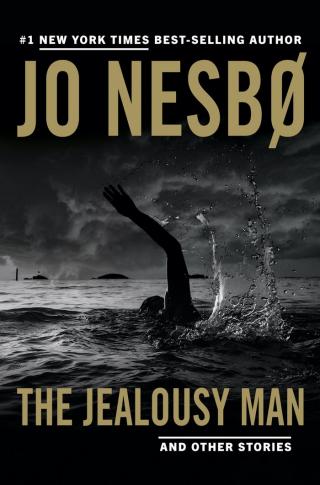
The Jealousy Man and Other Stories
- Автор: Несбё Ю
- Год: 2021
- Язык: английский
- Год: Alfred A. Knopf
- ISBN: 978-0-593-32100-3
- Переводчик: Robert Ferguson
- Жанр: Криминальные детективы

Электронная книга - «The Jealousy Man and Other Stories». Краткое содержание книги:
A detective with a nose for jealousy is on the trail of a man suspected of murdering his twin; a bereaved father must decide whether vengeance has a place in the new world order after a pandemic brings about the collapse of society; a garbage man fresh off a bender tries to piece together what happened the night before; a hired assassin matches wits against his greatest adversary in a dangerous game for survival; and an instantly electric connection between passengers on a flight to London may spell romance, or something more sinister.
With Nesbø’s characteristic gift for outstanding atmosphere and gut-wrenching revelations, The Jealousy Man confirms that he is at the peak of his abilities.
The cartel-run media tell us that people are richer than ever before and prove it by presenting us with statistics showing the real income per inhabitant. The reality is of course that the creators and directors of the cartels earn a thousand times more than the average worker. Eighty per cent of them are on temporary contracts with no chance to plan for the long term. They have to live in the ever-expanding slum that surrounds the city on all sides save in the north.
After Milan became the centre of European finance, with the Borsa Milano and the headquarters of seven of the cartels, the population exploded. The city was now not only the largest in Europe but also harboured the world’s third-largest slum. I’m no socialist, but you don’t need to be one to feel a longing for a time when incomes were lower but distributed more evenly, and there was a functioning state which did its best to help those who were struggling.
I passed the Duomo di Milano. In front of the imposing cathedral, queues of the tourists and the faithful extended into the large square of the Piazza Duomo. At the other end of the square I passed the tables of what those of us working in the business call Café Morte, Café Dead. The men sitting there — and they were exclusively men — had newspapers and phones in front of them while their eyes swept the square in search of possible employment. The market for contract killing had grown exponentially once the cartels and an unregulated open market took over, and those offering the service could principally be divided into two classes, a bit like prostitution. Café Morte was the outdoor market, for the street-walkers. Customers using the place could get a job done for a fee in the region of 10,000 euros. The quality was variable, as was the discretion offered; but in a society in which both the police and the authorities were drastically reduced and institutionally corrupt the risk of being caught was acceptably low. So the response of the family members or the employers of a target was quite commonly to arrange a contract killing. It meant that the business — like gun running or drug smuggling — was expanding.
The first cartel killings, in which personnel from rival cartels were killed in order to weaken their competitors, were carried out by taxi drivers, and it’s generally believed that that’s why we’re referred to as ‘drivers’. But you’ve got those who wait for their fares at a taxi rank like the Café Morte, and then you’ve got the limo drivers, the ones who work the indoor market, the luxury prostitutes, the ones you need to approach through a middleman called a ‘fixer’. Drivers like that have reputations and can cost as much as ten times what they charge at the Café Morte, but if you want to take out some well-protected employee from one of the cartels then these are the ones you need to hire. People like me.
I had no idea I had a talent for work of this kind, would even have thought the opposite. But a high degree of empathy can also help in understanding how an opponent thinks. In the two years I’d been in the killing business I’d become one of the most in-demand names. Income from my psychology had been sinking from the day my son turned eight years old and died, and after Maria committed suicide it dried up completely. But money wasn’t the reason I became a driver. As a psychologist I’m used to deducing people’s simple and often banal motivations, and that includes my own. And my motive was revenge. I was able to live with the fact that my child had been born dumb. That was just mere chance, no one’s fault, and it didn’t spoil anyone’s happiness. But I couldn’t live with what had taken Benjamin’s life: human greed, businessmen who had worked out that if they took a few discreet shortcuts around the expensive fire regulations required for their electrical products they could sell them cheaper than their competitors and still increase the profit margin. I realise it might seem a bit strange to claim that a defective bedside lamp could be the cause of a man abandoning his humanity and embarking on a career as a spreader of death. And I use the word ‘spread’ advisedly; because I didn’t have one name to focus my anger on I had to take revenge on all of those who ran the cartels and took those kinds of decisions, those whose unscrupulous worship of Mammon had taken Benjamin and Maria from me. The way a terrorist whose family has been killed by a bomb will fly a plane into a skyscraper full of people he knows aren’t personally responsible for his loss but who are still complicit in their death. Yes, I knew exactly why I had become a man who murdered prominent members of the cartels. But such knowledge doesn’t change anything; insight like that doesn’t necessarily lead to a change in behaviour. Spreading death did nothing to slake my thirst for revenge — I had to keep going. I could of course have ended my own life, but the sudden realisation that life is meaningless doesn’t necessarily mean that people want to stop living. People like Maria are, after all, the exception.
I carried out a test which I did at regular intervals, letting my gaze sweep across the pavement tables outside the cafe. Noted that I still did not register any flicker of recognition in the gazes that met mine. They simply recorded the fact that I was not a customer and moved on. Good.
To carry on making a living in the limousine trade it was imperative that no one — not even the customer — should know your face. The fixers took twenty-five per cent of the fee and they were worth it, if for no other reason than that we could hide ourselves behind them. Among those who got taken in the limo branch — and by ‘taken’ I don’t mean by the police — there were more fixers than drivers. You only had to look at the gravestones in the Cimitero Maggiore to know that.
In addition to my unquenchable thirst for revenge I had certain other advantages as a driver. One of them was Judith Szabó, known simply in the business as the Queen. She was one of the three or four best fixers and her abilities were legendary. People said the Queen never left a boardroom meeting without a deal, and at this moment in time I was her only regular client. And only lover. I think. Of course, I can’t be certain — her previous steady client also believed he was her only lover. Another advantage was that unlike many of the other drivers I had a credible cover, at least I did as long as I had enough patients not to make it seem odd that I should keep on turning up at the office. My third and most important advantage was that I had a murder weapon the others didn’t. Hypnosis.
I stopped at a pedestrian crossing and waited for the light to change from red to green, all senses on the alert. I no longer like standing still in a public setting without knowing who the people around me are. A rifle with a telescopic sight and silencer behind one of those French balconies, a knife in the back as the lights change to green, the blade up into the kidneys so the initial pain is so great the victim is unable to make a sound but is left lying there as the crowds move on.
There was a time when drivers were at the top of the food chain, or at least had no need to walk in fear of their lives. This was before the cartels began employing the best of them on a permanent basis, so that the drivers themselves became key employees and, as such, legitimate targets. The cartels had organised their own militia which were in practice above the law, and competition for the markets — meaning principally technology, entertainment and medicine — was becoming more and more reminiscent of old-fashioned wars than old-fashioned capitalism. I had recently read an article that compared the situation with that of the Opium War of 1839, when the British East India Company, with the support of the British government, went to war against China to defend their right to export opium to the Chinese, on the basis of the mercantile principle of free trade. Today it was no longer about opium but technology, entertainment, a kind of mild stimulant known as artstimuli, and medicines that extended one’s lifespan. The strange thing was that while the markets were deregulated and the competition in every way tougher, the number of actors had fallen, not risen, and the incidents of mono- and oligopoly more frequent as a result of the acquisitions. Because as they say in the world of the sharks: size is everything. Or rather, size won’t help if you’ve got no teeth. The teeth were the best brains, the best inventors, the best chemists, the best business strategists, and in due course these rose to the same status and wage levels as the top footballers. But after a while those companies that were unable to afford these wages — and were unscrupulous enough — began to kill the best brains of the others as a way of lowering the standards and enabling themselves to compete. The best companies had to respond in kind in order to remain market leaders, and the best chemists, inventors and leaders were replaced by a new aristocracy: the best contract killers. It looked as though the company with the best killers would, in the long run, turn out winners. And that’s what started the cannibalising process we’re in the middle of now. Companies hired killers to kill their competitors’ best contract killers.