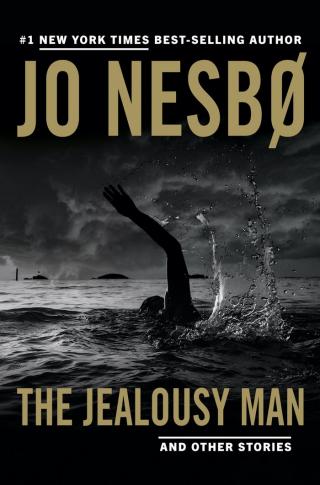
The Jealousy Man and Other Stories
- Автор: Несбё Ю
- Год: 2021
- Язык: английский
- Год: Alfred A. Knopf
- ISBN: 978-0-593-32100-3
- Переводчик: Robert Ferguson
- Жанр: Криминальные детективы

Электронная книга - «The Jealousy Man and Other Stories». Краткое содержание книги:
A detective with a nose for jealousy is on the trail of a man suspected of murdering his twin; a bereaved father must decide whether vengeance has a place in the new world order after a pandemic brings about the collapse of society; a garbage man fresh off a bender tries to piece together what happened the night before; a hired assassin matches wits against his greatest adversary in a dangerous game for survival; and an instantly electric connection between passengers on a flight to London may spell romance, or something more sinister.
With Nesbø’s characteristic gift for outstanding atmosphere and gut-wrenching revelations, The Jealousy Man confirms that he is at the peak of his abilities.
Three weeks after he had opened his eyes he shut them again as tightly as he could. The sun hung like an oversized reading lamp above the taxi rank outside the international airport in the not quite so international capital of Botswana, a country town the name of which was, his plane ticket told him, Gaborone. He took a taxi to the government offices, and after a week of running up and down the corridors of bureaucracy he left with all the necessary documentation, the licences, the signatures and rubber stamps, and had not since that day been back to Gaborone. And since Gaborone was the only international airport that meant he hadn’t left Botswana either.
Because why should he? As quickly and instinctively as he had hated Gaborone he fell in love with Tuli. The farm consisted of three old but well-maintained brick buildings where the staff of four lived alongside the eight hundred snakes, all of them with bites that were in greater or lesser degree fatal. The buildings were situated on a high plain surrounded by buffalo bushes and mongongo trees on gently sloping hillsides. The place was rarely visited, save by elephants taking the wrong route down to the riverbank, jackals in search of offal or discarded shoes, or the weekly jeep that came to fetch snakes and snake serum and brought in supplies along the almost impassable roads. Across the green-rimmed horizon dead trees pointed spectral black fingers up towards the sky, but apart from that there was nothing here to remind him of London.
When the dry season came, herds of impala gathered on the plains where they could be close to water, along with their regular fellow travellers, the apes. After them came the zebras and the kudu antelopes. The lions hunted day and night — it was party time for the savannah’s predators — and in the brief dusk they could see the sun flare up in the west before it disappeared, and later on hear the deep growl of the lions rolling through the night as moths swarmed around the outside lamps like snowflakes in a blizzard.
Only once had he doubted that here was where he belonged, and that was when a Naja nigricollis, a black-necked spitting cobra, gave birth to her young and he saw the father start to eat them alive, one after another, before they managed to get him out of the cage. Adolf had told him that small snakes were a natural part of the cobra’s diet — but its own young? It excited a disgust in him, a distaste for the nature of the creature that left him for a time wondering whether or not he could face carrying on. But then one evening Adolf showed him a dead tiger snake, bitten to death by its own young, and explained to him that the way of nature did not recognise ties of kinship, that it was always and everywhere a case of eat or be eaten. That it wasn’t evil or immoral to eat one’s own offspring or one’s parents — on the contrary it was simply living out nature’s imperative, and that was what Africa was about: survival, survival at any price. And in due course Emerson Abbott was able to accept this and even admire it as part of the pitiless system of things, the remorseless logic that kept nature in balance and gave the animals and the humans their right to live. And gradually he rediscovered what he had been missing for so long: the fear of dying. Or more accurately: of not being alive.
And then came the rainy season. He would never forget that first time. He fell asleep to the first rain at night, and when he looked out across the plain the next morning it looked as though some insane painter had gone berserk on the grey and yellow canvas. Within a day or two the plain was transformed into a billowing field of pungent smells, wildly psychedelic colouring and insects that flashed low above a carpet of petals and the swelling brown waters of the river.
And he thought: where else could he possibly want to be?
Six months after his arrival he sent a letter home to Ken, and then, having waited six months for a reply, a second letter. He concluded his monologue the year after with a Christmas greeting and, since he’d heard in a roundabout way that Ken hadn’t settled to anything meaningful in London, the offer of a job on the farm.
He wasn’t expecting an answer and he didn’t get one either. Not until three years later.
Ken liked almost everything about cocaine. He liked the effect it had on him, the people around him liked the effect it had on him, he didn’t get hangovers, and he didn’t notice any signs of dependency. The only thing he didn’t like was the price.
That was the reason, after two terrible weeks at the dog track had brought on a minor financial crisis, he’d turned to the poor man’s version — amphetamines. And he met Hilda Bronkenhorst. An ugly and surprisingly stupid health freak he’d slept with a few times in the hope that she’d loan him some of her father’s money. Each time he watched her open her legs and demand to be served he thought that at the very least he would have earned the money. Anyway, she was the one who told Ken that amphetamine is a synthetic product. That the body never manages to completely break down synthetic products. Meaning: once you’ve taken amphetamine there will always be traces of it in your system. And since there were two words that put Ken in an absolute panic — never and always — he stopped at once. He swore that from that time onwards he would never take anything but healthy, organic compounds like cocaine, and realised that he needed money. And quickly.
His chance came when he called in at the office of a former colleague in the City with the intention of refreshing the friendship so that the next time they met he could ask him for a loan. Just for fun Ken’s former colleague showed him an illegal betting ring on the World Cup final between France and Brazil which a couple of the big stockbrokers were running though their own encrypted pages on the Reuters screens. When his ex-colleague left the room to get more tea without logging out Ken didn’t hang about. He closed his eyes, saw an image of Ronaldo’s dinosaur-thick thighs, typed in his own name and address, navigated across to the stakes column, closed his eyes again, saw Brazil’s gold-clad heroes raising the trophy aloft and wrote ‘£1 million sterling’. Enter. He held his breath as he waited for a response, knew his name wasn’t registered, that the stake was too high, but also that in the Reuters world people dealt every second with obligations for ten times that amount without asking who was at the other end. He thought he had a chance. And the message came back: ‘CONFIRMED’.
If only Ronaldo hadn’t suffered an epileptic fit that night following a protracted PlayStation session then Ken might not have had to worry about how he was going to keep on paying for his cocaine habit nor — as the situation then unfolded — felt any anxieties concerning the immediate state of his health. Two days later, early in the morning, which in Ken’s case meant shortly before eleven o’clock, his doorbell rang and a man was standing there wearing a black suit and sunglasses and carrying a baseball bat and explaining to Ken the consequences for him if he wasn’t able to get his hands on a million pounds within the next fourteen days.
Four days afterwards, late in July, Emerson Abbott received a telegram in which his son returned his Christmas greetings, accepted the offer of a job and asked him to meet him at the airport in Gaborone in five days’ time. Plus details of the bank account for the money for the plane ticket, to be transferred as soon as possible. Emerson was delighted with this turn of events and annoyed only that it meant he would have to go back to Gaborone again.
Ken looked at his watch, a Raymond Weil in South African gold that ticks its way towards Judgement Day with Swiss precision.
This day had started the same as the twenty-six others. Ken woke up wondering where the hell he was and why. He remembered why first. Money. Which should have turned his thoughts in the direction of his creditors in London but which instead turned them to that white powder, which was now like a woman he was no longer quite so sure he had a platonic and no-strings-attached relationship with. The symptoms were classic, but it seemed to him the irritation and the bouts of sweating were just as likely the effects of being in this godforsaken place full of poisonous bugs, insects that were everywhere, and the disrespectful Blacks who seemed to have forgotten long ago just who it was that colonised and attempted to civilise this land. But the depressions were new. Those sudden, dark hours when he seemed to lose his grip on reality, the floor vanished beneath him and he fell down into a bottomless pit, and all he could do was wait until it passed.