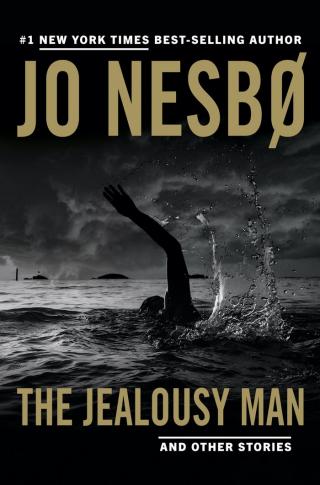
The Jealousy Man and Other Stories
- Автор: Несбё Ю
- Год: 2021
- Язык: английский
- Год: Alfred A. Knopf
- ISBN: 978-0-593-32100-3
- Переводчик: Robert Ferguson
- Жанр: Криминальные детективы

Электронная книга - «The Jealousy Man and Other Stories». Краткое содержание книги:
A detective with a nose for jealousy is on the trail of a man suspected of murdering his twin; a bereaved father must decide whether vengeance has a place in the new world order after a pandemic brings about the collapse of society; a garbage man fresh off a bender tries to piece together what happened the night before; a hired assassin matches wits against his greatest adversary in a dangerous game for survival; and an instantly electric connection between passengers on a flight to London may spell romance, or something more sinister.
With Nesbø’s characteristic gift for outstanding atmosphere and gut-wrenching revelations, The Jealousy Man confirms that he is at the peak of his abilities.
He began drinking but couldn’t quite make it work and instead started going to the greyhound races, though he’d never been able to abide dogs. It was then that the gambling really got out of hand. Not in pounds and pence, because Ken, despite his name, no longer had a credit rating. And anyway, it would have been difficult for him to top that orange juice deal. But the compulsive gambling consumed all his time and all his energy, and before too long he was tumbling headlong down a dark pit and on his way to the bottom. Or presumed bottom. Because so far, the falling hadn’t stopped, and looking on the bright side of things that might well mean there was no bottom.
Ken Abbott funded his accelerating addiction to gambling by turning to the only person he knew who still didn’t seem to have realised what was going on: his father. For the son had discovered that Emerson Abbott had the most wonderful talent for forgetting. Each time he knocked on the door to ask for money his father would stand there, looking at him as though it were for the first time. In fact, looking at him as though it was the first time he had ever stood there at all.
Ken pulls the needle up out through the plastic cork.
‘Do you remember how to do it?’ By now his father’s voice is no more than a hoarse whisper.
Ken tries to smile. He had never been able to stand needles, or else he would never have stopped taking cocaine but gone all the way with it. Not that he wanted to join the 27 Club like Jimi Hendrix, Kurt Cobain and Jim Morrison but, alas, he’s like Oscar Wilde in that he can resist everything except temptation. What he has to resist right now is the desire to throw up at the sight of the needle. But he has no choice. This is a matter of life and death.
‘Remember and remember,’ mumbles Ken. ‘Remind me. I have to locate a vein?’
His father shakes his head. He’s rolled up his trouser leg and points to his leg where two small holes puncture the skin. Blood is beading on one of them.
‘Forget about veins. Just inject the syringe close to the bite. Small injections, three or four pricks. Then one in the thigh.’
‘The thigh?’
Despite his condition the father manages to give Ken one of those exasperated looks he hates so much. ‘So it’s closer to the heart than the bite.’
‘Are you certain it was an Egyptian cobra, Father? It can’t have been one of those thingummies...’
‘Thingummies?’
‘I don’t know... a boomslang or something like that.’
Emerson Abbott tries to laugh but all that comes out is a cough.
‘A boomslang is a small green bastard that hangs in the trees all day, Ken. This one was black and it was wriggling along the ground. And the boomslang is haemotoxic, so the blood would have been pouring out of my mouth, my ears and my arse by now. Don’t you remember how we went through all this?’
‘I just want to be completely sure before I give you the injection.’
‘Of course. I’m sorry.’ His father closes his eyes. ‘I just hope you don’t feel these weeks have been a waste of time.’
Ken shakes his head and he means it. Sure, he’s hated every second of the twenty-seven days he’s been here, hated the long hot days trudging round the snake farm behind his father and the grizzled old Black foreman whose parents, in a darkly humorous moment, had named Adolf. Those voices have gone in one ear and out the other, about the green and the black mambos, about the fangs at the front and the back of the mouth, about the ones that can bite even when you’re holding them up by the tail, about which ones are to be fed mice and which ones birds. He doesn’t give a shit about whether cobras come from Egypt or Mozambique, all he knows is that there are a hell of a lot of them, and that his father must have been off his trolley when he bought the farm.
In the evenings they sat on the veranda in front of the house, his father and Adolf both sucking on pipes as they heard the cries of the animals out there, with Adolf describing the legends and beliefs related to each one of them as they announced themselves in this way. When the moon rose and the cold laughter of the hyenas made Ken shiver, Adolf told stories about the Zulus, who believed that snakes were the spirits of the dead and let them come into their houses; and about how the tribes in Zimbabwe would never kill pythons because a long drought was certain to ensue. And when Ken laughed at these superstitions his father talked about certain remote regions of the north of England, places in which people still observed an old ritual involving snakes: if you saw an adder you had to kill it at once, draw a circle round it with a cross inside and then read over it from Psalm 68. And as Ken watched in astonishment his father stood up there on the veranda and declaimed into the pitch-black jungle night:
‘Let God arise, let his enemies be scattered:
let them also that hate him flee before him.
As smoke is driven away, so drive them away:
as wax melteth before the fire,
so let the wicked perish at the presence of God.’
The bird shrieks again. Perched at the top of the tree the white, long-legged bird with the red comb on its head looks almost like a cockerel.
‘Isn’t it funny how little we know each other, you and I, Ken?’
Ken jumps. It’s as though his father can read his thoughts. His father sighs.
‘I don’t suppose we ever got to know each other really. I... was never really there, was I? It’s a pity when fathers aren’t there.’
The last sentence lingers in the air and seems to demand an answer, but Ken doesn’t have one.
‘Do you hate me, Ken?’
The buzzing of the insects suddenly stops, as though all of them are holding their breath.
‘No.’ Ken holds the point of the needle up and ejects the air until a drop runs down it. ‘Hate’s got nothing to do with it, Father.’
Emerson Abbott had woken at first light, looked at his sleeping wife as though trying to remember who she was, risen and crossed to the open window, looked at the trees in the park whose black branches reached starkly up towards the grey winter skies, at the asphalt far down below that glistened wetly in the light from the lamp posts, swaying in the wind.
Times were hard, people needed comfort, escapism, cheap lies and dreams, and since he sold these cheapest his publishing business was humming along. An American company had made an offer. The business had been in the family for three generations. Emerson Abbott had smiled. He stepped up onto the windowsill, a gust of wind had wrapped the curtain around his foot and almost made him fall. Holding on to the guttering he raised himself to his full, shivering height. The rain drove in from the side, prickling like icy nails against his skin. He opened his mouth. It tasted of ashes. He knew the time had come for the great leap. He closed his eyes.
When he opened them again he was divorced from Emma, whose surname was now Ives, which was not her maiden name but the name of her new husband, who had moved in after Emerson moved out because by the terms of the settlement she kept the house. The Americans had taken down the Abbott sign above the publisher’s door. They had decided they would use their own name, and in truth Emerson was happy that the family name was no longer associated with the products that emerged from behind that door. Through a friend he bought a snake farm in Tuli in the west of Botswana. He knew nothing about the business of farming snakes, only that they delivered snakes to reptile parks and to laboratories that produced serums that could prevent humans dying from snake bites, and that it wasn’t particularly profitable.