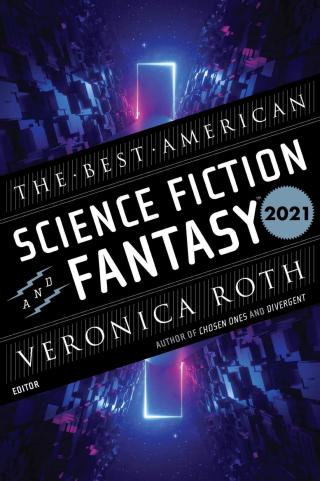
The Best American Science Fiction and Fantasy 2021
- Автор: Рот Вероника, Адамс Джон Джозеф
- Год: 2021
- Язык: английский
- Год: HMH Books : Mariner
- ISBN: 9780358470076
- Жанр: Малые литературные формы прозы

Электронная книга - «The Best American Science Fiction and Fantasy 2021». Краткое содержание книги:
This year’s selection of science fiction and fantasy stories, chosen by series editor John Joseph Adams and bestselling author of the Divergent series Veronica Roth, showcases a crop of authors that are willing to experiment and tantalize readers with new takes on classic themes and by exchanging the ordinary for the avant-garde. Folktales and lore come alive, the dead rise, the depths of space are traversed, and magic threads itself through singular moments of love and loss, illuminating the circulatory nature of life, death, the in-between, and the hereafter.
The Best American Science Fiction and Fantasy 2021 captures the all-too-real cataclysm of human nature, claiming its place in the series with compelling prose, lyrical composition, and curiosity’s never-ending pursuit of discovering the unknown.
Jumma and Kashmir was the only Indian state with a majority Muslim population, a former “princely state” caught in the middle of the Indo-Pakistani war of 1948. Eighty years after partition it was where the two countries worked out their issues while deciding whether to nuke each other. Pakistan-backed LeT insurgents fought the Indian army and sniped at the police, the police arrested and interrogated secessionists, secessionists bombed police stations. And the marines, as Pierce liked to say, were the filling in the shit sandwich.
Tartuk had been “secured” a month ago—insurgents pushed out, IEDs cleared—but since the town sat only 2.2 kilometers from the LOC, Bravo Company remained, keeping the peace, winning hearts and minds, et cetera, though everyone knew the area could turn hot at any moment. The civilians, like civilians do, insisted on staying in their homes, tending to their fields, sending their children to school. When the squad went on patrol, old men wearing long robes and Adidas running shoes watched from doorsteps. Schoolboys in blue shirts and red ties flowed around the marines, laughing. One morning a ten-year-old girl in an orange headscarf skipped up to the squad and patted the SHEP, chattering to it in Balti.
“I don’t get it,” Rashad said after she left. “Why do their parents let them stay here? They gotta have relatives somewhere south of here.”
“It may be a shit sandwich,” Pierce said, “but it’s their—”
His head jerked back. Only then did Rashad register the crack of a rifle shot. Pierce collapsed to the ground.
Rashad was only six feet behind him, leading the SHEP on its string. The wire was low-tech, hardly more than a fishing line, stretched between Rashad’s belt and the SHEP. Rashad stopped, stunned, and the SHEP halted with him. The squad was on a steep gravel street, the stone houses rising up on each side of them.
Sergeant Conseco, their squad leader, shouted commands, and the rest of the squad flattened onto walls or ducked into doorways. They were in a stone chute, very little cover. Rashad sprinted forward, still wired to the SHEP. The vehicle detected the angle and intensity of the pull and followed at the same speed, engine whining.
Rashad reached Pierce and knelt. Pierce looked up at him, his mouth working, but making no sound. His throat was awash in blood. A roar of gunfire, and the stone next to Rashad’s head exploded in dust. The sniper had switched to full auto. Someone, one of the squad, cried out. Wounded, not killed.
Conseco yelled, “Northwest, up high! Find that fucker.” Despite the loudness of her voice she sounded calm.
Rashad yanked the wire out of his harness and let it retract into the SHEP. He tapped his throat mic and said, “SHEP. Go two meters in front of me.” His voice was shaking. “Park at forty-five degrees to road. Scan for targets.” The robot lurched forward, swung around Rashad, and jolted to a stop. The .50 cal unlocked and began to swivel.
Suddenly Conseco was beside him. “I’ve got Pierce. I need eyes, okay?”
“Eyes. Yes, sir!” Rashad scrambled to uncover the screen wrapped around his arm, silently yelling at himself. Why the fuck hadn’t he had the drones in the air at the start of patrol? (Because it drained the batteries and that wasn’t SOP.) Why didn’t he at least have the tablet on? (Again, not SOP.) Why didn’t he see this coming? (Because because because.)
The screen filled with four windows streaming from the SHEP’s cameras and LIDAR. Immediately, a target popped up, outlined in red. A figure in a window, not thirty feet ahead. The palm switch in his right glove tingled. He declined the shot—the target wasn’t in the direction of the sniper.
He opened his hip pocket and extracted the black hornet. The drone was just four inches long, painted matte black. He toggled the switch and the rotors spun, tugging to get out of his grip. He tossed it into the air and it zipped away. Ten seconds later he launched the second hornet.
Sergeant Conseco had pulled off Pierce’s tactical vest. Blood soaked her hands and arms. Pierce was looking past her shoulder at Rashad; his lips were no longer moving.
“Hey man,” Rashad said. “Don’t worry. Don’t worry.”
“Eyes,” Conseco said.
Rashad swiped at the tablet, bringing up the hornet cameras. The drones were already twenty meters overhead, where they could not be heard and were practically invisible. He could see himself, and Pierce and Conseco, all huddled in the shadow of the SHEP. The other squaddies were arrayed along the street, guns up, but holding fire. He sent one hornet zooming back along the way the squad had come, to guard their rear. He flung the other northwest, where Conseco had guessed the shot had come from.
Somewhere, hiding in one of the gray buildings above them, was a sniper.
Everyone in the squad seemed to be shouting at once into the coms. Rashad tuned them out. He had a talent for concentration, a gift for leaving his own body behind while he saw to the needs of his machines. The hornets weren’t as smart as the SHEP, but they were semi-autonomous and programmed for combat semantics. He didn’t control them. He asked them to hunt, and when they reached the waypoints he’d set and found no target, they followed their own programming and entered a search pattern.
It was the rear-flying hornet that barked first, flashing red on his screen. A human figure, splayed on the roof of Building 31, pointing a long gun. Sergeant Conseco had been mistaken—the sniper was directly behind them. The parked SHEP provided no cover.
Rashad was watching the screen when the muzzle flashed. Two feet behind him, Sergeant Conseco died.
Three weeks after he’d started the experiential phase of treatment, Marisa found him standing in front of his closet again. “Do you need some help?” she asked.
The closet contained almost everything he owned here in California: half a dozen boxes from the apartment he’d lived in before enlistment, a few sets of clothes, and two pairs of shoes Leo and Marisa had picked out from when he’d been discharged. The remains of his childhood—his high school yearbooks and basketball trophies and science fair projects—waited for him in his parents’ garage in Arizona.
“Here,” she said. “Let me pick something.”
“I’m fine,” he said. “I can do it.”
The words came out sharp. He immediately apologized—and now there were tears in her eyes. He apologized again but now she was smiling at him despite the tears. She hugged him and said, “Hey there, Rashad.”
He was so confused.
“I don’t know why you put up with me,” he said. “If you want me to leave, I can—”
“No! You’re family.” She rubbed his arm. “We’re just glad you’re here with us.” She said this so gravely that he sensed he was missing something.
“Thank you,” he said, to fill the silence.
“Now, you go to it.” She closed the door behind her.
He gazed at the stack of boxes. An uneasy feeling rolled through him, and he almost walked out of the bedroom. Since the new phase had begun he’d been sleeping poorly. He’d wake up feeling as if the ceiling were closing in. Watching TV with Leo and Marisa made him feel restless, and he’d go out to the backyard to pace. Some food tasted better, but some of it much, much worse.
But mostly he felt the same as before. He went where he was told. He wore the clothes that were set out for him. And he went to his appointments in Berkeley. He didn’t know why, on this afternoon, while Leo was at work, he suddenly wanted to find the thing he’d hidden.
He took down the top box. Inside sat his old gaming console in a nest of cables. He opened the next box, and the next. Then he found a steel lockbox hardly larger than a shoebox.