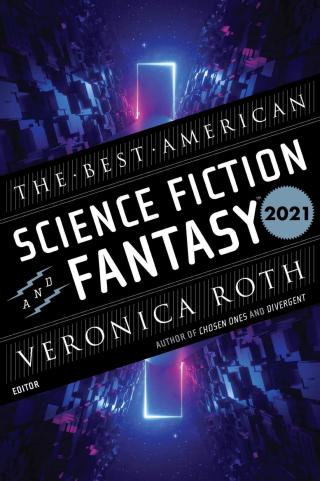
The Best American Science Fiction and Fantasy 2021
- Автор: Рот Вероника, Адамс Джон Джозеф
- Год: 2021
- Язык: английский
- Год: HMH Books : Mariner
- ISBN: 9780358470076
- Жанр: Малые литературные формы прозы

Электронная книга - «The Best American Science Fiction and Fantasy 2021». Краткое содержание книги:
This year’s selection of science fiction and fantasy stories, chosen by series editor John Joseph Adams and bestselling author of the Divergent series Veronica Roth, showcases a crop of authors that are willing to experiment and tantalize readers with new takes on classic themes and by exchanging the ordinary for the avant-garde. Folktales and lore come alive, the dead rise, the depths of space are traversed, and magic threads itself through singular moments of love and loss, illuminating the circulatory nature of life, death, the in-between, and the hereafter.
The Best American Science Fiction and Fantasy 2021 captures the all-too-real cataclysm of human nature, claiming its place in the series with compelling prose, lyrical composition, and curiosity’s never-ending pursuit of discovering the unknown.
He stared at it, his breath was coming high in his chest. His thumb ran across the combination lock, turned the wheel. The combination was his enlistment date—his second birthday.
The pistol lay swaddled in oilcloth. A fully loaded magazine lay beside it. He picked up the weapon with one hand, opened the cloth with the other. The gun was larger than he remembered. Heavier.
During his first leave, between boot camp in San Diego and deployment, he’d missed his sidearm—of course he hadn’t been allowed to leave the base with it. He drove to a gun shop on Pacific Avenue and chose a Glock 19M, the civilian twin to the M007 he’d been issued. He drove immediately to a firing range, and the first time he pulled the trigger he thought of the Rifleman’s Creed, which his drill sergeant had made him memorize: There are many like it, but this one is mine.
He’d never told Leo about the gun. He knew Marisa would never stand for a weapon in the house.
Finally he slipped his hand around the grip, his finger straight along the trigger guard. The safety was on. He pulled back the slide. There was no shell in the chamber.
He could load the gun or leave it empty.
Pierce was dead. Conseco was dead. And the sniper was still on the roof, with half the squad still within his field of fire.
Rashad threw himself against a wall and shouted “SHEP!” into his throat mic. “Building 31, go, go, go!”
The AI understood the sentence. Building 31: a known entity on its map, photographed and tagged months ago by drone. Triple-go: top speed. The robot spun in a tight circle, then charged down the steep road that Rashad had trained it to navigate.
Rashad swiped at his wrap and brought up the hornet’s stream side by side with the SHEP’s. The drone circled feet above the roof, close enough to show the sniper’s eyes, the silver snaps on his blue windbreaker, the white laces of his black sneakers. The gunman was on his feet now, holding his rifle with one hand, looking down at the robot charging toward him at forty miles per hour.
The shooter pivoted toward the far end of the roof, where a trapdoor lay open. He was going to go down into the house.
The SHEP reached the bottom of the steep road, spun around a low stone wall. Building 31 was a cement house, one large door in front, and two open windows. The .50 caliber swung to cover the edge of the roofline, but there was no angle for a shot.
“Grenade,” Rashad said. “The window to the right of the door.” The window lit up with a red outline. Rashad’s glove vibrated and he closed his fist: Yes. The grenade flew through the opening, thunked against an inner wall, and exploded with a bang that would have deafened him if he’d been there in person.
He sent the SHEP hurtling into the front entrance. The door seemed to vanish in front of the camera. The room was full of smoke. The SHEP, however, quickly identified heat signatures. Three red outlines popped up, and the glove seemed to be shaking itself from his hand. He made a fist. Yes. The gun erupted. Yes.
Another figure appeared at the edge of the screen. The SHEP’s M2 was already spinning to face the threat. More red outlines.
Yes and Yes and Yes and Yes and Yes and Yes and Yes.
Alejandra dealt three cards: blue square, yellow X, orange rectangle. He touched the blue square, and she made a note on her tablet. Then she dealt three more: yellow X, red circle, and another blue square. He understood, now, that these were arbitrary choices. What she was measuring was probably not what he chose, but the speed of his decision-making, or perhaps the level of stress in making the choice. Even so, he was reluctant to choose the blue square again, so he tapped the red circle.
After a few rounds of cards, Alejandra set up the slide show. She moved unhurriedly, projecting an aura of quiet he was reluctant to disturb. He wondered again what she thought of him. It alarmed him how desperately he wanted her to like him.
At the break after the first twenty-minute round of slides, she asked, “Have you scheduled a therapist yet?” It had been a month since they began the experiential phase.
He felt heat in his cheeks. So she still thought of him as a patient. “No, there’s a waiting list. The VA says they’ll call me.”
“So you haven’t gotten any meds, either?”
“No.”
“Damn it,” she said, almost under her breath. He’d never seen her express annoyance—or else he’d missed it.
“I’m sorry,” he said. “I’ll ask Leo to call again.”
“It’s not you. This should be part of the treatment. I told him—” She stopped herself. Him—Dr. Subramanian. The past several appointments, he’d not made an appearance. Alejandra had said that he was traveling. “I’ll make some calls,” she said.
“You don’t have to do that.”
“Your brother said you’re not sleeping.”
Leo talked to her? Behind his back?
“It’s okay,” Alejandra said. She was watching him with those dark eyes. She didn’t need a tablet to read him. “He’s worried about you.”
“I’m fine.” This was a lie. Sometimes he burst into tears for no reason. His body had developed strange aches. A sharp noise could make him jump out of his skin.
“Are you having suicidal thoughts?”
“No.” Another lie. Had he taken too long to answer? He wasn’t sure she believed him. What had Leo told her?
“It wouldn’t be unusual if those thoughts came back,” she said. “You haven’t been able to feel them for some time. If you want, I can turn down the signals from the DBI. Ease you back down.”
“You can do that?” Then: “I don’t want to be like before.”
“Not all the way off, just less . . . volume. Until you have a therapist. It would give you space to deal with what happened to you in India.”
So. She had read his file. Shame tightened his chest.
“I don’t know everything that happened there,” she said. “But I do know that they put you in a position where you had little choice about what to do. They trained you to fight, then put you in the line of fire. Then they gave you tools that made it easy for you to do what they wanted you to do.”
“You’re just describing how the military works.” His throat was tight.
“I’m saying you’re not completely responsible. Your options, your degrees of freedom, were restricted by so many things—the rules of engagement, the environment, the ATLAS targeting system—”
“No. I’m responsible.” He was surprised at how harsh he sounded. “I’m the man in the loop. The SHEP is just another weapon, like a rifle.” He was processing so much information. She knew about ATLAS, too? Did she have security clearance? Who had she talked to?
“ATLAS is much more than a rifle,” she said. “It was designed to make it easy to pull the trigger. It’s called automation bias. They wanted a system where it would be easier for a soldier to follow a suggestion rather than—”
“I’m not a soldier,” Rashad said. “I’m a marine.”
Alejandra stopped, blinked. She was embarrassed, he realized. Maybe the DBI was making it easier for him to read expressions, too.
“I’m sorry,” she said. “I know you’re not army. I didn’t mean to offend you.”
“I’m not offended,” he said. “But a marine—making hard choices while under fire is what we’re trained for. A machine can’t do that. Robots make bad marines.” That was something his instructor at special operations school liked to say.
Alejandra thought for a moment. “If you could go back in time, knowing what you know now, would you stop yourself from doing what you did?”
“You mean, take away my free will?”