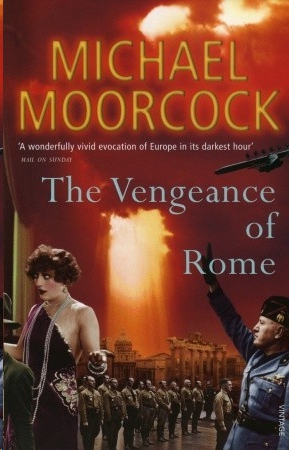
The Vengeance of Rome
- Автор: Муркок Майкл
- Серия: Between The Wars #4
- Язык: английский
- Жанр: Научная фантастика

Электронная книга - «The Vengeance of Rome». Краткое содержание книги:
I brought up the Jewish Question in relation to their domination of Hollywood. Contrary to later distortions, Röhm and his family were not rabidly anti-Semitic.
‘I’ve nothing against an honest Jew making a living,’ said Röhm. ‘Though usury’s the bane of modern economics. My complaint is that he then has to give his fifteen brothers and brothers-in-law a living — which means equally honest Germans are in the soup queues because Jews give jobs to Jews. You can’t blame them. We shall have a quota system so that Jewish businesses can only employ so many non-Aryans. At least it will give us a level battlefield.’ (A far cry, I think you will agree, from Treblinka!)
‘A few heads might have to roll in the present government.’ He laughed. He was using conventional phrases. These were the years of strong language, of newspaper hyperbole, where the vocabulary of war had infected all aspects of everyday life, just as military language translated through sport infects modern English. He never meant literally that people’s heads should be chopped off. He simply meant that Sozis and Nationalists would have to be replaced with National Socialists so that they had a large enough majority to pass such laws. He did not anticipate the punitive so-called Nuremberg Laws which Röhm had absolutely nothing to do with, of course, and which Hitler borrowed from America.
Fräulein Röhm seemed to wish to change the subject. As Röhm’s mother talked to him about a relative who had recently fallen ill, his sister moved to sit comfortably beside me on the lumpy couch and asked if I understood that cats had a religion.
‘Do you keep cats, Herr Peters?’ she asked rather diffidently.
‘No, madam. I fear I am away from home too often. You have cats of your own?’
‘Not at present, Herr Peters. Do you know what cats’ religion is? They believe that when they die they become humans. They live for seven or ten or fifteen years, as some cats do, and then they die and turn into humans. That is a sweet idea, don’t you think?’
‘Very, Fräulein. Extremely. Touching. And who are these people who were once cats? Can we recognise them or do they move secretly among us?’
‘Babies,’ she said. ‘They go from kitten, to cat, to baby and eventually to human maturity.’
‘What then?’
‘They become kittens again, I suppose.’ She smiled playfully. It was odd to see such imagination sparkling from such unremarkable features. ‘It is not a very complicated religion!’ She laughed again with unexpected, girlish spontaneity. She loved cats, she said, but it was impossible at the moment. The significance of her expression escaped me even as I nodded in sympathy.
Röhm had the soldier’s ability to relax in any circumstances. He seemed the only one actually comfortable on those chairs. Looking at his short military haircut and the way he held his coffee cup, I was suddenly reminded of a tonsured priest, and for a moment saw my friend, the leader of a great military force, as a monk on a visit home from the monastery. Many of the Nazis had the same puritanical rhetoric which had driven the Normans and helped them hold a conquered England, so I took it sometimes with a pinch of salt. The rhetoric was useful stuff, a kind of sustaining fuel, but it was not realistic. I am always pleasantly surprised by originality in the apparently unexceptional and warmed rather strongly to Fräulein Röhm. I could see that we might have a good, platonic friendship if I stayed longer in Munich. I think I had made a friend I would be able to see again. It occurred to me that while I waited for my opportunity to visit England, I could return temporarily to Vienna, which seemed a good place to be to test the waters, but once again I had no employer, no money and no certainty of being able to keep myself in the necessities of life. At some stage I would have to prevail upon Röhm for funds.
As Fräulein Röhm chatted to me, I must admit these anxieties went through my mind. She asked me if I planned to take any acting roles here in Munich. I told her that I was first and foremost an engineer. It seemed that the sooner I was in contact with some German manufacturer, who would buy my patents and offer me a royalty, the better. I was, I said, at present obliged to her brother, but that situation was, of course, untenable. She seemed disappointed when I remarked that, should I stay in Germany, I might find myself a flat in Berlin. I had privately formed the opinion that Bavaria was something of a backwater, its predominantly peasant culture both narrowly religious and prudent, glad to welcome tourists who, even in the darkest days, supplied many towns with their main trade. Munich, while delightful to look at, and full of the old, good-hearted spirit of those poets and painters attracted by the largesse of the Wittelbachs, themselves great patrons of the arts, was not at the heart of things, only at the heart of the NSDAP, which had started there. Even the party’s centre of gravity was shifting to Berlin.
I said nothing of this to Röhm’s sister. I had no wish to end my relationship with him. However, as the duties of party and army consumed him, he would be spending more and more time in Berlin. I merely told his sister that Berlin was where one had to be if one wished to get things done. She understood this. She said how hard all the travelling was for Ernst, with his arthritis being so painful. She darted him a sympathetic smile. Laughing, he assured her that these days he travelled first class on the best trains and in the finest cars. He had come quite a way from when he was reduced to selling encyclopaedias door to door like so many ex-servicemen. His mother pooh-poohed this as something he should not talk about, and I was reminded of Röhm’s respectable background. This was the man who had called himself a wicked, brutal creature. Yet, of course, that was far from being the whole individual, as he proved when, at his mother’s request, he played some Schubert songs for her on the piano.
Frau Röhm made me eat more cake but did not press her son. She said that Ernst had to watch his figure now that he was a great public man. He had always loved stories of the American wilderness, she said. Was I familiar with the work of Karl May? I told her that Old Shatterhand and Winnetou the Apache Prince were my constant companions as a boy. I almost made reference to old Professor Lustgarten, who had lent me the stories in Kiev, before I realised it would contradict her impression of my having been born in America. I found myself hesitating, at a loss for words. Röhm, believing me to be in trouble, made an excuse for us. He sprang up. We had a meeting, he said. Suddenly we were putting on our coats.
In the hall the women asked me to sign their friendship books and with simpering grace hoped that I would stay in Germany to make some films for them. They were both delightful. As we left, Frau Röhm gave my friend a large, awkward-looking parcel tied up in newspaper. ‘For the dog,’ she whispered.
I kissed hands. I hoped I would see the ladies again. Röhm was now in a hurry and bustled me and the parcel down the drive to the ordered taxi which would take us back to central Munich. He was a little embarrassed by the package of bones. ‘She loves my Griselda.’ He often left his Alsatian bitch with them when he went away. He felt better when she was there to protect them. Griselda was currently guarding Röhmannsvilla. I had rarely seen the animal.
He put the bones on the floor of the cab and instructed the driver to take us to the Königshof. I reminded him that I was being thrown out of that hotel. He nodded at this, but his attention was on our surroundings. He looked right and left, craning his head to peer through the small back window. ‘Just a precaution,’ he said. ‘If the cops are checking on us, they won’t get much, and if it’s one of Himmler’s new overzealous Boy Scouts, they’ll tell him I took you home to Mother.’