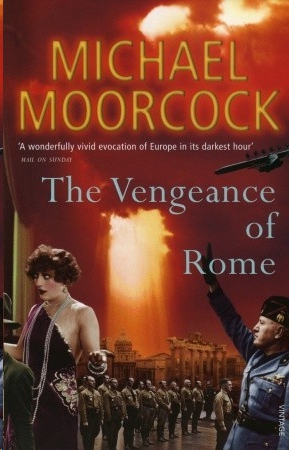
The Vengeance of Rome
- Автор: Муркок Майкл
- Серия: Between The Wars #4
- Язык: английский
- Жанр: Научная фантастика

Электронная книга - «The Vengeance of Rome». Краткое содержание книги:
This was surely overly cautious? But Röhm was a planner; his success was due to his ability to foresee every possible detail. So we entered the auditorium individually after the lights had dimmed. When it was safe, we joined each other in the dark of the expensive back rows. He had bought one of those boxes of chocolates they sell in foyers. He told me to eat all the dark ones. He preferred milk. He shouldn’t have chocolate at all with his arthritis.
Even as we settled in our seats, the interior was slowly transformed to a glorious cathedral of multicoloured neon. There came the wafting scents of spring roses. Pretty blonde girls in traditional costume went up and down the aisles freshening the air with spray guns. Then the whole theatre vibrated to the roar of a single, massive chord. Playing selections from well-known film scores, from the lovely operettas of Strauss and Lehar, the great organ began to rise from the pit.
My Virgil seemed tense, but he was jovial enough in his passing remarks, loosening his clothing and lighting a cigarette. The back of the Kino was completely empty. A few couples occupied the front seats together with some solitary men, but nobody was interested in us. Unusually, Röhm smelled of spirits. I heard the swill of a bottle in his pocket.
We began as usual with a newsreel. The excitement of the current political situation, the dominance of the Nazis in the Reichstag. The need for strong government. A rally of Nationalists and their own supporters, the impressive Stahlhelm battalions. Various Nationalist politicians were prominent. There were pictures of Hindenburg and of Hitler, of von Schleicher, von Papen and various other politicians. A general milling about outside parliament. Sozis raising their clenched fists in the air. Storm Troopers giving Nazi salutes, clearly in defiance of a disapproving constabulary. Nazi deputies returning the salutes as they made their way en masse into parliament. Socialists returning the clenched fist signal. All it needed was a deputy or two making scissors with their fingers and we should have had the entire scissors-paper-stone routine. Perhaps that was the origin of Churchill’s famous V-sign?
A mixture of Nazi uniforms and conventional pinstripes. Hess and Strasser mounting the steps. Scenes inside the Reichstag. Where is Hitler? Goebbels speaking to the congress. Shots of the corner of Prinzregentenplatz. Policemen interviewed. Considerable space given to the death of the niece of ‘prominent young Munich politician’ Adolf Hitler. Various other men gesticulating urgently. A general sense of tension and uncertainty. Röhm seemed horrified when, for a few moments, his gigantic uniformed image appeared on the screen. He was, of course, an increasingly well-known figure. No mention of him was made by name, but the marshalled ranks of Storm Troopers were testimony to his power.
I do not remember if there was sound. In those days the news-reels did not always have it, since most regional theatres were not converted. Röhm seemed unhappy with the reporting. He said that it was UfA news and that meant it was slanted towards the ideas of a few reactionary old industrialists who wanted to restore the Wittelbachs and the Kaiser. He relaxed into innocent amusement as we watched a concoction called something like Nie wieder Liebe. I found it mildly funny but Röhm was roaring and slapping at himself, his bottle forgotten. He was in excellent spirits when the two-reeler came on, a Western with Buck Jones. Jones was a new star, the best type of All-American boy, righting wrongs and rescuing fair maidens. Full of wild action and wholesome heroics, the film was well above the usual quality. People find it fashionable to mock at morality these days, but I see nothing amusing in showing evil thwarted and virtue triumphant. Röhm loved these tales. He nudged me once and whispered in fun that Mr Jones was an even better rider than I. The film had been given a decent budget. The subtitles were German, of course. Not a talkie, but a musical soundtrack had been attached. Röhm agreed with me that he would rather have a live orchestra.
Next came a pre-war Douglas Fairbanks Keystone comedy in his old style, with organ accompaniment, the titles in Gothic German, giving them all a vaguely Victorian quality, but the sparse audience filled that great cinema with appreciative laughter. Mack Sennett was a hero in Germany. They were fond of saying how much of the technology had been invented by Germans, how many of the American film-makers had German names. I sensed a peculiar feeling of goodwill towards America in those days, because the USA had not fallen into the vengeful trap of the rest of the Allies and made vast, unmeetable reparation demands on the defeated country.
With over a third of her citizens of German origin, America had no great animosity towards Germany. America had not been the cause of inflation. Wall Street, as Germans were fond of saying at that time, was not Wisconsin. When Röhm explained the reality, it made perfect sense. Most of Germany’s major national debts were either paid in deliberately inflated currency or written off. Big Business had taken advantage of a disaster which left ordinary families destitute but allowed private companies to make massive profits in foreign currency. Until the government produced the new hard mark those few fat businessmen benefited very well from inflation. Their profits were not poured back into the needy country but sent to Switzerland, England, Liechtenstein and America. Röhm understood this as well as any Bolshevik.
The understanding was beginning to dawn on the victors, too, I think, that an impoverished nation impoverishes the nations it trades with. The French and American Jews in particular had been quick to take advantage of Germany’s rock-bottom prices. With his eyes fixed on the screen, Röhm talked through the Keystone comedy in a low monotone which only I could hear. He was clearly a man obsessed. He had come here with the intention of forgetting his problems, but the problems had followed him into the Kino.
He only fell completely silent when the main feature, a glossy confection set in Vienna some time early in the nineteenth century, began, a talkie. I must admit, I was astonished by the quality of the sound. It was as if a full orchestra was playing in the theatre and the voices of the performers filled the air like a choir of angels. Slowly I was drawn into the wonderfully complex plot, featuring Metternich’s various machinations with wonderful romantic performances from Lilian Harvey, Conrad Veidt and Willy Fritsch. We even saw our great Russian Emperor Tsar Alexander represented. Waltzes were danced and balls were given, peasants sang and the world was merry, full of promise, for together we had defeated the threat from Napoleon. A high moment for Europe.
Both Röhm and I were enraptured by the film. I fell in love with Lilian Harvey. I could almost smell her. She was gorgeous and naturally graceful, a girl of the people very much of the Mrs Cornelius type, with the same helmet of white-blonde hair. The vital young Englishwoman, singing beautifully in German, was a great star here. The scene where she sings on her way to visit Willy Fritsch (as Tsar Alexander) and all the peasants join in with her has been copied a million times since. The background of the charming romance was the founding of the Holy Alliance between Prussia, Austria and Russia after Napoleon had been exiled to Elba. A serious political theme, telling us something of current political attitudes, which also engaged Röhm’s attention.
The Germans, of course, had always led the field in kinematography, and there was no faulting this extraordinary operetta, the form in which they were also the unrivalled masters. The extravaganza was produced with so much more flair and taste than those more famous American musicals which came to imitate Der Kongress tanzt and its successors.