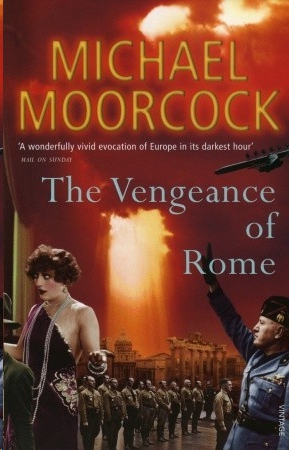
The Vengeance of Rome
- Автор: Муркок Майкл
- Серия: Between The Wars #4
- Язык: английский
- Жанр: Научная фантастика

Электронная книга - «The Vengeance of Rome». Краткое содержание книги:
Germany was witnessing so much electioneering she had become heartily sick of democracy. Democracy got her no further forward. Ruling chiefly by emergency decree, torn between extremes of left and right, the Reichstag had become a laughing stock. Only the NSDAP offered a genuine alternative to all this uncertainty. Only the NSDAP offered a clear advance. And it was obvious from every poster one saw that the NSDAP was Hitler.
Again, as I passed a particularly dramatic poster of Der Führer, I experienced a slight shock as those same eyes which had stared at me in Tegernsee seemed to bore into me again. A disturbing illusion. Later I wondered if Hitler’s eyes were not mirrors in which we saw everything we desired or feared. Were such shadows entirely creatures of our imagination, fashioned out of mud and entrails and made reality by a triumph of the will? Strange thoughts for a busy Tuesday in the centre of so much banal human activity.
Munich was vibrant with the sense of coming change. Indeed, she anticipated an apotheosis. A resolution to every dream Germany had nursed from the beginning of the century, when stability and growth would be reflected in the Reichstag’s domination by a Bavarian party, nurtured in Bavarian soil, putting an end to the dominance of ‘Red’ Prussia whose election of so many Socialist deputies in 1914 had precipitated this war. Until now Prussia had been the determining power in Germany’s history. But Munich would always remember the first blows of the Nazi revolution struck during 1923, the year of a noble, if unsuccessful, putsch. Now again there was hope, a spring in every citizen’s step, an optimism which put smiles on faces and displayed an inner radiance. The soul of Germany was returning to life.
Röhm had the rights of it. Stories of German poverty were dreamed up by the Jewish press, whose owners were only interested in buying cheap stocks in German-owned firms. In spite of all efforts to suppress her, the German economic giant had restored herself to power in less than a decade. We know now how certain alien influences in Germany conspired to produce conditions where only the decent German working people and ex-soldiers, poor mothers and children suffered the results of inflation. Even the Völkischer Beobachter had noticed a preponderance of Jews in the shops, stocking up for a season they enjoyed but did not celebrate. Many were not difficult to spot. Others, of course, were better disguised, with Aryan names and looks which could pass a casual glance.
We reached the tram stop. Baldur still talked enthusiastically about Hitler and Röhm. He admired both. He knew that Röhm’s bluff foul-mouthed manner hid a sensitive and generous heart. That’s what his men sensed, why they loved him so fiercely.. Schirach spoke of the people who had benefited from Röhm’s open-handedness. He was not a rich man, but was always generous with what he had. A Bavarian of the old, best sort, he knew how to talk to people at all levels. Just as the Führer did. Germany would know true equality under the National Socialist Party. Irrespective of social background, strong men and women would marry and produce the healthiest children in the world, a proud, self-reliant race with room to breathe and grow. Count and carpenter would work side by side to build a finer, cleaner country, whose broad new roads would be laid like wedding ribbons across the nation.
In response to his enthusiasm I asked a little sardonically if the wedding ribbons would be white.
‘Oh, white! Of course!’ He laughed heartily. ’White, white, white. I love white. So much easier to clean. Ha, ha! White for a virgin Germania, white for her Austrian husband! I wrote a poem on the subject for the Führer. He keeps it in his wallet.’ He shook his head as if I had made a great, insightful joke. ‘Poetry is another talent which runs in my family. White for the new Germany, black for our swastika, sign of rebirth, red for our blood, our pure German blood. Our Nazi colours are the true German colours. Do you see?’
He was only to a degree describing an idealised self. I said I was not the best person to be asked to evaluate a poetic work. I preferred novels and engineering books. ‘Of course you would, of course you would,’ he said rather mysteriously, more or less to himself. ‘Naturally, we are keeping our eye on the Hamburg elections. That will give us a gauge of our power.’ His discussion of strategy and politics was so narrow as to be all but meaningless to me. I was, however, well aware of the urgency of the situation. People scarcely realise these days how the fate of the Nazi Party hung on a knife edge in 1931 and 1932, why Röhm had needed my help so urgently.
At last the number 47 to Viktualienmarkt came along, and we struggled aboard while the driver complained and other passengers suggested we should have hailed a taxi. The thought had also occurred to me, but I did not have money for a taxi and received the impression young von Schirach, for all his expensive clothes, was not rolling in hard marks either. As it was, the two boys bought their own tickets, and von Schirach paid for me. Siegfried was blushing bright red, an unsuitable colour. The boys were far more embarrassed than von Schirach whose insouciance to social nuance was a characteristic of his class. Clinging to the overhead rail as I sat precariously on the edge of the only available wooden seat, with the boys swaying behind him, he spoke enthusiastically about the Jewish Question. The vehicle was a haze of human breath and smoke. The windows were steamed up, making it difficult to see where we were going.
Pausing only to assure me we were almost at our stop, Baldur continued with his cheerful babble. I was in agreement with many of his ideas but was also aware, as he was not, that a member of the tribe was sitting behind him glaring her disapproval. Von Schirach was one of those abstract anti-Semites who had nothing against individuals. He could not really tell the difference between a Jew and a Greek. All Mediterranean types looked the same to him. He spoke with the fire of the convert he was, having been inspired as a teenager by Hitler’s oratory. There was definitely something infectious about Baldur’s enthusiasm, his sense that something had to be done and done soon.
He was soon to be promoted to Youth Leader of the NSDAP, answering directly to Röhm, and he was very proud. The news would shortly be made public. Hitler and Röhm, he thought, were a perfect partnership - the dreaming philosopher and the realistic man of action. A combination of the German virtues. He laughed loudly again. ‘The Führer is a person of rare goodness and sanity, but he needs someone to organise things for him. Like many geniuses, he’s both highly strung and sensitive, though he hides it behind a mask of good humour. These Austrians, you know, are naturally easygoing, like most theatre folk. It’s their charm, isn’t it?’
Naturally I was a little confused and somewhat circumspect. Less than forty-eight hours had passed since the incident at Tegernsee and while it had faded, as all such things fade with the daylight, I found it still difficult to recall that von Schirach’s heroic saviour of Germany was the same creature I had left covered with excrement in its darkened lair. Von Schirach was an intimate. Had he any notion of the truth? It seemed not. Some people are so innocent they impose their own purity of vision on everything around them. No doubt young Baldur knew nothing of the darker Hitler. Whatever hints he received he interpreted as the Führer’s richness of reference and wisdom.
I was not particularly surprised by this, nor even by Hitler’s somewhat extreme means of finding release. Many had discovered such methods, as Röhm had said, in the heightened conditions of the trenches. Hitler was not the first idealistic hero to pursue a private devil. One recalls the great Gilles de Rais, defender of Joan of Arc, remembered by history as Bluebeard, rapist, murderer and torturer of some two hundred children. Possibly the aberrations occurred in direct contrast to altruistic heroism, as if one could not exist without the other. We have all read the Robert Louis Stevenson tale which he originally wrote as Rabbi Sheckel and Doctor Hide (altered by the Hollywood sons of Shem to a more innocuous title) in which by day the narrator is an upstanding Aryan doctor, but by night becomes a blood-drinking Jewish monster. The film was very popular in Germany in my day. Perhaps, suggests our story, sides of the same soul are completely unsunderable. If one dies, so does the other. Sometimes I think both forces are needed in balance to make a fully functional human being.