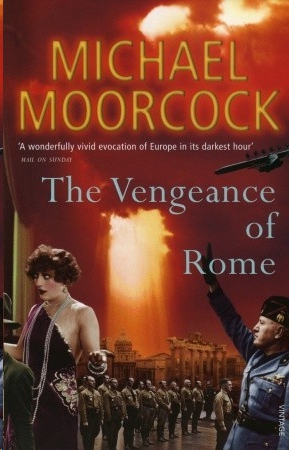
The Vengeance of Rome
- Автор: Муркок Майкл
- Серия: Between The Wars #4
- Язык: английский
- Жанр: Научная фантастика

Электронная книга - «The Vengeance of Rome». Краткое содержание книги:
Such people frequently refuse self-analysis, fearing it would only threaten or weaken them, like actors who change parts, from being ‘themselves’ in the dressing room to being ‘themselves’ onstage. Like an actor, Hitler needed only to work in short, hard bursts. Between his parts he rested. Perhaps the more important the role, the more he retreated into himself?
The tram stopped suddenly. Most of the passengers began to disembark. The boys waited impatiently to take my luggage off. Evidently they knew where we were going. While showing no insubordination, they clearly thought this job beneath them and were constantly under von Schirach’s disapproving glare until suddenly, they darted down a narrow, cobbled side street. For a second I thought they had decided to steal my bags and shouted in alarm. They were carrying everything of importance to my life. We ran to follow them as they disappeared through the gloomy entrance of a low building. Like a tunnel from one world to another, we were all at once in Wonderland, and childhood images came crowding into my head. My soul knew unexpected joy, a kind of memory. In that earlier time the writing had been in Cyrillic. Now it was in Gothic German.
Lit by dancing gas jets throwing fluttering shadows on to the ceiling was a vast covered market. Stalls and cubicles stretched almost endlessly into the half-light. The floor of the great roofed concourse was crowded with brilliantly coloured counters crammed with all kinds of country comestibles. Von Schirach told me this was Munich’s famous covered food market, one of the largest in the region. Specialising in delicacies from all over the South, as well as fruit, vegetables, meat and sausages, the place was full of people, in spite of there being so little money about. Folk from the surrounding towns came to buy their annual luxuries and to take advantage of the various beer concessions. Red-faced farmers and their sons strolled around the pitches buying little. Clumps of them exclaimed at the outrageous prices, comparing quality with their own home produce. City dwellers and stallholders regarded them with amiable contempt in the main, but the peasants were by no means unwelcome in this lean year of 1931.
We passed a monstrous pitch the size of a circus tent selling nothing but a huge variety of cheeses on four sides. Medals and ribbons hung from the striped canvas, advertising the owner and his ancestry. Yellow wheels the size of truck tyres, heavy wedges of blue-veined Cambozola, Stilton and Roquefort, slivers of delicate French Brie and Camembert, and all the good, solid pale pinks and browns of the local varieties, together with the Goudas and Edams and Cheddars. Their combined scent hinted at the ultimate cheese. Beef bones and deer carcasses, hares and rabbits, chickens and geese hung in military ranks from the steel hooks. I smelled blood, fur, feathers, fresh-killed. Glittering candies and rich mounds of chocolate; flowers, toys and slabs of shining fish; wooden booths selling hot dumplings and vanilla custard.
Rising into the gloom, steam streaked the roof’s dirty glass. We pushed through crowds lining up against a pork butcher’s elaborate canvas, decorated with gold medals and shields, proclaiming prizes won as far away as Saxony and the Sudetenland. Electricity and naphtha buzzed. The wealth of smells made you want to stop and begin eating. You felt you could eat the air itself, it was so rich. Massive men and women commanded those stalls, like so many sea captains aboard their ships. Their wiry, darting sons and plump daughters served the customers, shouting responses and exhortations while still others called to us to buy the best of this, the freshest of that. Old men stood arguing at coffee stalls. Old women disdainfully fingered fruit.
And then, from a little cleared space near the far side of the huge, echoing hall, a hurdy-gurdy began to sound. Its cheerful, cheap blasts and whines, amplified by the roof, again reminded me of Odessa and my happiest days. An Italian with a huge Kaiser Wilhelm moustache and a tall felt hat, a tiny, red-jacketed monkey on his shoulder, was operating the handle of his barrel organ while in front of it danced a little ballerina in vivid scarlet and green. Her legs and feet were bare but she moved with extraordinary grace, her dark curls bobbing above her grave, aquiline face as she pirouetted. Her dark eyes met mine, and I was back in Kiev, falling in love with Zoyea, the gypsy girl, all over again . . .
I wanted to pause, to ask her name. To drop a coin in the cup which a boy, by looks her brother, shook at me. But von Schirach was in a hurry, and the youths with my luggage had not stopped. Again I had to trot to catch up. We followed them through another short tunnel before we had left the market and were outside again, marching against the crowd, down a few more streets to a slightly wider thoroughfare with a large carpet store on the corner, selling a rather more conservative selection than in the more fashionable Munich shops.
I was happy to find myself in a lower-class area dominated by a great, Baroque church. St Peter’s was like one of our Kiev churches, though somewhat plainer. The invulnerable old bricks seemed to offer a stable centre. I felt thoroughly comfortable in this district and was again reminded of my childhood. While my father had been connected directly by blood to the most aristocratic family in Russia, therefore making me vulnerable to assassination by Reds, his irresponsible pursuit of socialism had led to all our ruin. So I grew up in a similar area, with children playing noisily in the streets, women gossiping, washing lines hanging across courtyards, with dogs, carts and bicycles everywhere. To me it was like home. Even the stone and brick felt warmer. The smells were more familiar. I began at once to relax. Here I could escape the hustle and bustle of political and sexual life! As I had been burning the candle at both ends, I needed to rest. I began to relish the prospect of peace. With the elections coming in several key areas, I was not likely to have much company among the Nazis, at least for a few weeks. I would spend my time rethinking my situation, considering what I could do to improve my circumstances.
A few more doors down the unremarkable street and we stopped at a shopfront whose windows were protected by an iron grille, securely padlocked. The grilles had received a heavy battering at some time. The red, black and white paint of the outside had flaked and the building hardly seemed used any more. Behind the grilles on the windows were older portraits of Adolf Hitler, ‘the saviour of Germany, the keeper of our national honour’. Swastika symbols and the initials of the NSDAP made it clear we were at a local Nazi HQ. I suspected here we would pick up a key to some nearby apartment, but no sooner had Schirach unlocked the side door than the boys were dragging my bags through the gloom, which smelled strongly of dusty old paper, and up a flight of stairs. Von Schirach closed the door behind us, following me as I climbed in the boys’ wake, my face a little too close to the nearest pair of tight black shorts whose owner was inclined to sweat readily and had that sour, unpleasant smell of most young boys, but I watched with pleasure his healthy little muscles and sinews rippling with the effort of dragging my worldly goods to the top of the building where we stopped at last. Von Schirach was beaming as he unlocked the door, flung it open and ceremoniously handed me the keys. ‘Your flat!’
It was, in fact, a very comfortable little place. I suspected a woman’s touch, a mistress or perhaps simply a mother, for it was almost feminine in its furnishings, with everything one might need neatly placed. Schirach had lived here himself until fairly recently, when his circumstances had improved, he said. His rent had helped the party through some thin times. Now the place was here for me as long as I needed it. The party required no rent these days. He understood I had accomplished important work for the Italian dictator. He was a great fan of Signor Mussolini, who had done wonders for Italy. He had undertaken the Herculean task of bringing masculine fire to that quintessentially feminine Italian soul. If anyone could do it, he could. Meanwhile, his emissaries were always welcome in Germany, especially among the ranks of Nazis. They had much in common with the Fascist cause. He quoted a favourite saying of the great dictators: ‘It is better to spend one day as a lion than to spend a lifetime as a lamb.’