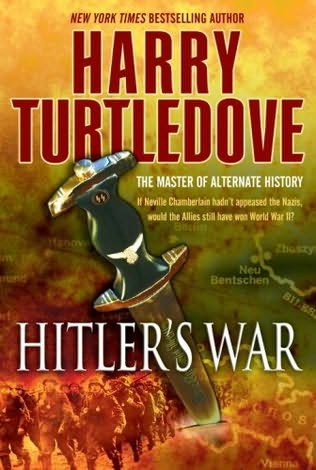
Hitler's war
- Автор: Тертлдав Гарри Норман
- Серия: The War that came early #1
- Язык: английский
- Жанр: Альтернативная история

Электронная книга - «Hitler's war». Краткое содержание книги:
Now, in this thrilling, provocative, and fascinating alternate history by Harry Turtledove, another scenario is played out: What if Chamberlain had not signed the accord? What if Hitler had acted rashly, before his army was ready-would such impatience have helped him or doomed him faster? Here is an action-packed, blow-by-blow chronicle of the war that might have been-and the repercussions that might have echoed through history-had Hitler reached too far, too soon, and too fast.
Turtledove uses dozens of points of view to tell this story: from American marines serving in Japanese-occupied China to members of a Jewish German family with a proud history of war service to their nation, from ragtag volunteers fighting in the Abraham Lincoln Battalion in Spain to an American woman desperately trying to escape Nazi-occupied territory-and witnessing the war from within the belly of the beast.
A novel that reveals the human face of war while simultaneously riding the twists and turns that make up the great acts of history, Hitler's War is the beginning of an exciting new alternate history saga. Here is a tale of powerful leaders and ordinary people, of spies, soldiers, and traitors, of the shifting alliances that draw some together while tearing others apart. At once authoritative, brilliantly imaginative, and hugely entertaining, Hitler's War captures the beginning of a very different World War II-with a very different fate for our world today.
Quietly, he said, “We have the gadget. If we need it, we know what to do with it. Till then, I don’t intend to break routine. Have you got that?”
“Yes, sir,” Gerhart Beilharz answered sourly. U-boat discipline was on the easygoing side-enough to threaten to give officers from the surface navy a stroke. That formal response felt like, and was, a reproach.
Where the conversation would have gone from there was anybody’s guess. Downhill was Lemp’s. But somebody yelled, “Smoke on the horizon!”
“It’ll keep,” Lemp said as he jumped to his feet.
“Ja.” Beilharz sprang up, too. He wore his cousin’s helmet all the time inside the U-boat-and needed it, too. It scraped on something overhead as he trotted along behind Lemp. He might make a submariner yet, even if he was oversized. Lemp would have thought hard about chucking him overboard had he tried to waste time.
The big, pole-mounted field glasses were aimed northwest when Lemp stepped out onto the top of the conning tower. “What is it?” he demanded.
“Looks like a light cruiser, skipper,” the bosun answered.
“Well, well,” Lemp muttered, peering through the powerful binoculars. It was indeed a warship: maybe a cruiser, maybe only a destroyer. He would rather have seen a fat freighter out there, but…Before he did anything else, he scanned the horizon himself. If it was a cruiser, it was likely to have destroyers escorting it. Ignoring them while making a run at the bigger ship could prove embarrassing, to say the least.
“Shall we stalk it?” Beilharz asked, all but panting at the chance. “It’ll give you a chance to try the snort in action.”
Lemp didn’t answer right away. Only after he’d gone through 360 degrees without spotting any more smoke or another hull did he slowly nod. “Ja,” he said. “We’ll do it.” He heard the odd reluctance in his own voice, whether the junior engineer did or not. Beilharz could afford to be eager. To him, this was like playing with toys. But Lemp had to be careful. U-30 and the crew were all on his shoulders, a burden that sometimes felt heavier than the one Atlas bore. He muttered something the wind blew away. Then he clapped Beilharz on the shoulder. “Let’s go below. We’ll see what we can do with your precious gadget.”
He didn’t submerge right away. He still wanted to get as close as he could on the surface, where he had the best turn of speed. When he did go under, he could still make the eight knots Beilharz had promised, and he would have been down to half that on battery power. The extra speed helped him maneuver into a good firing position.
He launched two torpedoes at the cruiser-he still thought it was one-from a little more than 800 meters. The British warship never changed course, which meant no one aboard saw them at all. One hit up near the bow, the other just abaft of amidship. Like a man bludgeoned from behind, the ship never knew what hit it. It shuddered to a stop, rolled steeply to starboard, and sank inside of fifteen minutes.
Cheers dinned through the long, hollow steel cigar of the U-30’s hull. Lemp went to his tiny cabin and pulled out the bottle of schnapps he used to congratulate sailors on a job well done. He thrust it at Leutnant Beilharz. “Here you go, Gerhart. Take a big slug,” he said. “You’ve earned it, you and your snort.”
Beilharz drank and then coughed; Lemp got the idea the young man didn’t take undiluted spirits very often. Well, if he stayed in U-boats long, he would. After a sailor pounded Beilharz on the back, he said, “Pretty soon, I bet every boat in the Kriegsmarine will mount a snorkel. But us, we’ve got ours now!” Everybody cheered some more. Why not? They’d just given the Royal Navy a damn good shot in the teeth.
* * *
Staff Sergeant Alistair Walsh shivered inside a house that once upon a time had kept an upper-middle-class French family warm and dry and snug. That family was gone now. So were the glass from the windows, a wall and a half, and most of the roof. What was left of the two-story house gave Walsh and several other British soldiers a good firing position from which to try to stop the Germans pushing down from the northeast.
He wasn’t sure whether he was technically in Paris or in one of the French capital’s countless suburbs. They blended smoothly into one another. Maybe the fine details mattered to a Frenchman. Walsh didn’t much care.
All he cared about right now was whether the side that mostly wore khaki could hold off the side in field-gray If the French were determined to fight, Paris could swallow up an army. Seizing the place block by block, house by house…Walsh wouldn’t have wanted to try it. And he would have bet the Germans weren’t what anyone would call keen on the notion, either.
If they got around Paris to the north and came in behind it, the jig was up. They’d tried that in the last war, but hadn’t quite brought it off. They were trying it again now. Walsh worried that they would make it this time. But he couldn’t do anything about that. All he could do was make life as rough as he could for any Boches who got within a few hundred yards of him.
More Boches were trying to do that than he would have liked. Germans had always been aggressive soldiers; he’d seen that the last time around, and it hadn’t changed a bit in the generation since. And they had their peckers up now, the way they hadn’t in 1918. They thought they were winning, and they wanted to keep right on doing it.
The Tommies who huddled with Walsh weren’t so sure how their side was doing. They’d all started out in different regiments, but here they were, thrown together by the fortunes or misfortunes of war. One of them-Walsh thought his name was Bill-said, “Where do we go if we have to fall back from here, Sergeant?”
“Beats me,” Walsh answered, more cheerfully than he felt. “They want us to hold where we are, so we’ll do that as long as we can.”
He peered out through a hole that had been a window. The bomb that had mashed this house had leveled three on the far side of the street. As far as Walsh was concerned, that was all to the good: it let him see farther than he could have if they still stood. Some British infantrymen were setting up a Bren gun over there, using the rubble to conceal and strengthen their position. That wouldn’t protect them from artillery the way a concrete emplacement would, but it was a damn sight better than nothing.
And Walsh liked having machine guns around. They stretched an ordinary rifleman’s life expectancy. Not only did they chew up enemy foot soldiers, they also drew fire, which meant the Germans wouldn’t be shooting anywhere else so much-say, at the precious and irreplaceable carcass of one Staff Sergeant Alistair Walsh.
Artillery probably based somewhere inside of Paris thundered behind the British position. The shells came down a few hundred yards in front of Walsh. A short round burst much too close to the Bren gunners. One of them turned and shook his fist in the direction of his own gunners.
Walsh would have done the same thing. Artillerymen and foot soldiers often brawled when they came together in taverns behind the line. The artillerymen seemed to wonder why. Not the infantry. They knew, all right.
“Can’t win, can you, Sergeant?” a different private said. His name was Nigel, and he talked like an educated man.
“Oh, I don’t know. Look at it the right way and we’re all winners so far,” Walsh replied.
Nigel looked puzzled. “How’s that? This isn’t a holiday on the fucking Riviera.” His wave encompassed the shattered house and the wreckage all around.
“Too bloody right it’s not,” Walsh agreed. “But you’re still here to piss and moan about it, eh? They haven’t thrown you in a hole in the ground with your rifle and tin hat for a headstone. They haven’t taken your leg off with a strap to bite on ‘cause they ran out of ether with the last poor bloke. If you’re not a winner on account of that, chum, what would you call it?”