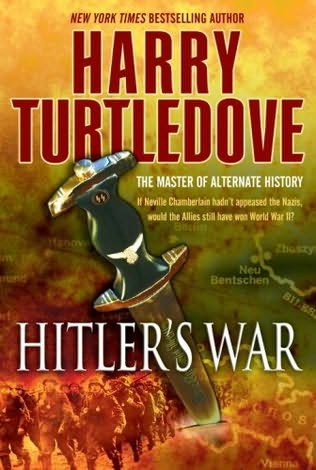
Hitler's war
- Автор: Тертлдав Гарри Норман
- Серия: The War that came early #1
- Язык: английский
- Жанр: Альтернативная история

Электронная книга - «Hitler's war». Краткое содержание книги:
Now, in this thrilling, provocative, and fascinating alternate history by Harry Turtledove, another scenario is played out: What if Chamberlain had not signed the accord? What if Hitler had acted rashly, before his army was ready-would such impatience have helped him or doomed him faster? Here is an action-packed, blow-by-blow chronicle of the war that might have been-and the repercussions that might have echoed through history-had Hitler reached too far, too soon, and too fast.
Turtledove uses dozens of points of view to tell this story: from American marines serving in Japanese-occupied China to members of a Jewish German family with a proud history of war service to their nation, from ragtag volunteers fighting in the Abraham Lincoln Battalion in Spain to an American woman desperately trying to escape Nazi-occupied territory-and witnessing the war from within the belly of the beast.
A novel that reveals the human face of war while simultaneously riding the twists and turns that make up the great acts of history, Hitler's War is the beginning of an exciting new alternate history saga. Here is a tale of powerful leaders and ordinary people, of spies, soldiers, and traitors, of the shifting alliances that draw some together while tearing others apart. At once authoritative, brilliantly imaginative, and hugely entertaining, Hitler's War captures the beginning of a very different World War II-with a very different fate for our world today.
His buddies, the ones who hadn’t caught packets themselves, hit the dirt and started moving up the way they’d learned in training. Luc wished for a battery of 75s to tear them to pieces. Wishing didn’t produce any French guns. Small-arms fire, then.
But damned if a couple of French tanks didn’t show up a few minutes later. They were Renaults left over from the last war, without much armor and without much speed. Still, each one had a cannon and a machine gun, and there didn’t seem to be any German armor around. The Boches didn’t like getting shot up while unable to reply any better than anyone else would have. Luc would have bugged out, and so did the Germans.
“I’ll be fucked,” Sergeant Demange said. “Wasn’t sure we’d get away with it this time. Well, I’d rather be lucky than good.”
He was good, which meant he could afford to talk like that. But luck counted, too. If a shell came down on your hole, how good you were didn’t matter. Luc shivered inside his own foxhole. He was still here. Maybe it was only fool luck, but he’d take it any which way.
* * *
Spring seemed to be coming early to eastern Poland and western Byelorussia. As far as Sergei Yaroslavsky was concerned, that was a mixed blessing. The warmer, clearer weather meant he could fly more often against the Poles and Germans. But it also meant the thaw would start pretty soon. And when it did, all the dirt airstrips in this part of the world would turn to mud. Nobody would do much flying till the ground dried out and hardened up again.
Rasputitsa. The mud time. Russian had a word for it. It came in both fall and spring; in fall because of rain, in spring from melting snow. The spring rasputitsa was worse, and lasted longer. Not just airplanes would be grounded. Armies would slow to a crawl, if they moved at all.
Sergei didn’t think the Soviet generals had intended to keep on fighting the Poles till the rasputitsa came. He didn’t think they’d intended to draw the Nazis in on the Poles’ side, either.
He did keep what he thought to himself. If he said something like that out loud, he’d end up in a place where the spring thaw started in June…if it ever did. The USSR had plenty of places like that, and plenty of people had found out more about them than they ever wanted to know.
He had the feeling he wasn’t the only one in his squadron thinking thoughts the NKVD wouldn’t like. Meals became oddly constrained. Men seemed to be chewing on more than sausage and black bread, swallowing more than tea and vodka. You couldn’t ask another pilot or navigator what was on his mind. If he told you, he proved himself a fool with a death wish. He was much more likely to say something innocuous and peg you for an informer. Sergei knew he didn’t trust a couple of his fellow pilots. You had to watch out. If the enemy didn’t get you, your own side would.
His bombardier had a simple solution. “Fuck ‘em all,” Ivan Kuchkov declared. “Fuck their mothers. Fuck their grannies, too, the filthy old cunts.” To him, that wasn’t mat. It was the way he talked. Maybe he didn’t know where ordinary Russian stopped and mat started. Maybe he just didn’t care.
“Some of these people you have to be careful around,” Sergei said…carefully.
“I suppose,” Kuchkov said with a noncom’s sigh about the foibles of his superiors. “The guys who think they have big dicks are the guys who’re big pricks, all right.”
“Right.” Yaroslavsky wondered why he bothered. He stood a better chance of talking a thunderstorm into changing its ways than he did of persuading Ivan.
But not even the NKVD could send a thunderstorm to a camp in Siberia. Ivan Kuchkov wasn’t so lucky. The blocky bombardier amazed Sergei by winking at him. “Don’t get your tit in a wringer, Captain,” he said. “They never come after the likes of me. I’m not worth bothering with.”
“How many other people have thought the same thing?” Sergei said. “How many of them turned out to be wrong?”
“Poor sorry fuckers,” Kuchkov said. Sergei started to nod, then caught himself. He’d already said more to Ivan than to any of his fellow officers, even Anastas Mouradian. If Ivan was a fellow with a pipeline to the NKVD, he’d said more than enough to hang himself.
He eyed the bombardier’s broad, rather stupid face. Ivan Kuchkov was a Russian peasant of purest ray serene. Surely he didn’t have the brains to inform on anybody…did he?
You never could tell. That was the first rule. There was that iron-jawed commissar who looked even more like a village pig butcher than Kuchkov did. What was his name? Khrushchev, that was it. Yes, he sure seemed the type who’d take off his shoe and pound it on the bar if he got into an argument. And if that didn’t work, he’d pound it on your head.
But, regardless of what he looked like, he was nobody’s fool. He’d lived through the purges, after all, when so many hadn’t. So maybe dear Ivan wasn’t as dumb as he let on, either.
Their SB-2 got off the ground to fly a mission against a Luftwaffe airstrip in eastern Poland. As Sergei guided the bomber into formation with the others, he wondered when the rasputitsa would close down operations. Muck had flown from the Tupolev’s tires as it roared down the strip, but it got airborne. Make the mud a little thicker, a little gooier, and it wouldn’t.
One way to deal with the problem would have been to pave runways. That never crossed Yaroslavsky’s mind. Soviet authorities didn’t pave highways between towns, not least because invaders could have used paved roads, too. But if the highways weren’t paved, airstrips weren’t likely to be, either.
“Here’s hoping we give the Nazis a nice surprise,” Anastas Mouradian said.
“That would be good,” Sergei agreed.
“Better than good,” his copilot said. “If we don’t surprise them, they’re liable to surprise us, and getting surprised by a bunch of Germans doesn’t sound like a whole lot of fun.”
“Er-right.” Sergei gave the Armenian a funny look. Did Mouradian talk that way because he was making a joke or because his Russian was slipping? Maybe it was both together; Anastas did like to make jokes, but they didn’t always come out the way he wanted.
Maybe that was why Stalin and Beria and Mikoyan and the other formidable fellows from the Caucasus cut such a swath through Soviet politics-the Russians who were trying to deal with them couldn’t figure out what the devil they were talking about till too late. Yaroslavsky didn’t say that to Anastas. One more time-you never could tell. If the Armenian took it wrong, it might end up as a one-way ticket to a labor camp.
And then Sergei forgot about it. Me-109s tore into the Soviet bombers. The plane just in front of his spun down toward the dappled ground trailing flame from its left engine. Another SB-2, fortunately farther away, blew up in midair. That felt worse than a near miss from an antiaircraft shell; Sergei’s bomber staggered as if bouncing off a wall.
One of the rear machine guns chattered. Kuchkov’s voice came through the voice tube: “These pricks are all over everywhere like crabs on cunt hair! Do something about it, for Christ’s sake!”
Off to Sergei’s left, a Soviet bomber dropped its load over nothing in particular, broke formation, and scooted for Byelorussia. That looked like cowardice. Another SB-2 went down, and then another. However the Fascists had found out about this attack, they were all over it. What had seemed cowardice a moment before began to look more and more like good sense.
Sergei fired the forward machine gun at a 109. Tracers didn’t come close. The German fighter flipped away with almost contemptuous ease. During the Spanish Civil War, the SB-2 outran and outclimbed Nationalist fighters. Everybody said so. But those German and Italian biplanes must have been mighty clumsy. As Yaroslavsky had first seen in Czechoslovakia, the bomber was no match for a Messerschmitt.
One more SB-2 tumbled in flames. That was enough-no, too much-for Sergei. “Dump the bombs, Ivan!” he yelled into the speaking tube. “We’re heading for home!”