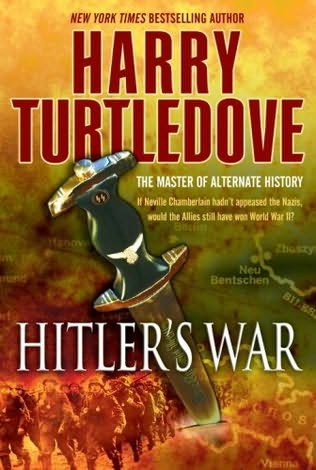
Hitler's war
- Автор: Тертлдав Гарри Норман
- Серия: The War that came early #1
- Язык: английский
- Жанр: Альтернативная история

Электронная книга - «Hitler's war». Краткое содержание книги:
Now, in this thrilling, provocative, and fascinating alternate history by Harry Turtledove, another scenario is played out: What if Chamberlain had not signed the accord? What if Hitler had acted rashly, before his army was ready-would such impatience have helped him or doomed him faster? Here is an action-packed, blow-by-blow chronicle of the war that might have been-and the repercussions that might have echoed through history-had Hitler reached too far, too soon, and too fast.
Turtledove uses dozens of points of view to tell this story: from American marines serving in Japanese-occupied China to members of a Jewish German family with a proud history of war service to their nation, from ragtag volunteers fighting in the Abraham Lincoln Battalion in Spain to an American woman desperately trying to escape Nazi-occupied territory-and witnessing the war from within the belly of the beast.
A novel that reveals the human face of war while simultaneously riding the twists and turns that make up the great acts of history, Hitler's War is the beginning of an exciting new alternate history saga. Here is a tale of powerful leaders and ordinary people, of spies, soldiers, and traitors, of the shifting alliances that draw some together while tearing others apart. At once authoritative, brilliantly imaginative, and hugely entertaining, Hitler's War captures the beginning of a very different World War II-with a very different fate for our world today.
“Now you’re talking, boss!” Kuchkov said. Grating metallic noises said he was opening the bay and pulling release levers as fast as he could. Half a dozen 220kg bombs whistled toward the ground. “They’re bound to come down on some mother’s head,” Kuchkov called cheerfully.
He wasn’t even wrong; Sergei could console himself with that thought. He hauled the SB-2 around and roared east at full throttle. Maybe it could outrun an Italian Fiat. Next to a 109, he might have been piloting a garbage scow. The airspeed indicator said he was making better than 400 kilometers an hour. All the same, he felt nailed in place in the sky. When a Messerschmitt could get up over 550, how could anybody blame him, either?
Kuchkov’s ventral machine gun barked again. The bombardier let out a shout of triumph-or was it surprise? “Nailed the fucker!” he roared.
“Damned if he didn’t.” Anastas Mouradian certainly sounded surprised. As bomb-aimer, he had a better view below than Sergei did. “The pilot managed to get out and hit the silk.”
“Too bad. Only means he’ll be flying against us again before too long,” Sergei said. He tried to look every which way at once, including in his rearview mirror. German fighters were bad enough when you knew they were around. If they took you by surprise, you were dead. It was about that simple.
He flew over the Poles and Russians. Soldiers from both sides fired at the SB-2. That always happened. They weren’t likely to hit anything.
“Won’t it be wonderful,” Mouradian said in his Armenian-accented Russian, “if we lead the Fascists to our airstrip and they shoot us up after we land?”
“Fucking wonderful,” Sergei half-agreed. His superiors wouldn’t love him for leading the Luftwaffe back to the field. But what could you do? His only other choice was putting down on the first open ground he saw. And if it was rough or muddy-and odds were it would be one or the other if not both-he was asking to go nose-up or dig a prop or a wingtip into the dirt. His superiors wouldn’t love him for that, either.
There was the airstrip. Groundcrew men could get the plane under cover in a hurry. Sergei landed in a hurry, too-as much a controlled crash as a proper descent. His teeth clicked together when the landing gear smacked the ground. He tasted blood-he’d bitten his tongue. Anastas said something flavorful in Armenian that he didn’t translate.
“You all right, Ivan?” Sergei asked the bombardier.
“I’m here, anyway,” Kuchkov answered darkly.
That would do. Right now, anything would. They scrambled out of the plane. The groundcrew men hauled it towards a revetment. They’d drape camouflage netting over it. In minutes, it would be next to impossible to spot from the air. No 109s circled overhead or swooped low. All the same, Sergei decided he could hardly wait for the rasputitsa to kick in full bore.
* * *
The Front was Paris. Alistair Walsh would have known as much even if papers didn’t scream it, even if posters weren’t pasted to everything that didn’t try to pick you up. Bomb craters and, now, shell hits from Nazi heavy artillery told their own story. When the 105s started reaching the City of Light, that would be real trouble.
No, Walsh thought. When the Boches drive their tanks down the Champs-Elysees, that’s real trouble. Till it happened, he’d damn well enjoy Paris instead of fighting in it.
Or he hoped he would. This time, he didn’t exactly have leave. His unit had fallen back into the eastern outskirts of town. Maybe they were supposed to be setting up somewhere, getting ready to hold back the next German push. If they were, though, nobody’d bothered to tell him about it.
In a way, that wasn’t so good. It said orders from on high weren’t getting where they needed to go. He would have been more upset were he less surprised. If the Germans kept pushing everybody else back, of course things would go to hell every so often. God only knew they had in 1918.
A lot of Parisians had already run away. On the other hand, a lot of provincials from the north and west had fled into Paris one step ahead of the invaders. You couldn’t be sure whether the face that peered out a window at you belonged to a homeowner or a squatter who’d picked a lock or broken a window. If you were a Tommy, what the hell difference did it make, anyhow?
Plenty of bars stayed open. Most of the men who filled them were soldiers-French, English, or from heaven knew where. Walsh had run into Czechs before. Maybe the hard-drinking fellows who spat incomprehensible consonants at one another were more from that lot. Or maybe they were Yugoslav adventurers or White Russians or…But what the hell difference did that make, either?
One of the poilus had a concertina. When he started playing it, several other Frenchmen sang with more enthusiasm than tune. Walsh knew just enough of the language to recognize a dirty word or two every line. The barmaids pretended to be shocked. Their acting might have been even worse than the soldiers’ singing.
Half a dozen military policemen stormed into the joint. The concertina squalled to a stop. The French MPs started hauling poilus out into the street. Then they grabbed one of the maybe-Czechs. He was in French uniform. He said something to them. It didn’t help-they dragged him toward the door. Then he hit one of them in the face. The Frenchman went down with a groan. His buddy, unperturbed, hauled out a blackjack and coshed the Slav, who also crumpled. He might not have wanted to go wherever they were taking people, but he would.
Walsh’s hand tightened on his mug of piss-sour, piss-thin beer. They wouldn’t haul him off without a fight.
They didn’t haul him off. One of them nodded his way, shrugged Gallically, and said, “Eh bien, Monsieur le Anglais?” He pointed to the flattened MP and soldier, as if to say, Well, what can you do?
“Just leave me alone, that’s all.” Walsh didn’t loosen his grip on the mug. He didn’t want to provoke the military police, but he also didn’t want them taking him anywhere.
By the time they got through, they’d more than half emptied the dive. “Wot’ll it be, mate?” the barman asked Walsh in English he might have picked up from an Australian in the last war.
“Another mug of the same.” For what Walsh felt like spending, the wine would be urine, too, and the whiskey or brandy loaded with enough fusel oil in them to make him wish he were dead come morning.
“Right y’are.” The barman was opening a bottle when Walsh heard the scream of a big shell in the air. Two wars’ worth of reflexes threw him flat on the floor a split second before the shell burst in the street outside.
Plywood covered the plate-glass windows. But how much did that help when a 150-maybe even a 170-blew up far too close? Blast shoved in the plywood-and brought down part of the roof. Fist-sized chunks of jagged metal slammed through wood and glass. Not so many knifelike glass splinters spun through the air as would have without the plywood, but one as long as a pencil buried itself in the side of the bar about three inches in front of Walsh’s nose.
More shells screamed in. He rolled himself into a ball, not that that would do him any good if his luck was out. Maybe it wasn’t. None of the others hit close enough to do the tavern any more harm. After an eternity of ten or fifteen minutes, the bombardment stopped.
Walsh had to make himself unroll. He felt like a sowbug that had just escaped an elephant. As he dazedly picked himself up, he realized not everybody in the little bar had been so lucky. If he wanted that beer, he would have to get it himself. The barman’s blood splashed broken bottles behind the bar. The stink of the spilled potables almost drowned the butcher-shop odor of blood.
Other soldiers were down, too. Walsh did what he could for them, which mostly consisted of pulling tables and chairs off them and using their wound dressings. He hoped he helped a little.
The door had been blasted open. The door, not to put too fine a point on it, had been blasted off its hinges, and lay in the middle of the floor. He stepped over it and out into the street, which now had a crater big enough to hold a horse. It was filling up with water from a broken main.