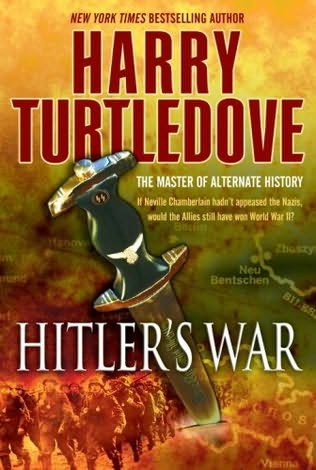
Hitler's war
- Автор: Тертлдав Гарри Норман
- Серия: The War that came early #1
- Язык: английский
- Жанр: Альтернативная история

Электронная книга - «Hitler's war». Краткое содержание книги:
Now, in this thrilling, provocative, and fascinating alternate history by Harry Turtledove, another scenario is played out: What if Chamberlain had not signed the accord? What if Hitler had acted rashly, before his army was ready-would such impatience have helped him or doomed him faster? Here is an action-packed, blow-by-blow chronicle of the war that might have been-and the repercussions that might have echoed through history-had Hitler reached too far, too soon, and too fast.
Turtledove uses dozens of points of view to tell this story: from American marines serving in Japanese-occupied China to members of a Jewish German family with a proud history of war service to their nation, from ragtag volunteers fighting in the Abraham Lincoln Battalion in Spain to an American woman desperately trying to escape Nazi-occupied territory-and witnessing the war from within the belly of the beast.
A novel that reveals the human face of war while simultaneously riding the twists and turns that make up the great acts of history, Hitler's War is the beginning of an exciting new alternate history saga. Here is a tale of powerful leaders and ordinary people, of spies, soldiers, and traitors, of the shifting alliances that draw some together while tearing others apart. At once authoritative, brilliantly imaginative, and hugely entertaining, Hitler's War captures the beginning of a very different World War II-with a very different fate for our world today.
Chaim knew the answer to that: just before the big European war started. Since then, that supply line had dried up. All the supply lines for both sides had dried up. Nationalists and Republicans were fighting with what they had left from before and with what they could make for themselves. That that might affect policy hadn’t occurred to him up till now.
But it did. “The Party isn’t the tail that wags the dog any more,” Harvey Jacoby said regretfully. “Russian officers can’t tell the Spaniards what to do and how to do things.” His grin was crooked. “Well, they can, but the Spaniards have quit listening.”
Chaim’s chuckle sounded forced. In his time with the Internationals, he’d seen that Russians could be as obnoxious and arrogant as Germans. Firmly convinced they were the wave of the future, they ordered people around to suit themselves and had as much give as so many snapping turtles. Somebody-Chaim had forgotten who-had said, “If the fuckers weren’t on our side, there’d be a bounty on ‘em.” That about summed things up.
“We’re tougher’n any outfit the Republic has,” someone told Jacoby. “If we don’t want to move, they can’t make us.”
“They want us to move because we’re tough,” the new leader said. “Way it sounds to me is, they’re going to push the Fascists back from Madrid, and they want troops who know what they’re doing.”
A different kind of murmur ran through the troops who’d volunteered to come to Spain. There was a time, early in the civil war, when Marshal Sanjurjo could have taken Madrid easily. But he chose instead to rescue Colonel Moscardo, besieged in the fortress at Toledo with a small garrison. He succeeded, but he gave the Republic time to fortify the capital. The Internationals had taken gruesome casualties keeping it in Republican hands. Getting on toward three years later, it still was.
Mike turned to Chaim. “Think we can move the bastards?”
“Damned if I know-depends on just where we go and what we’ve gotta do,” Chaim answered. “Even getting there’ll be a bitch kitty-know what I mean?”
“Fuck! I don’t want to think about that,” Mike said with feeling. The Republic’s railway net had more holes than a cheap sock. The roads might have been in worse shape yet, even assuming the quartermasters could scrape together enough trucks to move all the Internationals and enough gas to keep them moving. Chaim wanted to march from the Ebro to Madrid like he wanted a hole in the head. He’d signed up to give Sanjurjo a black eye, not to walk his own legs off.
“Madrid!” Jacoby said again, as if the name carried magic all by itself. And damned if it didn’t. He went on, “Do you want to keep on fighting for chicken coops and frozen hills here, or do you want to fight for a place that really counts?”
Madrid had magic, yes. Another thoughtful murmur rose from the Abe Lincolns. But even magic was worth only so much to veterans. “Cut the crap, Harvey!” said a guy who could only have come from New York City. “Fighting’s fighting. It’s all shitty, no matter where you do it.”
“You can cry if you want to,” Jacoby said. “You can go home if you want to-and if the commissars and border guards let you get away with it. But if you stick with the Abe Lincolns, you’re damn well going to Madrid. So what’ll it be, Izzy?”
“Oh, I’ll go,” Izzy answered. “I still want to kick these Fascist assholes around the block, same like the rest of us. But you got to let us blow off steam first.”
“What do you think I’m doing?” Jacoby said. “I know how hot the boilers run on some of you guys.”
Chaim found himself nodding. The new CO’d hit that nail right on the head. A meeting of the Abe Lincolns-a meeting of any group from the International Brigades-was more like a workers’ soviet than a typical military gathering. Or such meetings always had been like that, anyway. Not everybody who came to Spain to fight for the International Brigades was a Red, but most of the men were. And the Reds had always dominated the way things went.
They had, yes. How long could they keep on doing it? As Jacoby had said, the Party’s stock was down. Chaim snorted. There was a capitalist figure of speech for you! Well, everybody else’s stock in Spain was down, too. The war still mattered to the people who had to fight it. The rest of the world cared only for what was happening near Paris.
Spanish anarchist militiamen came forward to take the International Brigades’ place on the Ebro line. They had a sprinkling of foreigners with them, too; as Chaim trudged toward the railhead down in Tortosa, he exchanged nods with a tall, pale, skinny fellow with a dark mustache and hair who had to come from England or Ireland.
The Internationals were a raggedy bunch: Americans (many of them Jews), anti-Nazi Germans, anti-Fascist Italians, Frenchmen who remembered the ideals of the Revolution, Englishmen, Magyars who hated Horthy, and Poles and Romanians and Greeks and God knew who all else who couldn’t stand their local strongmen. There were even a couple of Chinamen and a Jap. They were raggedy, all right, but they could fight.
Bombs cratered the approaches to the bridge across the Ebro. Plenty of bombs must have gone into the river, too. But the bridge still stood. Aerial bombardment was no fun, but it wasn’t the war-winning monster people had feared it would be. There weren’t enough bombs, and the planes couldn’t place them accurately enough to do everything the generals wanted.
The train that chuffed into Tortosa for the fighters had seen better days, better years, better decades. The locomotive wheezed asthmatically The cars seemed to be missing half their windows. Once Chaim squeezed inside, he discovered the compartments had nothing but hard benches. He was lucky to get to sit down at all; the Internationals were packed in tight as sardines, without the benefit of olive oil to grease the spaces between them.
“Boy, this is fun,” he said to nobody in particular.
“Scheisse,” declared the tall, skinny, blond German wedged in beside him. “My ass.” The guy looked as if he ought to belong in the SS, but his heart was in the right place. He took a pack of Gitanes from his breast pocket and offered it to Chaim. “Zigarette?”
“Thanks,” Chaim said. He shared the red wine in his canteen with the young blond fellow. They talked in a weird mixture of English, German, Yiddish, and Spanish. The German’s name was Wladimir-he insisted on the W at the front, even if it sounded like a V-Diehl. Chaim could think of only one reason why a German his age would be called Wladimir. “Your folks name you for Lenin?”
“You betcha,” Diehl answered, a phrase he must have picked up from an American. “They tried to help the Red revolution in Bavaria. My father, I think, was lucky to live. They fought Hitler’s goons in the streets when the Nazis were new and no one thought they would ever amount to anything. My father and mother have been fighting the Nazis longer than almost anyone.” He spoke with somber pride. And well he might: among the Internationals, that was something to be proud of.
If anything, the locomotive seemed even wheezier pulling out of Tortosa than it had coming in. Chaim knew why: it was pulling all these cars stuffed with soldiers. And it had to take the long way to Madrid. If the Republicans hadn’t recaptured the corridor to the sea from the Nationalists, there would have been no direct route through their territory from the upper Ebro to the city. They would have had to go to Barcelona, take ship, land in Valencia or some other port, and then head west from there. And they probably would have arrived just too late to do the cause any good.
Nobody bothered to feed the Internationals on the train. Along with the wine in his canteen, Chaim had enough bread and garlicky sausage to keep from getting too hungry for a couple of days. He’d been in Spain long enough to assume inefficiency would rear up and try to bite him in the ass. Wladimir carried stewed beans and smoked herrings instead. They swapped some of their iron rations. What Chaim got was no better than what he gave away, but at least it was different.